 Lunarya
Columbianite
Columbianite — colombianite in Spanish, and piedra rayo, lightning stone, to the people who find it — is a dark natural glass from the Cauca valley in Colombia, usually a smoky grey-brown to black, translucent at the edges, in rounded pebbles a few centimetres across. It is sold internationally as a tektite, one of the glasses thrown out by a meteorite impact. Every analysis published so far says it is obsidian: rhyolitic volcanic glass, formed on Earth.
The distinction matters because tektites are rare and expensive and obsidian is neither. Real tektites have a composition unlike any lava, almost no water in them, and flow structures from a flight through the atmosphere; the Colombian material has the silica, alumina and water content of an ordinary rhyolite. The same story attaches to agni manitite from Java and saffordite from Arizona, both also sold as tektites, both also volcanic glass. None of that makes them uninteresting — they are handsome, genuinely natural and genuinely old — but the label on the box is wrong.
In short
- Colour
- Dark
- Mineral
- Volcanic glass
- Formula
- SiO₂
- Hardness
- 5.5–6 on the Mohs scale
- Crystal system
- None — it is a glass
- Found in
- The Cauca and Valle del Cauca departments of Colombia, in soils and stream gravels of the western Andes.
- Element
- Fire
- Planet
- Pluto
- Chakra
- Third eye
- Handling
- Water and light are both fine
How it forms
A rhyolite erupts, chills too quickly for crystals to grow and freezes as glass. Buried in its own ash and tuff, the glass weathers out over hundreds of thousands of years; groundwater etches its surface into pits and grooves, and streams round the pieces off. What is picked up in a Colombian field is therefore a nodule of volcanic glass that has been out in the weather a long time, which is exactly what gives it the pitted, sculpted look that makes people think of something that fell from the sky.
In human hands
The indigenous peoples of the Cauca region are reported to have gathered these stones and treated them as thunderstones — objects left where lightning struck — which is a belief found all over the world, usually attached to prehistoric stone tools or to fulgurites. The name columbianite and the tektite claim are both recent, made by the metaphysical trade in the 1990s and 2000s, and were repeated until they hardened into fact. Geologists in Colombia have been saying otherwise for as long as the stones have been exported.
Varieties and trade names
- Agni manitite
- The Indonesian equivalent, from Java, with the same story and the same answer; it has its own page here.
- Saffordite
- Arizona obsidian pebbles sold as a tektite under the trade name cintamani.
- Apache tears
- Rounded obsidian nodules weathered out of perlite, honest about what they are.
- Moldavite
- A real tektite, green, from the Ries impact fifteen million years ago; the thing columbianite is being sold as.
- Libyan desert glass
- Another real impact glass, pale yellow, from the Great Sand Sea; twenty-nine million years old.
Telling it from a fake
It is glass, so it breaks in smooth curved shells, holds a razor edge and has bubbles inside. Held to a strong light the edges glow brown or grey-green. Real tektites show flow lines and no bubbles worth mentioning, and moldavite is green and etched in a distinctive way. Density and a refractive index would settle it in a laboratory; in a shop, treat any tektite claim without an analysis as marketing, and pay obsidian prices.
None of this needs a laboratory, and none of it is proof. A shop that will not say whether a stone is treated has answered the question; ask, and have the answer written on the receipt.
What it is said to do
The trade sells it for protection and for clearing what is stale, and borrows the tektite folklore of contact with something beyond the Earth. The older local belief, that it is a stone left by lightning, is more interesting and at least has the merit of being genuinely traditional.
Living with it
Volcanic glass: hard enough to keep a polish, brittle enough to chip if dropped, and completely stable in water and sunlight. Wash it in soapy water. Freshly broken edges are sharp.
In magic
Columbianite is used in modern practice for protection and for clearing out what has gone stale, and is sold with the tektite story of a stone from beyond the Earth. The older belief where it is found, that such glass was left by lightning, is the genuine folklore. As a glass it is safe in water and light.
- Energy
- Projective
- Day
- Tuesday
- Worked for
- Protection · Cleansing
More of this colour
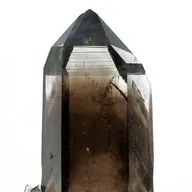 Smoky quartz
Quartz turned brown by the radioactivity of its own bedrock.
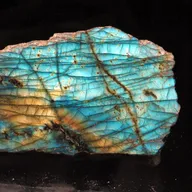 Labradorite
A dull grey stone until you turn it, and then it is peacock blue.
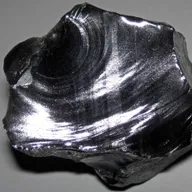 Obsidian
Volcanic glass with an edge finer than a surgical steel blade.
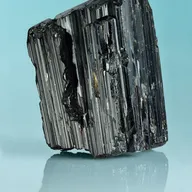 Black tourmaline
The stone that pulls ash out of a pipe when you warm it.
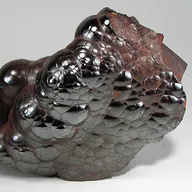 Hematite
Black as a mirror, and it leaves a blood-red line on anything you scratch it against.
Agni manitite
A black glass from Java, sold as a tektite; volcanic, as it turns out.
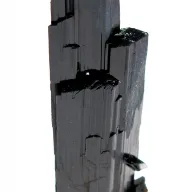 Arfvedsonite
A black amphibole with a blue flash, named for the man who found lithium.
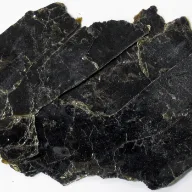 Biotite
Black mica: the flakes in every granite, and sheets big enough to roof a shed.
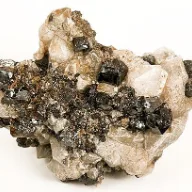 Brookite
Titanium dioxide in its rarest shape: thin red-brown blades grown in Alpine cracks.
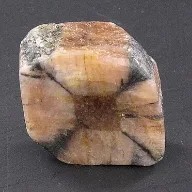 Chiastolite
An andalusite that grows a dark cross inside itself, and was sold for centuries as a Christian charm.
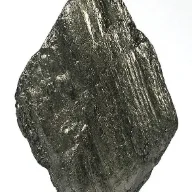 Graphite
Carbon in its soft form: the same element as diamond, stacked in sheets that slide.
 Aegirine
Black pyroxene needles from the strangest rocks on the planet.
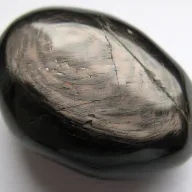 Hypersthene
A bronze-sheened pyroxene whose name the mineralogists retired.
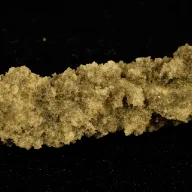 Fulgurite
Sand struck by lightning and fused, in a second, into hollow glass.
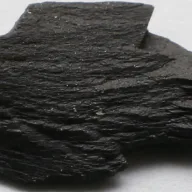 Jet
Fossil driftwood, black and warm in the hand, and Victorian mourning.
Indigo gabbro
A Madagascan rock sold under a wizard name it was given in 2010.
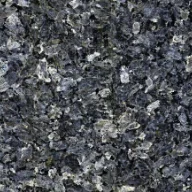 Larvikite
Norway's national rock, and the blue flash on half the shop fronts in Europe.
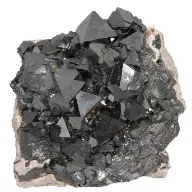 Magnetite
The most magnetic mineral there is, and the first compass.
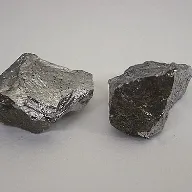 Manganese
The metal that makes steel tough, and that never occurs native.
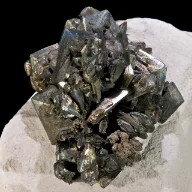 Marcasite
Pyrite's unstable twin, which eats itself in a damp drawer.
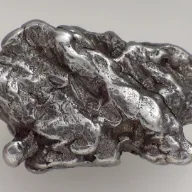 Campo del Cielo
An iron meteorite that fell on the Argentine Chaco four thousand years ago.
 Nuummite
Three-billion-year-old Greenlandic rock that flashes gold and copper.
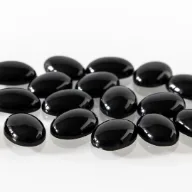 Onyx
Straight-banded chalcedony, and the black stone that is nearly always dyed.
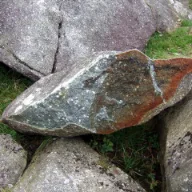 Preseli bluestone
The spotted dolerite of Stonehenge, from a Welsh hillside 250 kilometres away.
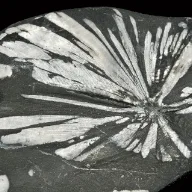 Chrysanthemum stone
Black rock with white mineral flowers that are not fossils.
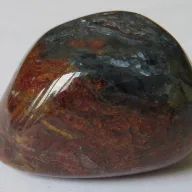 Pietersite
Tiger's eye smashed and cemented back together, so the light swirls.
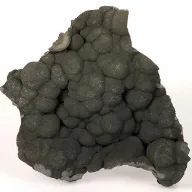 Psilomelane
A field name for the hard black manganese ores, kept alive by lapidaries.
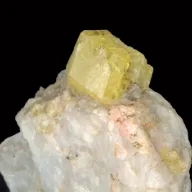 Rhodizite
A caesium borate as hard as topaz, and about as rare as minerals get.
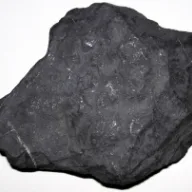 Shungite
Two-billion-year-old carbon rock from Karelia, and a great deal of nonsense.
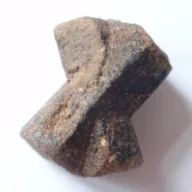 Staurolite
Two crystals grown through each other at sixty degrees, which comes out as a cross.
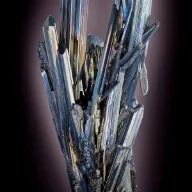 Stibnite
Steel-grey swords in a spray, soft enough to mark with a fingernail, and poisonous.
 Terahertz stone
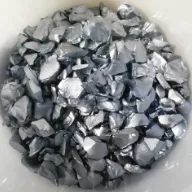
Furnace silicon, cut into beads and sold on a claim about radiation it does not emit.