 Lunarya
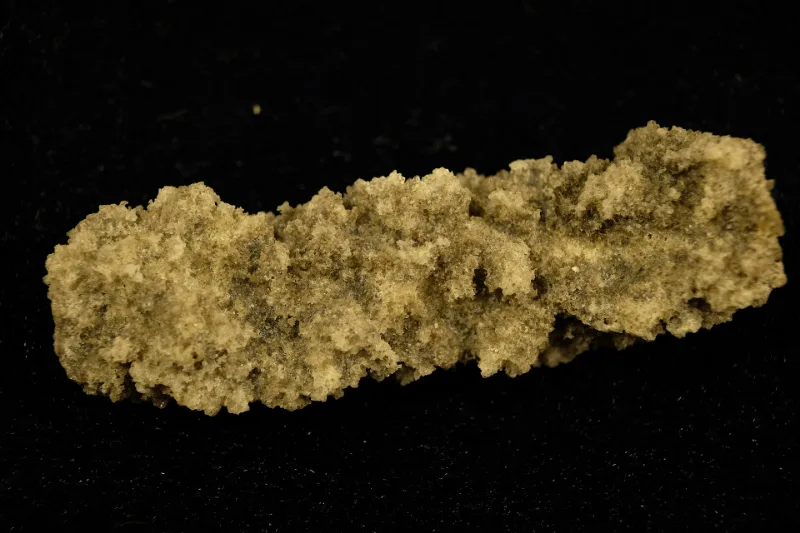
Fulgurite
A fulgurite is not a mineral. It is a glass, and it is made in about a hundredth of a second, when lightning goes to ground through dry sand. The bolt heats the sand past 1,800 degrees, the quartz grains melt into pure silica glass, the expanding gas blows the melt outward, and the whole thing freezes in place around the path the current took: rough and sandy outside, smooth and glassy within, hollow down the middle.
The glass is lechatelierite, silica with no crystal structure at all, the same material as the glass in a meteorite impact and in the Libyan desert. The name is from the Latin fulgur, lightning. Geologists sort them by what was struck: sand fulgurites, the hollow branching tubes; rock fulgurites, glassy crusts welded to a struck outcrop; and clay or caliche fulgurites, which are stubbier. They are studied as a record of ancient lightning, and a 2021 paper on an Illinois fulgurite found phosphide minerals in one, which matters to the argument about where the reactive phosphorus that life needs first came from.
In short
- Colour
- Dark
- Mineral
- Natural glass
- Formula
- SiO₂
- Hardness
- 5–6 on the Mohs scale
- Crystal system
- None — it is a glass
- Found in
- The Sahara, in Morocco, Algeria and Libya, supplies almost everything sold. Others come from the Sahel, from the dune fields of Florida and the Great Lakes, from the beaches of northern Europe, from Australia, and from anywhere a thunderstorm meets dry sand.
- Element
- Fire
- Planet
- Uranus
- Chakra
- Crown
- Handling
- Keep out of water
How it forms
A lightning channel carries tens of thousands of amperes into the ground. Resistive heating along the path vaporises some of the sand and melts the rest; the vapour pressure blows a tube open through the melt; and the surrounding cold sand quenches it in seconds, welding a crust of unmelted grains to the outside. The branching follows the current as it spread out and dissipated, so a fulgurite is a cast of the last fraction of a second of a lightning strike.
In human hands
A Silesian pastor, David Hermann, dug one out of a hill in 1706 and worked out correctly what had made it, which is early for that kind of reasoning. Charles Darwin collected fulgurites at Maldonado in Uruguay on the Beagle voyage and described them in his account of it. They stayed a curiosity of natural history until the crystal trade began importing Saharan tubes in the 1990s, and the lore attached to them is entirely of that period.
Varieties and trade names
- Sand fulgurite
- The classic hollow tube, branching, grey to tan; Saharan pieces are a few centimetres to half a metre.
- Rock fulgurite
- A thin glassy skin fused onto a struck outcrop, found on mountain summits and lightning-prone ridges.
- Caliche fulgurite
- Formed in hard, carbonate-cemented desert soil; stubbier and thicker-walled than the sand kind.
- Exogenic fulgurite
- The splash of melt thrown out around the strike point rather than the tube below it.
- Man-made imitations
- Torch-fused sand and sand-rolled glass tubes are sold as fulgurite; an even bore and no welded crust give them away.
Telling it from a fake
Pick it up. A real fulgurite is surprisingly light, hollow, with an irregular bore that narrows and branches, a glassy lining that catches the light, and sand grains sintered to the outside rather than glued on. Break a fragment and the glass shows a conchoidal fracture. Industrial slag is heavier, bubbled throughout and often coloured; a fused imitation has a regular tube and a uniform surface.
None of this needs a laboratory, and none of it is proof. A shop that will not say whether a stone is treated has answered the question; ask, and have the answer written on the receipt.
What it is said to do
Everything written about fulgurite is about lightning: sudden change, the answer that arrives all at once, prayers going up and something coming down. It is given to Uranus, to Sagittarius and Aquarius, and to the crown. The association is obvious enough to have been invented independently more than once, but as a crystal-trade stone it dates from the 1990s.
Living with it
The most fragile thing in this whole collection. It is glass held together by welded sand, and it breaks if it is dropped, squeezed, or carried in a pocket. Keep it in a padded box. Do not wash it: water works into the crust, loosens the grains, and can crack a tube as it dries. Sunlight does nothing, but almost everything else does.
In magic
Fulgurite is lightning made solid, and lightning has always been magic: across Europe 'thunderstones' were kept in the rafters so that lightning would not strike the house, though those were usually prehistoric axes or fossils. Modern practice uses fulgurite for sudden change and for prayers sent upwards. It is too fragile for water or handling and lives in a padded box.
- Energy
- Projective
- Day
- Saturday
- Worked for
- Change and letting go · Divination and intuition
More of this colour
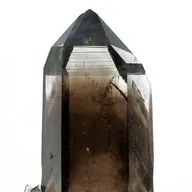 Smoky quartz
Quartz turned brown by the radioactivity of its own bedrock.
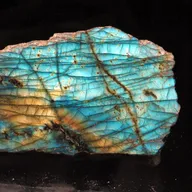 Labradorite
A dull grey stone until you turn it, and then it is peacock blue.
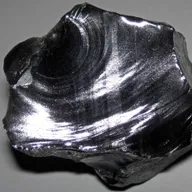 Obsidian
Volcanic glass with an edge finer than a surgical steel blade.
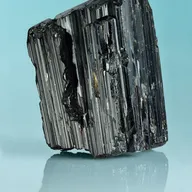 Black tourmaline
The stone that pulls ash out of a pipe when you warm it.
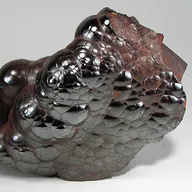 Hematite
Black as a mirror, and it leaves a blood-red line on anything you scratch it against.
Agni manitite
A black glass from Java, sold as a tektite; volcanic, as it turns out.
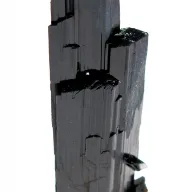 Arfvedsonite
A black amphibole with a blue flash, named for the man who found lithium.
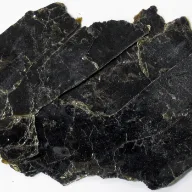 Biotite
Black mica: the flakes in every granite, and sheets big enough to roof a shed.
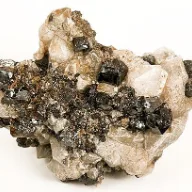 Brookite
Titanium dioxide in its rarest shape: thin red-brown blades grown in Alpine cracks.
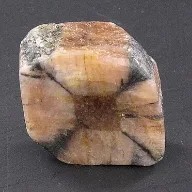 Chiastolite
An andalusite that grows a dark cross inside itself, and was sold for centuries as a Christian charm.
Columbianite
Colombian volcanic glass, sold as a tektite it is not.
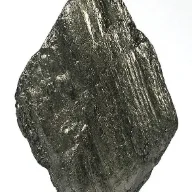 Graphite
Carbon in its soft form: the same element as diamond, stacked in sheets that slide.
 Aegirine
Black pyroxene needles from the strangest rocks on the planet.
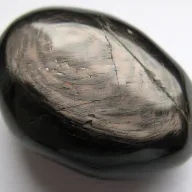 Hypersthene
A bronze-sheened pyroxene whose name the mineralogists retired.
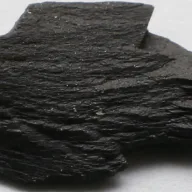 Jet
Fossil driftwood, black and warm in the hand, and Victorian mourning.
Indigo gabbro
A Madagascan rock sold under a wizard name it was given in 2010.
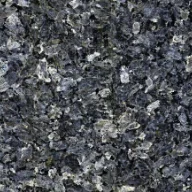 Larvikite
Norway's national rock, and the blue flash on half the shop fronts in Europe.
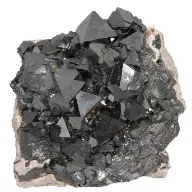 Magnetite
The most magnetic mineral there is, and the first compass.
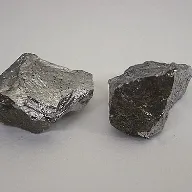 Manganese
The metal that makes steel tough, and that never occurs native.
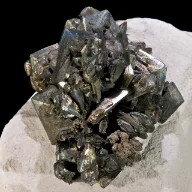 Marcasite
Pyrite's unstable twin, which eats itself in a damp drawer.
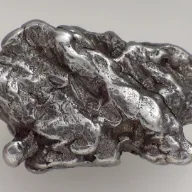 Campo del Cielo
An iron meteorite that fell on the Argentine Chaco four thousand years ago.
 Nuummite
Three-billion-year-old Greenlandic rock that flashes gold and copper.
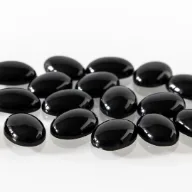 Onyx
Straight-banded chalcedony, and the black stone that is nearly always dyed.
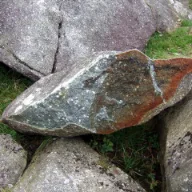 Preseli bluestone
The spotted dolerite of Stonehenge, from a Welsh hillside 250 kilometres away.
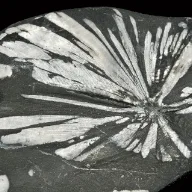 Chrysanthemum stone
Black rock with white mineral flowers that are not fossils.
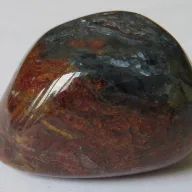 Pietersite
Tiger's eye smashed and cemented back together, so the light swirls.
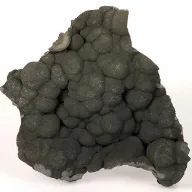 Psilomelane
A field name for the hard black manganese ores, kept alive by lapidaries.
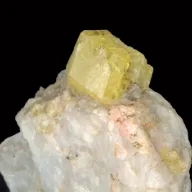 Rhodizite
A caesium borate as hard as topaz, and about as rare as minerals get.
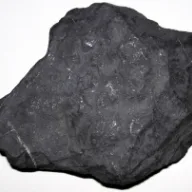 Shungite
Two-billion-year-old carbon rock from Karelia, and a great deal of nonsense.
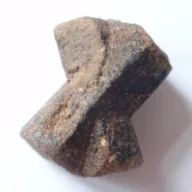 Staurolite
Two crystals grown through each other at sixty degrees, which comes out as a cross.
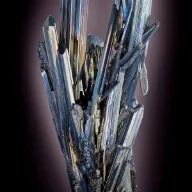 Stibnite
Steel-grey swords in a spray, soft enough to mark with a fingernail, and poisonous.
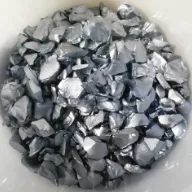 Terahertz stone
Furnace silicon, cut into beads and sold on a claim about radiation it does not emit.