 Lunarya
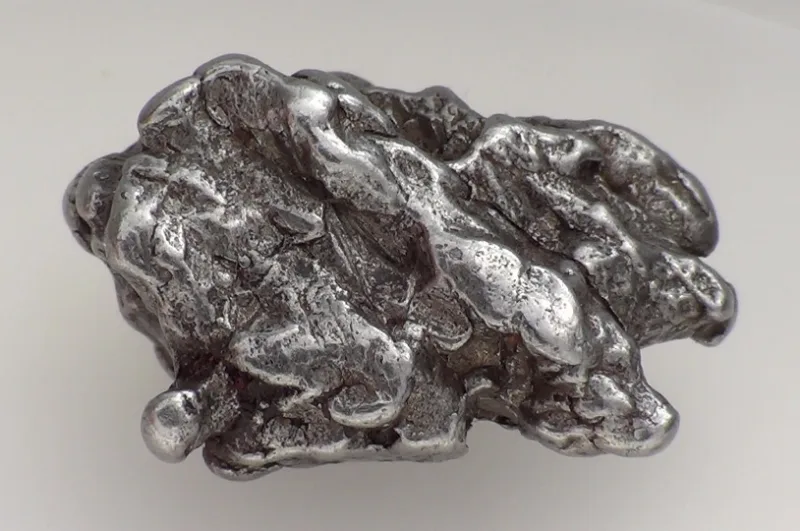
Campo del Cielo
Campo del Cielo is not a mineral but a meteorite: a mass of iron and nickel alloy that condensed in the core of a small planetary body, was smashed out of it, and fell on what is now the border of Chaco and Santiago del Estero in Argentina somewhere between four and five thousand years ago. It is about 93 per cent iron and 6.7 per cent nickel, with traces of cobalt, phosphorus, gallium and iridium.
The object broke up on the way down and made a field of at least 26 craters spread over 18 kilometres, and tonnes of it have been recovered — the El Chaco mass alone weighs about 28 tonnes, one of the heaviest single meteorite masses ever found. Structurally it is a coarse octahedrite: two nickel-iron alloys, kamacite and taenite, that separated as the parent body's core cooled over millions of years, and a cut and etched face shows the interlocking bands of the Widmanstätten pattern, which cannot be faked because nothing on Earth cools that slowly.
In short
- Colour
- Dark
- Mineral
- A meteorite, not a mineral
- Formula
- Fe + Ni
- Hardness
- 4–5 on the Mohs scale
- Crystal system
- Cubic
- Found in
- Only one place, by definition: the strewn field at Campo del Cielo, in northern Argentina. Fragments from a few grams to a few kilos are sold worldwide; large masses are protected by Argentine law, and there have been prosecutions for attempting to remove them.
- Element
- Fire
- Planet
- Mars
- Chakra
- Root
- Handling
- Keep out of water
How it forms
A body a few hundred kilometres across, early in the solar system, melted enough to separate into a silicate mantle and a metallic core. The core cooled at a few degrees per million years, slowly enough for kamacite to grow in plates through the taenite, which is the Widmanstätten pattern. A collision then broke the body apart, and one fragment of that core spent a long time in space before crossing the Earth's path.
In human hands
The indigenous peoples of the region knew it and worked pieces of it, and the name is a translation of what they told the Spanish: Piguem Nonralta, field of the sky. A Spanish expedition under Hernán Mexía de Miraval went looking in 1576, expecting an iron mine. The masses were described repeatedly over the next three centuries; the largest, El Chaco, was located in 1969 and weighed in 1980. In 2012 a plan to ship it to Germany for an art exhibition was stopped by the Moqoit people and Argentine scientists.
Varieties and trade names
- Individual fragments
- Rounded, thumbprinted pieces from a few grams up; the specimens most collectors own.
- Etched slices
- Cut and acid-etched faces showing the Widmanstätten pattern of interlocking kamacite bands.
- El Chaco and Gancedo
- The two giant masses, about 28 and 30 tonnes; both are protected and stay in Argentina.
- Other iron meteorites
- Sikhote-Alin, Muonionalusta, Gibeon; the same kind of object from other falls, and other trade names.
- Tektites
- Not meteorites at all: Earth rock melted by an impact, which is what moldavite is; it has a page here.
Telling it from a fake
It is heavy, it is strongly attracted to a magnet, and a cut face etched with dilute nitric acid shows the Widmanstätten bands, which no terrestrial iron has. The rounded hollows on the surface, called regmaglypts, are where the atmosphere ablated the metal on the way down. Slag and cast iron are lighter, often bubbled, and show nothing on etching. A certificate is not proof; the etch is.
None of this needs a laboratory, and none of it is proof. A shop that will not say whether a stone is treated has answered the question; ask, and have the answer written on the receipt.
What it is said to do
The meteorite lore of the last thirty years is all about arrival from elsewhere: courage, cutting through, being shaken out of a rut. It is given to Mars, to Aries and Aquarius, and to the root. Behind that sits something much older and better attested — meteoritic iron was worked into blades and beads long before iron smelting, the Egyptian word for it meant iron of the sky, and Tutankhamun was buried with a dagger made of it.
Living with it
It rusts, and it rusts badly, because meteoritic iron carries chlorides that keep the reaction going. Keep it in a dry sealed box with silica gel, handle it with dry hands or gloves since sweat starts the process, and never wash it. Some collectors oil a piece lightly or coat it with lacquer. A specimen that sprouts orange whiskers is already in trouble.
In magic
Iron from the sky was magic before any other iron was: meteoritic iron was hammered into beads and blades long before smelting, and the iron that fairies and witches feared in European folklore was, to begin with, the rarest metal there was. Modern practice uses Campo del Cielo for courage, for cutting through and for new starts. It rusts badly, so it is kept dry and handled with dry hands.
- Energy
- Projective
- Day
- Tuesday
- Worked for
- Courage and drive · Change and letting go
More of this colour
 Smoky quartz
Quartz turned brown by the radioactivity of its own bedrock.
 Labradorite
A dull grey stone until you turn it, and then it is peacock blue.
 Obsidian
Volcanic glass with an edge finer than a surgical steel blade.
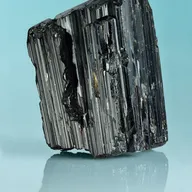 Black tourmaline
The stone that pulls ash out of a pipe when you warm it.
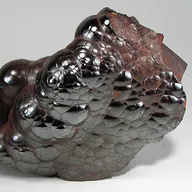 Hematite
Black as a mirror, and it leaves a blood-red line on anything you scratch it against.
Agni manitite
A black glass from Java, sold as a tektite; volcanic, as it turns out.
 Arfvedsonite
A black amphibole with a blue flash, named for the man who found lithium.
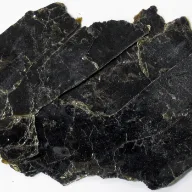 Biotite
Black mica: the flakes in every granite, and sheets big enough to roof a shed.
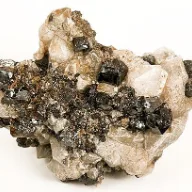 Brookite
Titanium dioxide in its rarest shape: thin red-brown blades grown in Alpine cracks.
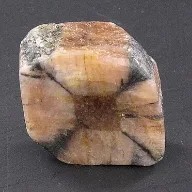 Chiastolite
An andalusite that grows a dark cross inside itself, and was sold for centuries as a Christian charm.
Columbianite
Colombian volcanic glass, sold as a tektite it is not.
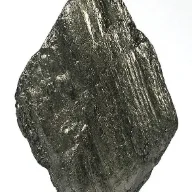 Graphite
Carbon in its soft form: the same element as diamond, stacked in sheets that slide.
 Aegirine
Black pyroxene needles from the strangest rocks on the planet.
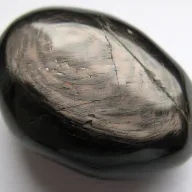 Hypersthene
A bronze-sheened pyroxene whose name the mineralogists retired.
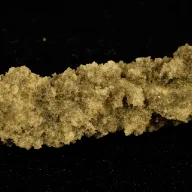 Fulgurite
Sand struck by lightning and fused, in a second, into hollow glass.
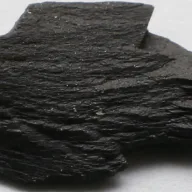 Jet
Fossil driftwood, black and warm in the hand, and Victorian mourning.
Indigo gabbro
A Madagascan rock sold under a wizard name it was given in 2010.
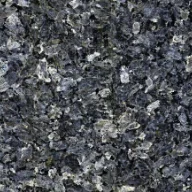 Larvikite
Norway's national rock, and the blue flash on half the shop fronts in Europe.
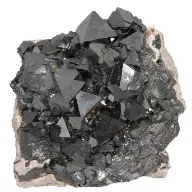 Magnetite
The most magnetic mineral there is, and the first compass.
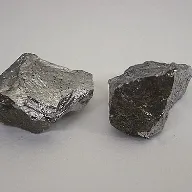 Manganese
The metal that makes steel tough, and that never occurs native.
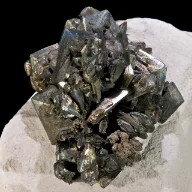 Marcasite
Pyrite's unstable twin, which eats itself in a damp drawer.
 Nuummite
Three-billion-year-old Greenlandic rock that flashes gold and copper.
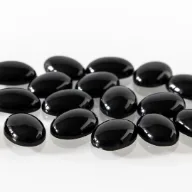 Onyx
Straight-banded chalcedony, and the black stone that is nearly always dyed.
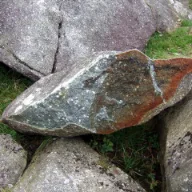 Preseli bluestone
The spotted dolerite of Stonehenge, from a Welsh hillside 250 kilometres away.
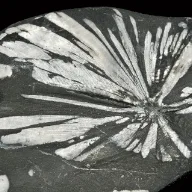 Chrysanthemum stone
Black rock with white mineral flowers that are not fossils.
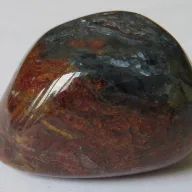 Pietersite
Tiger's eye smashed and cemented back together, so the light swirls.
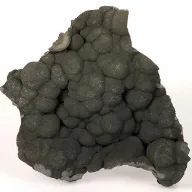 Psilomelane
A field name for the hard black manganese ores, kept alive by lapidaries.
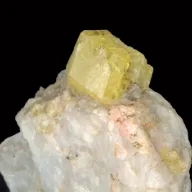 Rhodizite
A caesium borate as hard as topaz, and about as rare as minerals get.
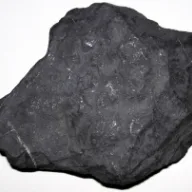 Shungite
Two-billion-year-old carbon rock from Karelia, and a great deal of nonsense.
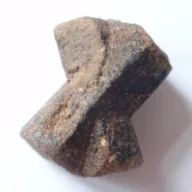 Staurolite
Two crystals grown through each other at sixty degrees, which comes out as a cross.
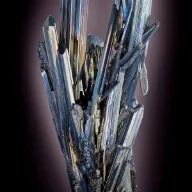 Stibnite
Steel-grey swords in a spray, soft enough to mark with a fingernail, and poisonous.
 Terahertz stone
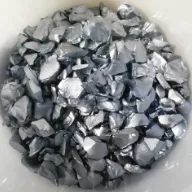
Furnace silicon, cut into beads and sold on a claim about radiation it does not emit.