 Lunarya
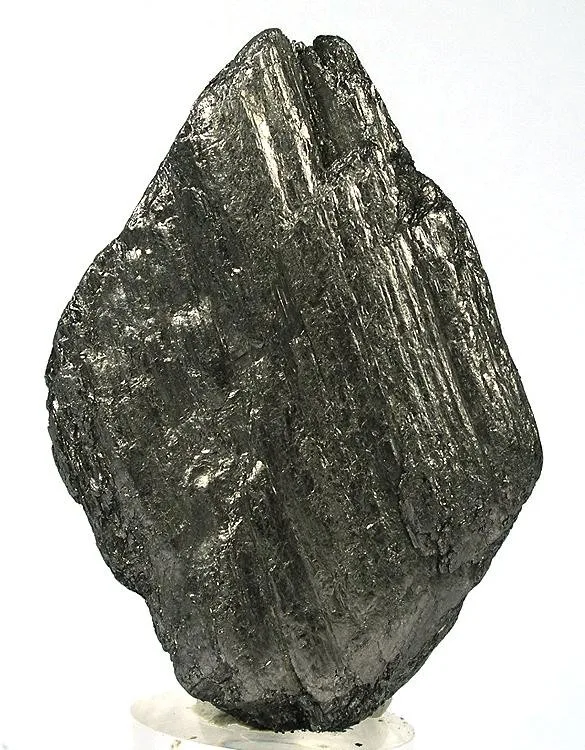
Graphite
Graphite is pure carbon, the same element as diamond, arranged in flat hexagonal sheets that are strongly bonded within each layer and barely held to the layer above. The sheets slide, which makes graphite one of the softest minerals known — one to two on the Mohs scale — and one of the best dry lubricants. It conducts electricity, which almost no other non-metal does, and it marks paper, which is the property that gave it its name.
Diamond and graphite are the same atoms under different conditions: pressure stacks carbon into the rigid three-dimensional frame of diamond, and at surface pressures the sheets of graphite are the stable form. In principle every diamond on Earth is slowly becoming graphite; in practice the conversion needs so much energy to start that it will not happen in the life of the universe. Peel a single sheet off a graphite crystal and you have graphene, which is how it was first made in 2004, with sticky tape, and which won a Nobel prize six years later.
In short
- Colour
- Dark
- Mineral
- Native element
- Formula
- C
- Hardness
- 1–2 on the Mohs scale
- Crystal system
- Hexagonal
- Found in
- Sri Lanka, Madagascar, Mozambique, China, Canada, the Urals, and Borrowdale in Cumbria, which was worked out long ago.
- Element
- Earth
- Planet
- Saturn
- Chakra
- Root
- Handling
- Water and light are both fine
How it forms
Most graphite was once alive. Organic carbon buried in mud is cooked by metamorphism through coal and anthracite until nothing is left but carbon, and at high grade that carbon organises itself into flakes of graphite scattered through marble and schist. The other kind is hydrothermal: carbon-bearing fluids deposit solid graphite in veins, and Sri Lanka's veins of nearly pure lump graphite, up to a metre thick, are the best in the world. A little comes straight from the mantle in igneous rocks, and a little arrives in meteorites.
In human hands
In the 1500s a storm uprooted trees at Borrowdale in Cumbria and exposed a body of solid graphite so pure it could be sawn into sticks — the only deposit of its kind ever found. It was used for casting cannonballs, guarded by armed men, taxed, smuggled and eventually flooded to keep thieves out, and it made Keswick the pencil town it still is. Everybody thought it was a lead ore and called it plumbago, which is why we still say pencil lead; Scheele proved it was carbon in 1779, and Werner named it graphite ten years later from the Greek for writing. Today the largest use by far is neither pencils nor lubricant but battery anodes.
Varieties and trade names
- Flake graphite
- Scattered flakes in marble and schist; the ordinary ore, ground for refractories and batteries.
- Vein graphite
- Solid lumps of nearly pure carbon from Sri Lanka, the purest natural graphite there is.
- Amorphous graphite
- Microcrystalline and dull, from metamorphosed coal seams; cheap, and the least useful.
- Graphene
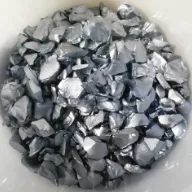
- A single sheet one atom thick, first isolated with sticky tape from a crystal like the one pictured.
- Diamond
- The same element under pressure, and the hardest natural material; it has a page of its own here.
Telling it from a fake
It marks paper and fingers, feels greasy, is dark metallic grey and is absurdly soft. Molybdenite looks almost identical but is denser, bluer, and leaves a greenish streak; hematite is harder and streaks red; and coal is dull, lighter and does not conduct. A graphite crystal is a flat plate or a rosette of plates, and it weighs little for its size.
None of this needs a laboratory, and none of it is proof. A shop that will not say whether a stone is treated has answered the question; ask, and have the answer written on the receipt.
What it is said to do
The crystal literature is thin here and honest enough about it: graphite is given for writing and study, for grounding, and as a stone for people whose work is with ideas. There is no old tradition — the material was industrially important long before anybody thought of it as a talisman — and some of the modern claims made for carbon minerals in general are best treated as marketing.
Living with it
It dirties everything it touches, so keep a specimen in a box and away from anything pale. Water does it no harm but there is nothing to gain by washing it; a soft brush is enough. Wash your hands afterwards, and never carry it in a pocket with a white shirt above it.
In magic
Graphite is the stone you can write a spell with: a pencil is graphite and clay, and modern practitioners draw sigils, the private signs used to charge an intention, with one. Beyond that it serves for grounding and for study. It dirties everything it touches, so a specimen stays in a box.
- Energy
- Receptive
- Day
- Saturday
- Worked for
- Study and clear thinking · Grounding and endurance
More of this colour
 Smoky quartz
Quartz turned brown by the radioactivity of its own bedrock.
 Labradorite
A dull grey stone until you turn it, and then it is peacock blue.
 Obsidian
Volcanic glass with an edge finer than a surgical steel blade.
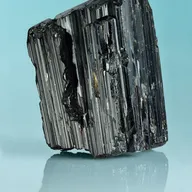 Black tourmaline
The stone that pulls ash out of a pipe when you warm it.
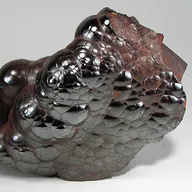 Hematite
Black as a mirror, and it leaves a blood-red line on anything you scratch it against.
Agni manitite
A black glass from Java, sold as a tektite; volcanic, as it turns out.
 Arfvedsonite
A black amphibole with a blue flash, named for the man who found lithium.
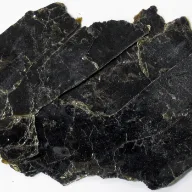 Biotite
Black mica: the flakes in every granite, and sheets big enough to roof a shed.
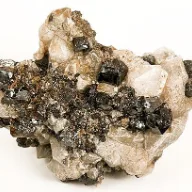 Brookite
Titanium dioxide in its rarest shape: thin red-brown blades grown in Alpine cracks.
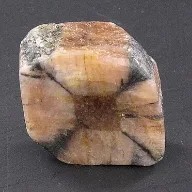 Chiastolite
An andalusite that grows a dark cross inside itself, and was sold for centuries as a Christian charm.
Columbianite
Colombian volcanic glass, sold as a tektite it is not.
 Aegirine
Black pyroxene needles from the strangest rocks on the planet.
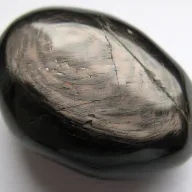 Hypersthene
A bronze-sheened pyroxene whose name the mineralogists retired.
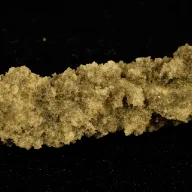 Fulgurite
Sand struck by lightning and fused, in a second, into hollow glass.
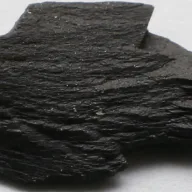 Jet
Fossil driftwood, black and warm in the hand, and Victorian mourning.
Indigo gabbro
A Madagascan rock sold under a wizard name it was given in 2010.
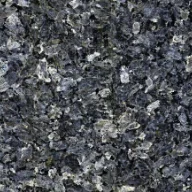 Larvikite
Norway's national rock, and the blue flash on half the shop fronts in Europe.
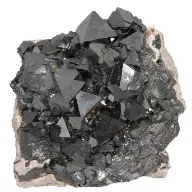 Magnetite
The most magnetic mineral there is, and the first compass.
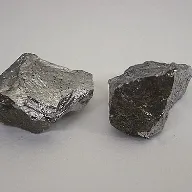 Manganese
The metal that makes steel tough, and that never occurs native.
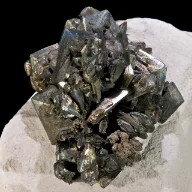 Marcasite
Pyrite's unstable twin, which eats itself in a damp drawer.
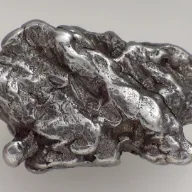 Campo del Cielo
An iron meteorite that fell on the Argentine Chaco four thousand years ago.
 Nuummite
Three-billion-year-old Greenlandic rock that flashes gold and copper.
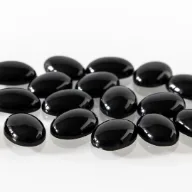 Onyx
Straight-banded chalcedony, and the black stone that is nearly always dyed.
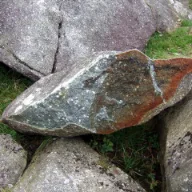 Preseli bluestone
The spotted dolerite of Stonehenge, from a Welsh hillside 250 kilometres away.
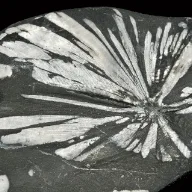 Chrysanthemum stone
Black rock with white mineral flowers that are not fossils.
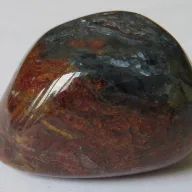 Pietersite
Tiger's eye smashed and cemented back together, so the light swirls.
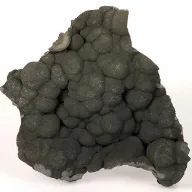 Psilomelane
A field name for the hard black manganese ores, kept alive by lapidaries.
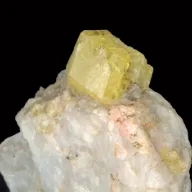 Rhodizite
A caesium borate as hard as topaz, and about as rare as minerals get.
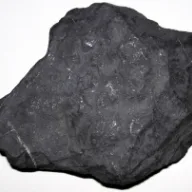 Shungite
Two-billion-year-old carbon rock from Karelia, and a great deal of nonsense.
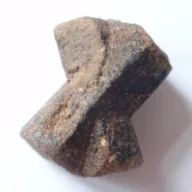 Staurolite
Two crystals grown through each other at sixty degrees, which comes out as a cross.
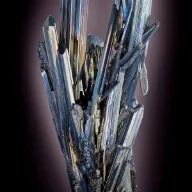 Stibnite
Steel-grey swords in a spray, soft enough to mark with a fingernail, and poisonous.
 Terahertz stone
Furnace silicon, cut into beads and sold on a claim about radiation it does not emit.