 Lunarya

Labradorite
A plagioclase feldspar that looks like nothing much until the light catches it, when a whole face flashes blue, gold or green at once. The effect — labradorescence — comes from the stone having separated as it cooled into microscopically thin alternating layers, which interfere with light the way an oil film does. Turn it a few degrees and the flash vanishes.
It was described in 1770 from the Isle of Paul off Labrador, where Moravian missionaries collected it, and the Inuit of the coast had a story ready for it: the northern lights, trapped in the rock, released when an ancestor struck it with a spear. The richest material, flashing in several colours at once, comes from Ylämaa in Finland and is sold as spectrolite. Most of the world's supply now comes out of Madagascar.
In short
- Colour
- Dark
- Mineral
- Feldspar
- Formula
- (Ca,Na)(Al,Si)₄O₈
- Hardness
- 6–6.5 on the Mohs scale
- Crystal system
- Triclinic
- Found in
- Madagascar, Finland, Canada and Russia.
- Element
- Water
- Planet
- Uranus
- Chakra
- Third eye
- Handling
- Water and light are both fine
How it forms
Labradorite is a plagioclase feldspar, one of the commonest minerals in dark igneous rock, and the flash is not colour in the stone at all: as the rock cooled, slowly and deep, the feldspar unmixed into layers thinner than a wavelength of light, and light bouncing between them interferes with itself. The thickness of the layers sets the colour, blue for the thinnest and gold and red for the thicker, so one slab flashes different colours at different angles and nothing at all from most of them. It needs the slow cooling of a big intrusion: the anorthosites of Labrador, Madagascar, Finland, Norway and Ukraine.
In human hands
Moravian missionaries found it on the coast of Labrador near Nain in 1770 and sent it to Europe, which named it. The Norwegians have been quarrying larvikite, its silvery cousin, at Larvik since the 1880s, and it faces banks and shopfronts in half the cities of Europe under the name blue pearl granite. Spectrolite was found in Finland in 1940 by men quarrying stone for the anti-tank barriers of the Salpa Line, and named that year. Madagascar's deposits took over the ornamental trade in the 1990s and are where the polished slabs, palm stones and towers now come from.
Varieties and trade names
- Spectrolite
- The Finnish kind, with the full spectrum flashing off a black body; found in 1940 and the best there is.
- Larvikite
- Norway's silvery-blue schiller in a grey rock, quarried by the thousand tonnes for the fronts of buildings.
- Rainbow moonstone
- White labradorite from India with a blue and many-coloured flash, sold under the other feldspar's name.
- Madagascar labradorite
- The grey-green shop standard, with blue and gold flash on a polished face, and the source of nearly everything on the shelf.
Telling it from a fake
The flash is a physical structure that no glass has, and labradorite is hard to fake for that reason. What is sold as it in glass has an even surface sheen that does not switch on and off as you tilt it; opalite, a milky blue glass, has a glow rather than a flash. Real labradorite flashes only from certain angles, often across part of the face only, shows flat cleavage steps at the edges, and has a grey-green body when the flash is off. The tricks are in the cutting: a slab polished so its one good face meets the buyer, and rainbow moonstone that is labradorite by another name.
None of this needs a laboratory, and none of it is proof. A shop that will not say whether a stone is treated has answered the question; ask, and have the answer written on the receipt.
What it is said to do
The stone of the in-between: it is given for periods of change, for imagination and for the nerve to go through with something, and it is read as a protector of the person's own energy — a stone that keeps what is yours in and what is not out.
Living with it
Reasonably hard but it cleaves in two directions, so it chips on an edge. Soapy water is fine. The flash only shows from certain angles, which is worth knowing before ordering one from a photograph.
In magic
Labradorite is the modern practitioner's stone for thresholds: worn during divination and trance to keep one's own energy in and other people's out, held through a change of life, and used in workings at dusk and dawn, the in-between hours. The trade tells a story, attributed to the Inuit, of the northern lights trapped in the rocks of the Labrador coast; it is a good story, and nobody can say how old it is.
- Energy
- Receptive
- Day
- Saturday
- Worked for
- Protection · Change and letting go · Divination and intuition
More of this colour
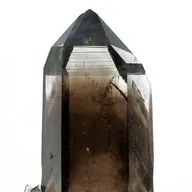 Smoky quartz
Quartz turned brown by the radioactivity of its own bedrock.
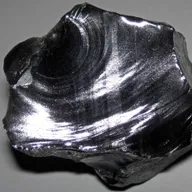 Obsidian
Volcanic glass with an edge finer than a surgical steel blade.
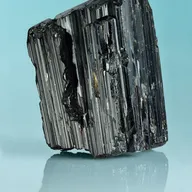 Black tourmaline
The stone that pulls ash out of a pipe when you warm it.
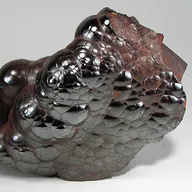 Hematite
Black as a mirror, and it leaves a blood-red line on anything you scratch it against.
Agni manitite
A black glass from Java, sold as a tektite; volcanic, as it turns out.
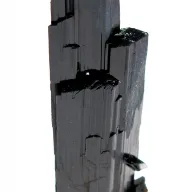 Arfvedsonite
A black amphibole with a blue flash, named for the man who found lithium.
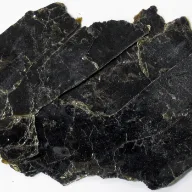 Biotite
Black mica: the flakes in every granite, and sheets big enough to roof a shed.
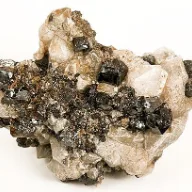 Brookite
Titanium dioxide in its rarest shape: thin red-brown blades grown in Alpine cracks.
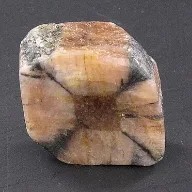 Chiastolite
An andalusite that grows a dark cross inside itself, and was sold for centuries as a Christian charm.
Columbianite
Colombian volcanic glass, sold as a tektite it is not.
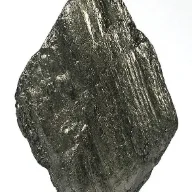 Graphite
Carbon in its soft form: the same element as diamond, stacked in sheets that slide.
 Aegirine
Black pyroxene needles from the strangest rocks on the planet.
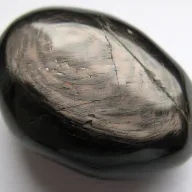 Hypersthene
A bronze-sheened pyroxene whose name the mineralogists retired.
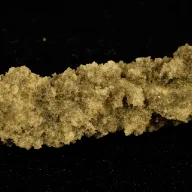 Fulgurite
Sand struck by lightning and fused, in a second, into hollow glass.
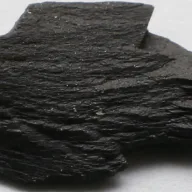 Jet
Fossil driftwood, black and warm in the hand, and Victorian mourning.
Indigo gabbro
A Madagascan rock sold under a wizard name it was given in 2010.
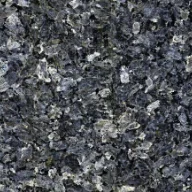 Larvikite
Norway's national rock, and the blue flash on half the shop fronts in Europe.
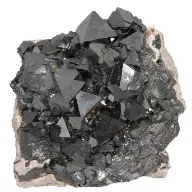 Magnetite
The most magnetic mineral there is, and the first compass.
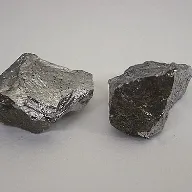 Manganese
The metal that makes steel tough, and that never occurs native.
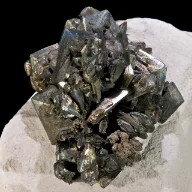 Marcasite
Pyrite's unstable twin, which eats itself in a damp drawer.
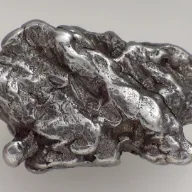 Campo del Cielo
An iron meteorite that fell on the Argentine Chaco four thousand years ago.
 Nuummite
Three-billion-year-old Greenlandic rock that flashes gold and copper.
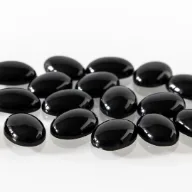 Onyx
Straight-banded chalcedony, and the black stone that is nearly always dyed.
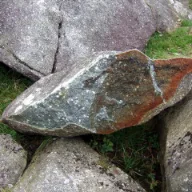 Preseli bluestone
The spotted dolerite of Stonehenge, from a Welsh hillside 250 kilometres away.
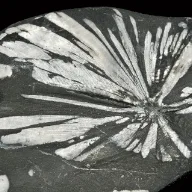 Chrysanthemum stone
Black rock with white mineral flowers that are not fossils.
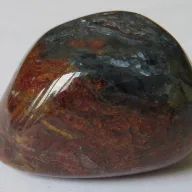 Pietersite
Tiger's eye smashed and cemented back together, so the light swirls.
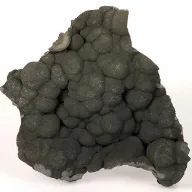 Psilomelane
A field name for the hard black manganese ores, kept alive by lapidaries.
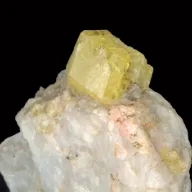 Rhodizite
A caesium borate as hard as topaz, and about as rare as minerals get.
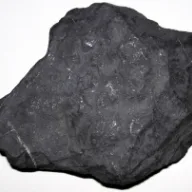 Shungite
Two-billion-year-old carbon rock from Karelia, and a great deal of nonsense.
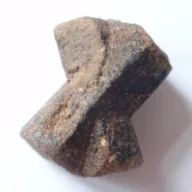 Staurolite
Two crystals grown through each other at sixty degrees, which comes out as a cross.
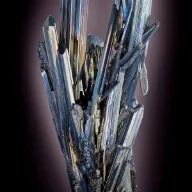 Stibnite
Steel-grey swords in a spray, soft enough to mark with a fingernail, and poisonous.
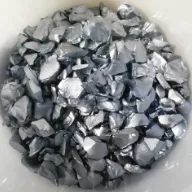 Terahertz stone
Furnace silicon, cut into beads and sold on a claim about radiation it does not emit.