 Lunarya
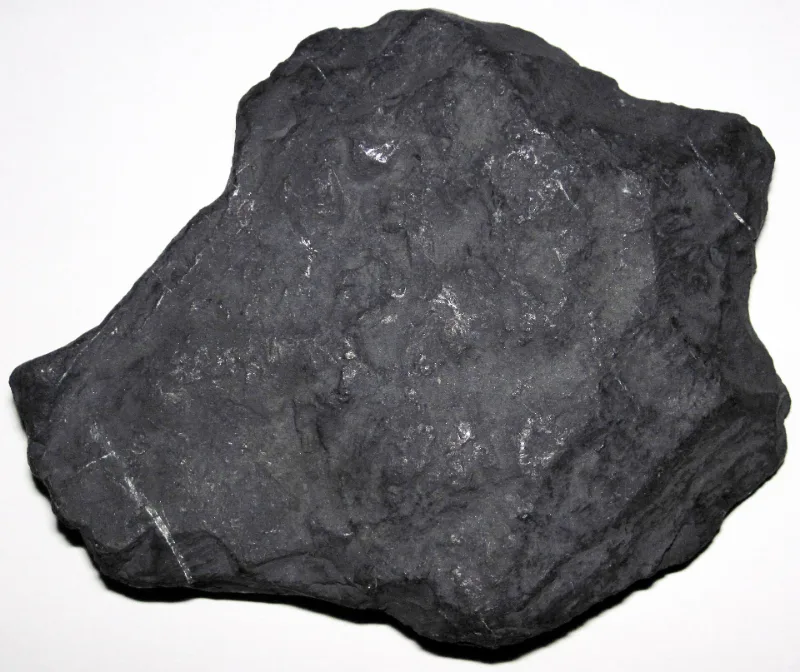
Shungite
Shungite is a rock, not a mineral: a black, carbon-rich sedimentary rock from Karelia in northwestern Russia, about two billion years old. It is named after the village of Shunga on Lake Onega. Ordinary shungite is thirty to fifty per cent carbon in a matrix of quartz and silicates; the material the trade calls elite or noble shungite is up to ninety-eight per cent carbon, bright, brittle and much scarcer.
Its carbon is genuinely unusual. It predates land plants by more than a billion and a half years, so it came from microbial mats and organic sludge on an ancient sea floor, and it is not graphite — the carbon is amorphous and includes fullerenes, the cage-shaped carbon molecules found in shungite in the early 1990s not long after they were made in a laboratory. That is a real and interesting finding. What has been built on top of it is another matter, and this page will say so.
In short
- Colour
- Dark
- Mineral
- A rock, not one mineral
- Formula
- C + SiO₂
- Hardness
- 3–4 on the Mohs scale
- Crystal system
- None — it is a rock
- Found in
- One region: Karelia, around Lake Onega, principally the Zazhoginskoye deposit. Carbon-rich rocks of similar age occur in Gabon and elsewhere, but shungite as sold is Karelian.
- Element
- Earth
- Planet
- Saturn
- Chakra
- Root
- Handling
- Water and light are both fine
How it forms
Organic matter accumulated in an anoxic basin two billion years ago, at a moment when the Earth's atmosphere had just begun to hold oxygen. Buried and mildly metamorphosed, it lost its volatiles and concentrated its carbon, stopping short of turning into graphite. Some of it was mobile enough to be injected into fractures as a kind of carbon melt, which is where the shiny elite material comes from.
In human hands
Peter the Great founded a spa at Marcial Waters in Karelia in 1719 on the strength of local iron-rich springs and, the story goes, ordered his soldiers to carry shungite to purify their drinking water; the story is the historical core of the modern claims, and no document has been produced for it. The rock was described scientifically in 1879 and used as an industrial filler, a pigment and a filter medium. Its crystal-trade career began in the 2000s and accelerated with the arrival of mobile phones and Wi-Fi.
Varieties and trade names
- Elite shungite
- Up to ninety-eight per cent carbon, bright silvery-black and brittle; about one per cent of what is mined.
- Type II and III shungite
- The ordinary matt black rock, thirty to sixty per cent carbon; what tiles, pyramids and spheres are cut from.
- Shungite water stones
- Rough chips sold to be put in a jug; carbon does adsorb some organic compounds, which is the honest part.
- Petrovsky shungite
- A trade grade between elite and ordinary, named after Peter the Great.
- Fake shungite
- Black-painted or resin-bound imitations are common; real shungite is light for its size and leaves a black mark.
Telling it from a fake
It is light in the hand — carbon is not dense — and it conducts electricity, which almost no other black stone does; a multimeter across a polished face will show a reading, and that is the standard test. Unpolished shungite leaves a faint black mark on paper. Black obsidian is heavier, glassy and non-conductive; black tourmaline is much harder; jet is lighter still and smells of coal under a hot needle.
None of this needs a laboratory, and none of it is proof. A shop that will not say whether a stone is treated has answered the question; ask, and have the answer written on the receipt.
What it is said to do
The modern readings are grounding, purification and protection, and one of them deserves contradicting on the page. Shungite is widely sold as a shield against electromagnetic radiation from phones, routers and power lines. It does not do that, the radiation in question is non-ionising and has not been shown to cause the harms claimed, and a pebble beside a router would not stop it if it did. The water-filtering claim is more defensible, since carbon adsorbs organics, but a shungite chip in a jug is not a water filter either. It is given to Saturn, to Capricorn and Scorpio, and to the root.
Living with it
It marks everything. Raw shungite leaves black on hands, cloth and pale surfaces until it has been washed several times, and polished pieces still do it a little. Keep it dry and off upholstery, rinse it before use if it is going into water, and wash your hands after handling. Light does no harm and the rock is not toxic; it is simply carbon and it behaves like it.
In magic
Shungite is used in modern practice for protection, cleansing and grounding, and above all against the electromagnetic fields of phones and routers, which the lore above explains it cannot do. As a carbon-rich rock it does purify water in industry, and practitioners who put it in a jug are borrowing that. A ritual is the better reason to use it. It marks hands and cloth, so it is rinsed first.
- Energy
- Receptive
- Day
- Saturday
- Worked for
- Protection · Cleansing · Grounding and endurance
More of this colour
 Smoky quartz
Quartz turned brown by the radioactivity of its own bedrock.
 Labradorite
A dull grey stone until you turn it, and then it is peacock blue.
 Obsidian
Volcanic glass with an edge finer than a surgical steel blade.
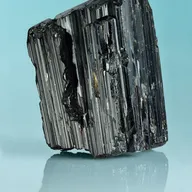 Black tourmaline
The stone that pulls ash out of a pipe when you warm it.
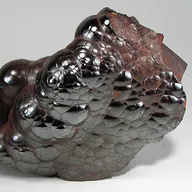 Hematite
Black as a mirror, and it leaves a blood-red line on anything you scratch it against.
Agni manitite
A black glass from Java, sold as a tektite; volcanic, as it turns out.
 Arfvedsonite
A black amphibole with a blue flash, named for the man who found lithium.
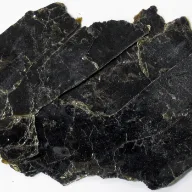 Biotite
Black mica: the flakes in every granite, and sheets big enough to roof a shed.
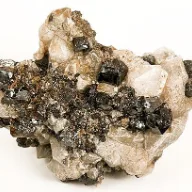 Brookite
Titanium dioxide in its rarest shape: thin red-brown blades grown in Alpine cracks.
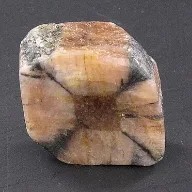 Chiastolite
An andalusite that grows a dark cross inside itself, and was sold for centuries as a Christian charm.
Columbianite
Colombian volcanic glass, sold as a tektite it is not.
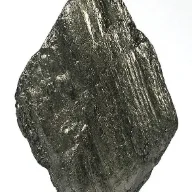 Graphite
Carbon in its soft form: the same element as diamond, stacked in sheets that slide.
 Aegirine
Black pyroxene needles from the strangest rocks on the planet.
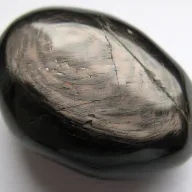 Hypersthene
A bronze-sheened pyroxene whose name the mineralogists retired.
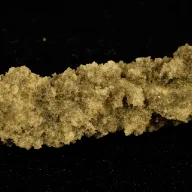 Fulgurite
Sand struck by lightning and fused, in a second, into hollow glass.
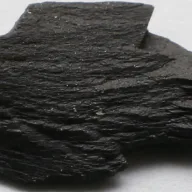 Jet
Fossil driftwood, black and warm in the hand, and Victorian mourning.
Indigo gabbro
A Madagascan rock sold under a wizard name it was given in 2010.
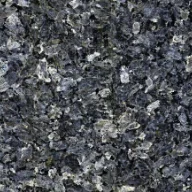 Larvikite
Norway's national rock, and the blue flash on half the shop fronts in Europe.
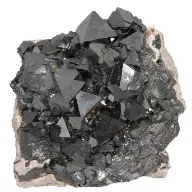 Magnetite
The most magnetic mineral there is, and the first compass.
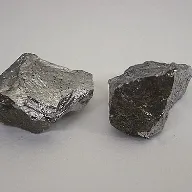 Manganese
The metal that makes steel tough, and that never occurs native.
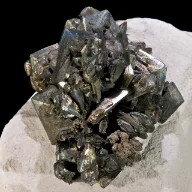 Marcasite
Pyrite's unstable twin, which eats itself in a damp drawer.
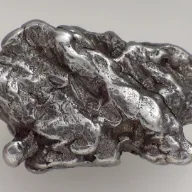 Campo del Cielo
An iron meteorite that fell on the Argentine Chaco four thousand years ago.
 Nuummite
Three-billion-year-old Greenlandic rock that flashes gold and copper.
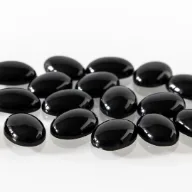 Onyx
Straight-banded chalcedony, and the black stone that is nearly always dyed.
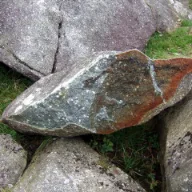 Preseli bluestone
The spotted dolerite of Stonehenge, from a Welsh hillside 250 kilometres away.
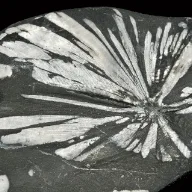 Chrysanthemum stone
Black rock with white mineral flowers that are not fossils.
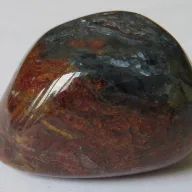 Pietersite
Tiger's eye smashed and cemented back together, so the light swirls.
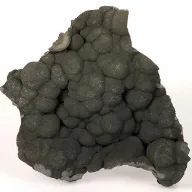 Psilomelane
A field name for the hard black manganese ores, kept alive by lapidaries.
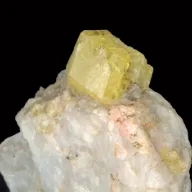 Rhodizite
A caesium borate as hard as topaz, and about as rare as minerals get.
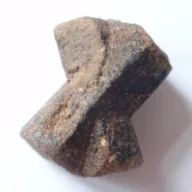 Staurolite
Two crystals grown through each other at sixty degrees, which comes out as a cross.
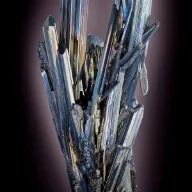 Stibnite
Steel-grey swords in a spray, soft enough to mark with a fingernail, and poisonous.
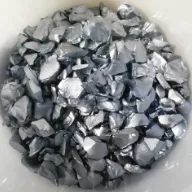 Terahertz stone
Furnace silicon, cut into beads and sold on a claim about radiation it does not emit.