 Lunarya
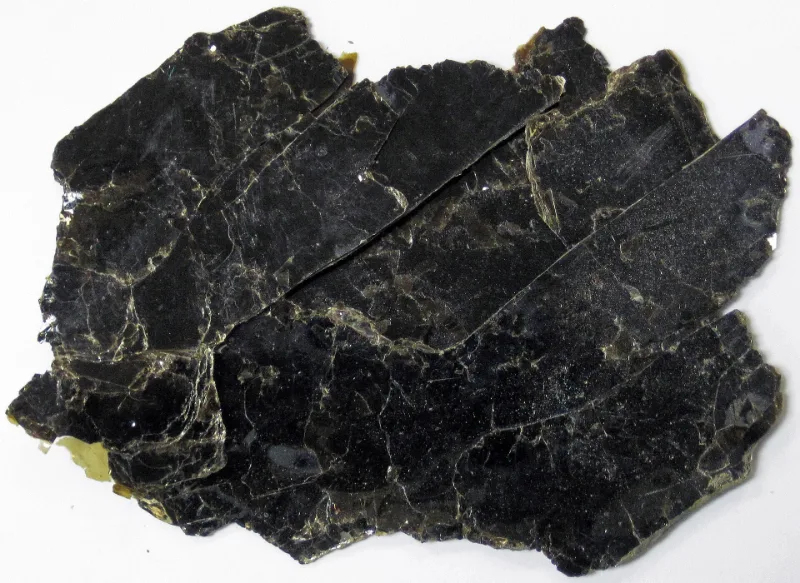
Biotite
Biotite is the dark mica: a potassium, magnesium and iron silicate that grows in sheets so thin and so perfectly cleavable that a book of it can be split with a fingernail into leaves that bend without breaking. It is in most granites, in gneiss and schist, and in the sand of most rivers, where its flakes flash gold in the water and have fooled a great many prospectors.
It is named for Jean-Baptiste Biot, who worked out the optics of mica in the 1810s, and since 1998 it is officially not a mineral at all but a series — annite to phlogopite, iron to magnesium — with biotite as the field name for the dark middle. Some of the largest crystals ever found are biotite sheets from Iveland in Norway, seven square metres across. It makes up as much as seven per cent of the exposed continental crust, and geologists date rocks by it, from the argon that its potassium decays into.
In short
- Colour
- Dark
- Mineral
- Mica
- Formula
- K(Mg,Fe)₃AlSi₃O₁₀(OH,F)₂
- Hardness
- 2.5–3 on the Mohs scale
- Crystal system
- Monoclinic
- Found in
- Everywhere granite is; large sheets from Norway (Iveland), Ontario, Quebec, Madagascar and Russia.
- Element
- Earth
- Planet
- Saturn
- Chakra
- Root
- Handling
- Keep out of water
How it forms
Mica grows in sheets because its structure is sheets: layers of silica tetrahedra sandwiching a layer of magnesium and iron, held to the next sandwich only by potassium ions, which is a weak enough bond that the layers part at a touch. Biotite crystallises in cooling granite among the last of the dark minerals, and it grows again in metamorphic rocks whenever a mudstone is heated enough for its clay to recrystallise, which is what gives schist its glitter and its tendency to split. In the weather it goes to vermiculite and clay, and its flakes wash into rivers, where they stay bright long enough to be mistaken for gold.
In human hands
Mica in general has a history — the muscovite windows of Muscovy, the isinglass of old stoves — but biotite, being dark, has little of it; its role was to be the black flecks in granite for as long as granite has been cut, and the pyrite-coloured glitter that emptied a few pans in the gold rushes. Hausmann named it in 1847, for Biot's work on the way mica splits polarised light, and it entered the laboratory rather than the shop: from the 1950s its potassium-argon clock has dated the crust, and the ages of most of the world's mountains were read out of it. The stone trade found it late, as a black shiny thing in a tumbled bag.
Varieties and trade names
- Phlogopite
- The magnesium end of the series, bronze-brown rather than black, from marbles and from the mica mines of Ontario and Madagascar.
- Annite
- The iron end, black and brittle, from the Cape Ann granite in Massachusetts it is named for.
- Lepidomelane
- An old name for iron-rich black biotite, on the labels of museum drawers and nowhere else.
- Biotite in granite
- The black flecks in any polished granite worktop, which is how most people have met it.
Telling it from a fake
Biotite splits into thin flexible sheets and nothing else black does: press a fingernail into the edge and a leaf lifts. The sheets are dark brown to black and translucent brown at the edges against a lamp, where muscovite is silver and clear and phlogopite bronze. The flakes in a stream are the classic fool's gold, and they give themselves away by floating, by being flat, and by turning dull when the light moves, where gold is bright from every side. Nothing is faked as biotite. It is confused with graphite, which is greasy and marks paper, and biotite does neither.
None of this needs a laboratory, and none of it is proof. A shop that will not say whether a stone is treated has answered the question; ask, and have the answer written on the receipt.
What it is said to do
A stone of the lists' newer pages: given for clarity and order, on the reading that a mineral made of perfect layers might help sort things into layers, and for seeing through — the sheets are windows, of a dark kind. Some file it under the root for the colour; the tradition has not settled, since it is only a few decades old.
Living with it
Keep it dry and do not bend it more than it wants to; the sheets part and the edges fray. Wipe it rather than wash it, since water gets between the leaves and stays there.
In magic
Biotite has little place in the craft, with one remarkable exception. In Arouca, in Portugal, granite boulders 'give birth' to biotite discs as they weather — the pedras parideiras, the birthing stones — and local women once slept with one under the pillow in the hope of a child. Modern books give biotite to clarity and to sorting things into order. It flakes, so it is kept dry and in a dish.
- Energy
- Receptive
- Day
- Saturday
- Worked for
- Study and clear thinking
More of this colour
 Smoky quartz
Quartz turned brown by the radioactivity of its own bedrock.
 Labradorite
A dull grey stone until you turn it, and then it is peacock blue.
 Obsidian
Volcanic glass with an edge finer than a surgical steel blade.
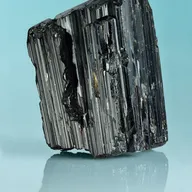 Black tourmaline
The stone that pulls ash out of a pipe when you warm it.
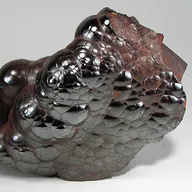 Hematite
Black as a mirror, and it leaves a blood-red line on anything you scratch it against.
Agni manitite
A black glass from Java, sold as a tektite; volcanic, as it turns out.
 Arfvedsonite
A black amphibole with a blue flash, named for the man who found lithium.
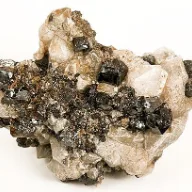 Brookite
Titanium dioxide in its rarest shape: thin red-brown blades grown in Alpine cracks.
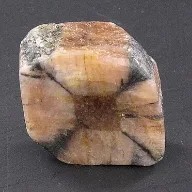 Chiastolite
An andalusite that grows a dark cross inside itself, and was sold for centuries as a Christian charm.
Columbianite
Colombian volcanic glass, sold as a tektite it is not.
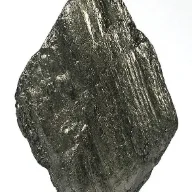 Graphite
Carbon in its soft form: the same element as diamond, stacked in sheets that slide.
 Aegirine
Black pyroxene needles from the strangest rocks on the planet.
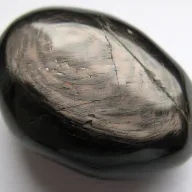 Hypersthene
A bronze-sheened pyroxene whose name the mineralogists retired.
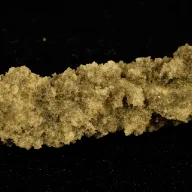 Fulgurite
Sand struck by lightning and fused, in a second, into hollow glass.
 Jet
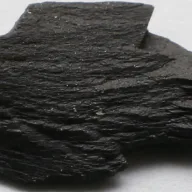
Fossil driftwood, black and warm in the hand, and Victorian mourning.
Indigo gabbro
A Madagascan rock sold under a wizard name it was given in 2010.
 Larvikite
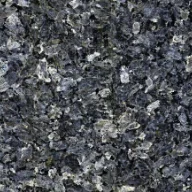
Norway's national rock, and the blue flash on half the shop fronts in Europe.
 Magnetite
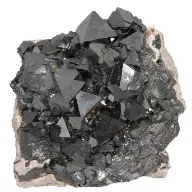
The most magnetic mineral there is, and the first compass.
 Manganese
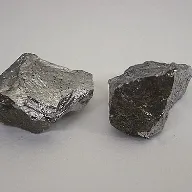
The metal that makes steel tough, and that never occurs native.
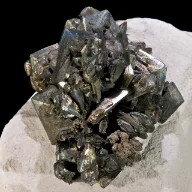 Marcasite
Pyrite's unstable twin, which eats itself in a damp drawer.
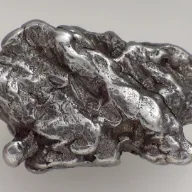 Campo del Cielo
An iron meteorite that fell on the Argentine Chaco four thousand years ago.
 Nuummite
Three-billion-year-old Greenlandic rock that flashes gold and copper.
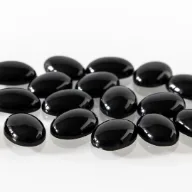 Onyx
Straight-banded chalcedony, and the black stone that is nearly always dyed.
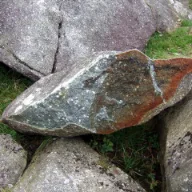 Preseli bluestone
The spotted dolerite of Stonehenge, from a Welsh hillside 250 kilometres away.
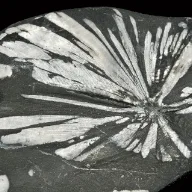 Chrysanthemum stone
Black rock with white mineral flowers that are not fossils.
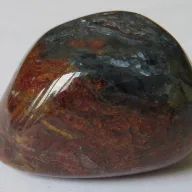 Pietersite
Tiger's eye smashed and cemented back together, so the light swirls.
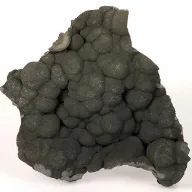 Psilomelane
A field name for the hard black manganese ores, kept alive by lapidaries.
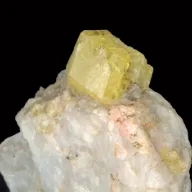 Rhodizite
A caesium borate as hard as topaz, and about as rare as minerals get.
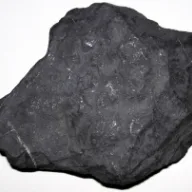 Shungite
Two-billion-year-old carbon rock from Karelia, and a great deal of nonsense.
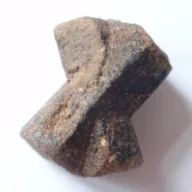 Staurolite
Two crystals grown through each other at sixty degrees, which comes out as a cross.
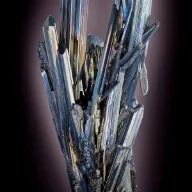 Stibnite
Steel-grey swords in a spray, soft enough to mark with a fingernail, and poisonous.
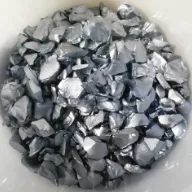 Terahertz stone
Furnace silicon, cut into beads and sold on a claim about radiation it does not emit.