 Lunarya
Pietersite
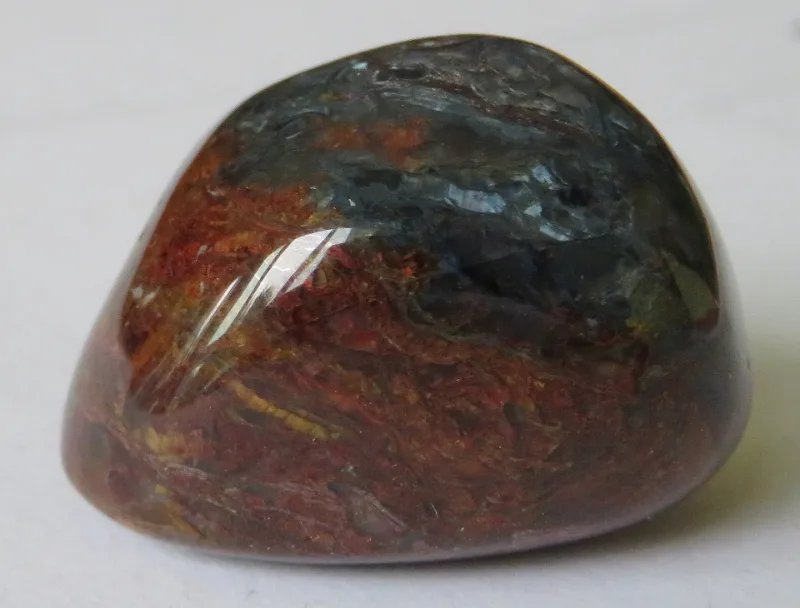
Pietersite is a breccia: tiger's eye and hawk's eye that were broken apart by earth movement and then cemented back together by quartz, with the fibre bundles left pointing in every direction. The result is chatoyancy that does not run in one stripe but rolls across the stone in swirls and patches as it turns, in gold, red-brown, blue-grey and steel. The trade calls it the tempest stone, and for once the name fits what you see.
Chemically it is quartz, hardness 6.5 to 7, and it behaves like any other silicified fibrous material on the wheel. Its parent is crocidolite, a blue asbestos amphibole, which silica replaced fibre by fibre; where the iron in it oxidised the stone went gold, and where it did not it stayed blue. That much it shares with ordinary tiger's eye, which has a page here. What makes pietersite is what happened afterwards: faulting, fragmentation and recementation, which is why no two pieces are alike and why a slab can carry four colours at once.
In short
- Colour
- Dark
- Mineral
- Quartz
- Formula
- SiO₂
- Hardness
- 6.5–7 on the Mohs scale
- Crystal system
- Trigonal
- Found in
- Two deposits only. The original is in Namibia, in the Kuraman hills near Outjo, found in 1962 and now largely worked out. The second is in Henan province in China, found in the 1990s, and supplies most of what is on sale; it tends to be bluer and more evenly swirled than the Namibian.
- Element
- Fire
- Planet
- Uranus
- Chakra
- Third eye
- Handling
- Water and light are both fine
How it forms
Banded ironstone with seams of crocidolite is invaded by silica-rich water, which replaces the asbestos fibres and preserves their alignment. Later, the rock is caught in a shear zone, broken into angular fragments and rotated, and a second generation of silica cements the pieces back together. Both stages have to happen, in that order, for pietersite to exist, which is why it is so localised.
In human hands
Sid Pieters, a Namibian dealer, found the first material on a farm in 1962 while prospecting, and it was described and named for him in 1964. For thirty years it was scarce and expensive. The Chinese discovery changed the supply but not the reputation, and pietersite remains one of the few stones whose name honours the man who found it rather than a place or a Greek adjective.
Varieties and trade names
- Namibian pietersite
- The original: gold, red and blue in tight swirls, from the worked-out Outjo deposit and priced accordingly.
- Chinese pietersite
- From Henan, generally bluer and larger; almost all current production and perfectly good material.
- Blue pietersite
- Pieces where the crocidolite never oxidised, so the whole stone is steel and slate rather than gold.
- Tiger's eye
- The unbroken parent material, with its light in one band rather than many; it has a page of its own here.
- Hawk's eye
- The blue stage of the same replacement, before the iron rusted; also on the tiger's eye page.
Telling it from a fake
The swirl is the test. Tiger's eye has one band of light that slides straight across; pietersite has several, at different angles, that light up separately and often meet along sharp fracture lines. Those angular boundaries — a fragment of gold set against a fragment of blue with a clean edge between them — are the breccia showing, and no imitation reproduces them convincingly. Dyed and glass imitations have an even, printed-looking shimmer.
None of this needs a laboratory, and none of it is proof. A shop that will not say whether a stone is treated has answered the question; ask, and have the answer written on the receipt.
What it is said to do
The modern reading is all weather: the storm, the clearing after it, courage in the middle of something turbulent, and the nerve to make a decision while things are still moving. It is given to Uranus, to Leo and Aquarius, and to the third eye. It is a recent tradition, as it has to be for a stone discovered in 1962, and it was built from the look of the thing.
Living with it
As hard-wearing as quartz and unaffected by water or sunlight. The only real caution is that the breccia has healed fracture planes through it, and a hard knock can part it along one of those; set a cabochon where it will not take a blow. A soft brush and warm water are all it needs.
In magic
Pietersite, the tempest stone, is used in modern practice for courage in the middle of turbulence and for decisions taken while things are still moving: carried through a storm in one's life, held in meditation for the clearing after it. It was found in Namibia in 1962 and has no older magic. It is as tough as quartz.
- Energy
- Projective
- Day
- Saturday
- Worked for
- Courage and drive · Change and letting go
More of this colour
 Smoky quartz
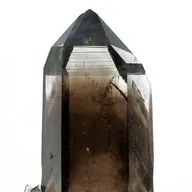
Quartz turned brown by the radioactivity of its own bedrock.
 Labradorite
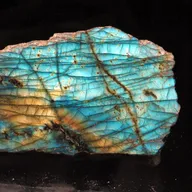
A dull grey stone until you turn it, and then it is peacock blue.
 Obsidian
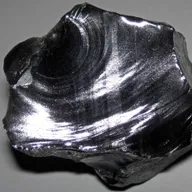
Volcanic glass with an edge finer than a surgical steel blade.
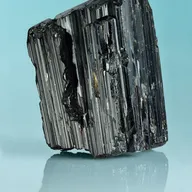 Black tourmaline
The stone that pulls ash out of a pipe when you warm it.
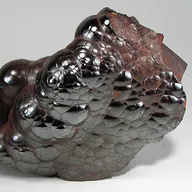 Hematite
Black as a mirror, and it leaves a blood-red line on anything you scratch it against.
Agni manitite
A black glass from Java, sold as a tektite; volcanic, as it turns out.
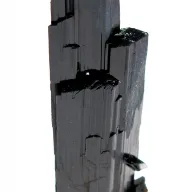 Arfvedsonite
A black amphibole with a blue flash, named for the man who found lithium.
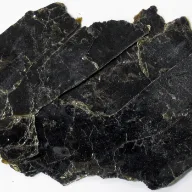 Biotite
Black mica: the flakes in every granite, and sheets big enough to roof a shed.
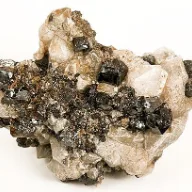 Brookite
Titanium dioxide in its rarest shape: thin red-brown blades grown in Alpine cracks.
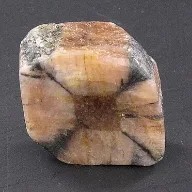 Chiastolite
An andalusite that grows a dark cross inside itself, and was sold for centuries as a Christian charm.
Columbianite
Colombian volcanic glass, sold as a tektite it is not.
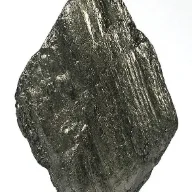 Graphite
Carbon in its soft form: the same element as diamond, stacked in sheets that slide.
 Aegirine
Black pyroxene needles from the strangest rocks on the planet.
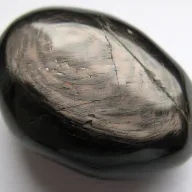 Hypersthene
A bronze-sheened pyroxene whose name the mineralogists retired.
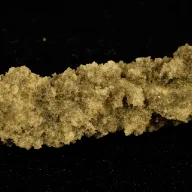 Fulgurite
Sand struck by lightning and fused, in a second, into hollow glass.
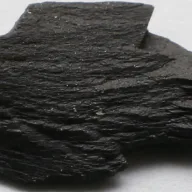 Jet
Fossil driftwood, black and warm in the hand, and Victorian mourning.
Indigo gabbro
A Madagascan rock sold under a wizard name it was given in 2010.
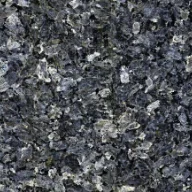 Larvikite
Norway's national rock, and the blue flash on half the shop fronts in Europe.
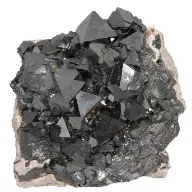 Magnetite
The most magnetic mineral there is, and the first compass.
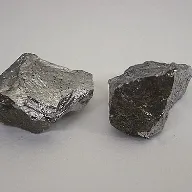 Manganese
The metal that makes steel tough, and that never occurs native.
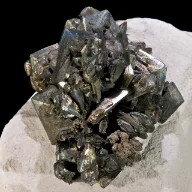 Marcasite
Pyrite's unstable twin, which eats itself in a damp drawer.
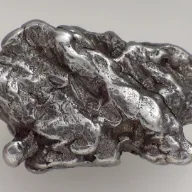 Campo del Cielo
An iron meteorite that fell on the Argentine Chaco four thousand years ago.
 Nuummite
Three-billion-year-old Greenlandic rock that flashes gold and copper.
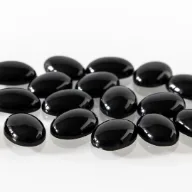 Onyx
Straight-banded chalcedony, and the black stone that is nearly always dyed.
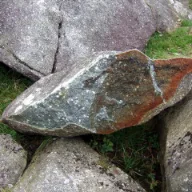 Preseli bluestone
The spotted dolerite of Stonehenge, from a Welsh hillside 250 kilometres away.
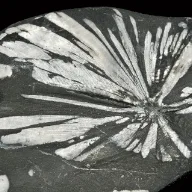 Chrysanthemum stone
Black rock with white mineral flowers that are not fossils.
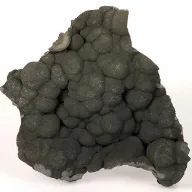 Psilomelane
A field name for the hard black manganese ores, kept alive by lapidaries.
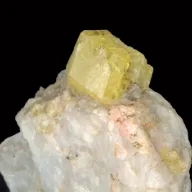 Rhodizite
A caesium borate as hard as topaz, and about as rare as minerals get.
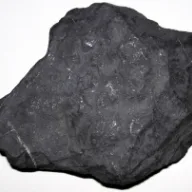 Shungite
Two-billion-year-old carbon rock from Karelia, and a great deal of nonsense.
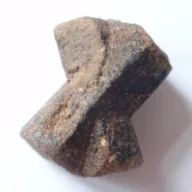 Staurolite
Two crystals grown through each other at sixty degrees, which comes out as a cross.
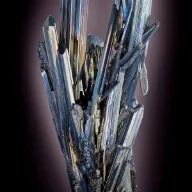 Stibnite
Steel-grey swords in a spray, soft enough to mark with a fingernail, and poisonous.
 Terahertz stone
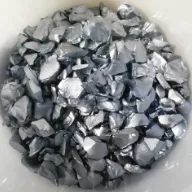
Furnace silicon, cut into beads and sold on a claim about radiation it does not emit.