 Lunarya
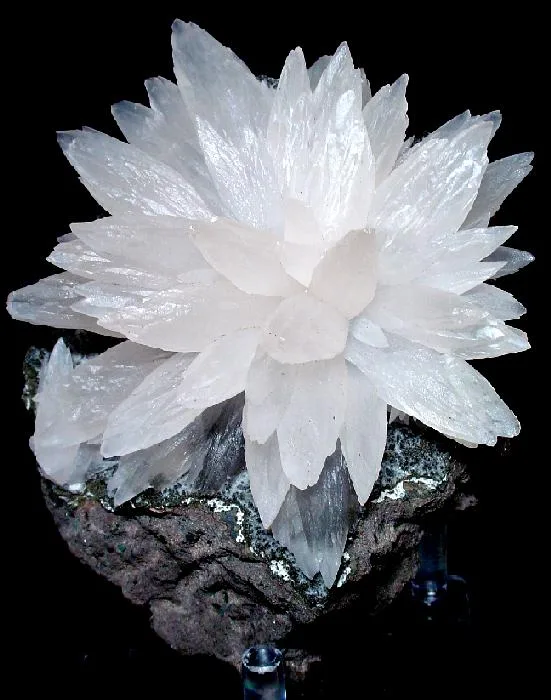
Calcite
Calcite is calcium carbonate, the mineral limestone is made of, and marble, and chalk, and stalactites, and the shells of most things that grow one. It is soft — number three on the Mohs scale, which is defined by it — it fizzes in weak acid, and it cleaves into rhombs so readily that a struck crystal falls into a heap of little leaning boxes. It takes more crystal shapes than any other mineral: several hundred forms have been described.
A clear cleavage rhomb laid over a line shows two lines. Calcite splits light into two rays travelling at different speeds, and does it more strongly than almost anything else, which is why the clear Icelandic material was the key to the physics of polarisation and the making of the Nicol prism, the polarising microscope, and the sights and bombsights of the Second World War. There is also a good case that the sunstone of the Norse sagas was a piece of it, used to find the sun through cloud by watching the polarised sky.
In short
- Colour
- Clear and white
- Mineral
- Carbonate
- Formula
- CaCO₃
- Hardness
- 3 on the Mohs scale
- Crystal system
- Trigonal
- Found in
- Everywhere there has been water: Helgustaðir in Iceland, Egremont in Cumbria, Elmwood in Tennessee, Chihuahua in Mexico, Guangxi in China, and the Maramureș mines in Romania — Cavnic, Baia Sprie and Herja.
- Element
- Water
- Planet
- The Moon
- Chakra
- Crown
- Handling
- Keep out of water and sunlight
How it forms
Calcite comes out of water. Sea creatures take it out to build shells and drop it on the sea floor, where it becomes limestone; heat and pressure turn limestone into marble; rain that has picked up carbon dioxide dissolves that limestone underground, carries it along and lets it go again in caves, as stalactites, flowstone and the crust round a hot spring. Hydrothermal veins grow the big transparent crystals, often as a late mineral coating older ore, and geodes line themselves with it. Between them, these processes make calcite about four per cent of the Earth's crust.
In human hands
Iceland spar was described from the Helgustaðir quarry in the seventeenth century, and Rasmus Bartholin's account of its double refraction in 1669 opened a two-hundred-year argument about the nature of light that ended with waves. Limestone and marble have carried architecture since Egypt; burnt limestone is quicklime, the binder of Roman concrete and of every mortar since. The Romanian mines of Maramureș, worked for gold and silver, produced calcite crystals as a by-product that are in museums all over Europe.
Varieties and trade names
- Iceland spar
- Water-clear cleavage rhombs that show a doubled image; the optical material, and the classroom demonstration.
- Blue calcite
- Soft powder blue, usually massive, mostly from Mexico; the bright blue tumbled stones are often dyed.
- Honey calcite
- Warm amber-yellow, coloured by iron, in big cleavable masses from Mexico and Pakistan.
- Orange calcite
- Bright orange, again iron, from Chihuahua; glows under ultraviolet in some pieces.
- Red calcite
- Brick to rust red from hematite dust caught in the crystal as it grew.
- Green calcite
- Pale green, coloured by traces of copper or iron; the Mexican material is banded and often mistaken for onyx marble.
- Cobaltoan calcite
- Deep pink to magenta, coloured by cobalt, in glittering crusts from Morocco and the Congo; the most valuable of them.
- Dogtooth spar
- Long steep-pointed crystals lining cavities, named for the obvious; nailhead spar is the blunt-ended form.
Telling it from a fake
A drop of vinegar fizzes on calcite and does nothing to quartz or to the many pale stones sold beside it. It is soft enough for a copper coin to mark, and it breaks into rhombs, never into curved shells. A clear piece doubles a printed line. Dyed calcite is everywhere: electric blue and turquoise tumbled stones, and "green onyx" slabs, take the colour along the grain boundaries, and a cotton bud with acetone will often pick it up. Aragonite is the same chemistry in a different structure, and fizzes just as well.
None of this needs a laboratory, and none of it is proof. A shop that will not say whether a stone is treated has answered the question; ask, and have the answer written on the receipt.
What it is said to do
The books treat calcite as an amplifier and a cleanser — the stone put in the room to keep the others working, and the one given for studying, sorting and clearing out. Because it comes in every colour, each colour has its own reading, which is convenient rather than ancient: green for the heart, orange for creativity, blue for speech. It is one of the few stones whose tradition is honestly modern; the ancients used the rock and ignored the crystal.
Living with it
Soft, cleavable, and attacked by anything acidic: no vinegar, no lemon, no ultrasonic cleaner, no long soaking. Dust it dry or wipe it with a barely damp cloth. Keep dyed and iron-coloured pieces out of the sun, and keep it away from harder stones in a drawer, which will scratch it in an afternoon.
In magic
Calcite comes in every colour, and modern practice uses it by colour: orange for creativity, green for the heart, blue for speech, honey for confidence, clear for study, and every kind as a cleanser set among the other stones. The ancients built with the rock and ignored the crystal, so none of this is old. It is soft and dissolves in acid, so no vinegar or salt washes.
- Energy
- Receptive
- Day
- Monday
- Worked for
- Cleansing · Study and clear thinking
More of this colour
 Clear quartz
The plain one, and the one the modern world actually runs on.
 Selenite
Gypsum in satin fibres, soft enough to mark with a fingernail.
 Moonstone
Feldspar with a light inside it that moves when the stone does.
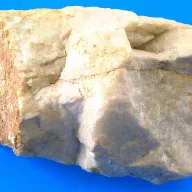 Amblygonite
A lithium phosphate from the pegmatites, and the palest yellow gem you have never heard of.
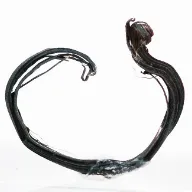 Silver
The metal of the moon, grown in wires and ferns in the veins of the earth.
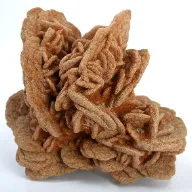 Baryte
The heavy stone: barium sulfate, and the reason a rose can grow in the desert.
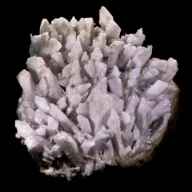 Danburite
A borosilicate that looks exactly like topaz, named after a Connecticut town that paved over the deposit.
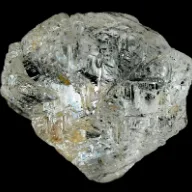 Phenakite
A beryllium silicate so like quartz that it was named the deceiver.
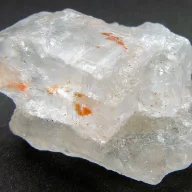 Halite
Rock salt: perfect cubes that will dissolve in a damp room.
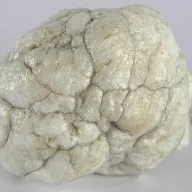 Howlite
White nodules with black veins, and the most dyed mineral in the trade.
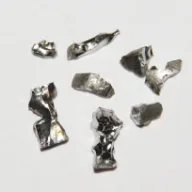 Iridium
The most corrosion-proof metal there is, and the layer that dates the end of the dinosaurs.
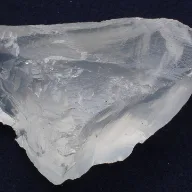 Petalite
The mineral lithium was discovered in, and it looks like nothing at all.
Cradle of Humankind stone
Ordinary grey chalcedony from an extraordinary place outside Johannesburg.
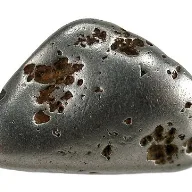 Platinum
Little silver, the Spanish called it, and threw it back in the river.
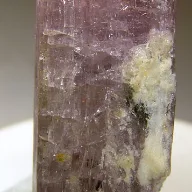 Scapolite
A tetragonal silicate that glows yellow under ultraviolet and fades in the sun.
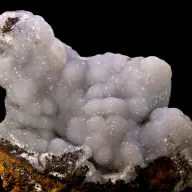 Smithsonite
Zinc carbonate in botryoidal crusts, named after the man who founded the Smithsonian.
Shiva lingam
A Narmada river cobble, ground by hand into an egg and sold as a sacred stone.
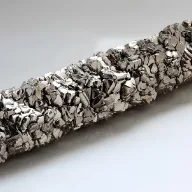 Titanium
The ninth commonest element in the crust, and almost never found as a metal.
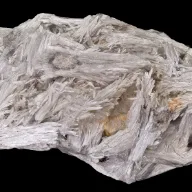 Tremolite
The white amphibole that makes nephrite jade, and, in its fibrous form, asbestos.
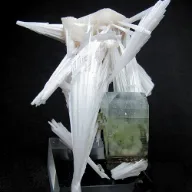 Zeolite
Minerals built like sponges at the atomic scale, which is why industry uses more of them than jewellers do.
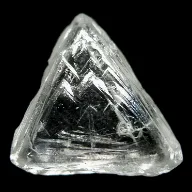 Diamond
Carbon, arranged the hard way, and carried up from two hundred kilometres down.