 Lunarya
Shiva lingam
A shiva lingam stone is cryptocrystalline quartz — jasper in the loose sense — from the bed of the Narmada river in Madhya Pradesh. The cobbles are hard, 6.5 to 7, tan to grey-brown, and marked with irregular red and cream patches from iron oxide and from fragments of the basalt the river cuts through. They are sold as smooth ovoids, and the honest thing to say first is that the ovoid is made by people.
That matters, because the trade regularly claims the shape is natural, formed by the river. It is not. The stones are gathered from the Narmada, ground on a wheel by hand into the symmetrical egg form, and polished, which is a craft with its own history and nothing to apologise for; but a river does not produce a batch of identical ovoids with a flat base. The markings are natural. The form is a workshop's.
In short
- Colour
- Clear and white
- Mineral
- Chalcedony
- Formula
- SiO₂
- Hardness
- 6.5–7 on the Mohs scale
- Crystal system
- Trigonal
- Found in
- The Narmada river in Madhya Pradesh, principally around Omkareshwar and Mandhata in the district of Khandwa, where the collecting and the grinding are both local industries.
- Element
- Water
- Planet
- The Moon
- Chakra
- Sacral
- Handling
- Water and light are both fine
How it forms
The Narmada runs through the Deccan basalts, one of the largest outpourings of lava in Earth's history. Silica-rich water filled cavities and fractures in that lava with chalcedony and jasper, and as the basalt weathers the harder silica survives. The river breaks it up, rolls it and rounds it, and the cobbles that reach the collecting reaches are already tough, dense and smoothly water-worn before anyone touches them.
In human hands
The lingam is the aniconic form in which Shiva is worshipped, and Omkareshwar on the Narmada is one of the twelve jyotirlinga, the most important Shaivite sites in India. Stones from the river have been used as banalinga — naturally occurring lingams needing no consecration — for a very long time, and the Narmada is specifically named in that tradition. The export of polished ovoids to the western crystal trade is a much more recent business, from the late twentieth century.
Varieties and trade names
- Banalinga
- The traditional Narmada stone used in worship, often left closer to its river shape and treated as already consecrated.
- Polished ovoids
- The export form, ground and polished to a symmetrical egg with a flat base; what a crystal shop sells.
- Red-marked stones
- Pieces with strong iron oxide markings, read in the tradition as especially auspicious and priced higher.
- Carved stone lingams
- Temple objects sculpted from granite or basalt; a different thing entirely, and not a crystal-shop item.
- Jasper and chalcedony
- The same material under its mineral names, which both have pages here.
Telling it from a fake
It is jasper: hard enough to scratch glass, opaque, waxy, and it will not fizz in acid. Beyond that, the questions are about honesty rather than mineralogy. A batch of identical eggs has been ground, whatever the label says. Painted markings show under a loupe as a film sitting on the surface rather than a pattern going into the stone, and acetone on a cotton bud lifts them. Reconstituted or resin pieces are light and warm in the hand.
None of this needs a laboratory, and none of it is proof. A shop that will not say whether a stone is treated has answered the question; ask, and have the answer written on the receipt.
What it is said to do
The tradition here is living and Hindu, not lapidary: the lingam with the yoni is the form of Shiva and Shakti together, read as the union of the masculine and feminine principles and as the origin of things rather than as a fertility charm, which is the reading western books usually reach for first. Shops file it under Scorpio and Capricorn, under the Moon, at the sacral centre. It is worth handling with the respect due to a religious object rather than a decoration.
Living with it
Hard, waterproof and lightfast, so it needs nothing. Wash it with soapy water and dry it. The polish will dull if it is kept with harder stones, and a dropped one will chip on the base. In devotional use it is bathed in water or milk, and the stone takes that without complaint.
In magic
Shiva lingam stones from the Narmada are sacred objects in Hindu worship, bathed in water or milk as part of devotion, and that context deserves respect before any other use. Western practice uses them in workings for union and balance, often reading them as fertility charms, which is the shallowest of the readings on offer. Water does them no harm, which suits the devotional bath.
- Energy
- Receptive
- Day
- Monday
- Worked for
- Love and friendship
More of this colour
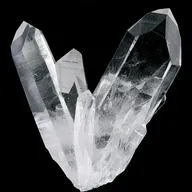 Clear quartz
The plain one, and the one the modern world actually runs on.
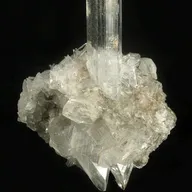 Selenite
Gypsum in satin fibres, soft enough to mark with a fingernail.
 Moonstone
Feldspar with a light inside it that moves when the stone does.
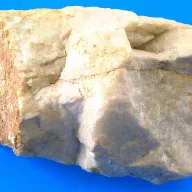 Amblygonite
A lithium phosphate from the pegmatites, and the palest yellow gem you have never heard of.
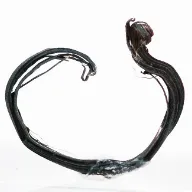 Silver
The metal of the moon, grown in wires and ferns in the veins of the earth.
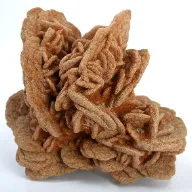 Baryte
The heavy stone: barium sulfate, and the reason a rose can grow in the desert.
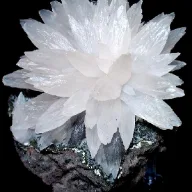 Calcite
The commonest carbonate on Earth, and the crystal that showed physicists light has two paths.
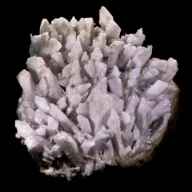 Danburite
A borosilicate that looks exactly like topaz, named after a Connecticut town that paved over the deposit.
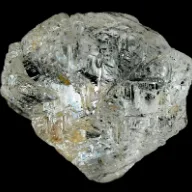 Phenakite
A beryllium silicate so like quartz that it was named the deceiver.
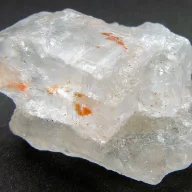 Halite
Rock salt: perfect cubes that will dissolve in a damp room.
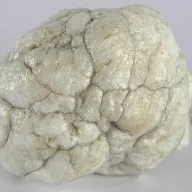 Howlite
White nodules with black veins, and the most dyed mineral in the trade.
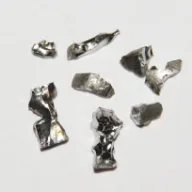 Iridium
The most corrosion-proof metal there is, and the layer that dates the end of the dinosaurs.
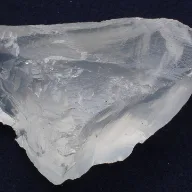 Petalite
The mineral lithium was discovered in, and it looks like nothing at all.
Cradle of Humankind stone
Ordinary grey chalcedony from an extraordinary place outside Johannesburg.
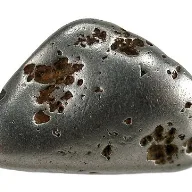 Platinum
Little silver, the Spanish called it, and threw it back in the river.
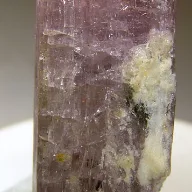 Scapolite
A tetragonal silicate that glows yellow under ultraviolet and fades in the sun.
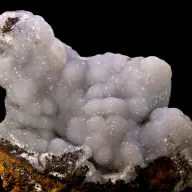 Smithsonite
Zinc carbonate in botryoidal crusts, named after the man who founded the Smithsonian.
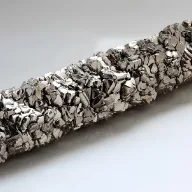 Titanium
The ninth commonest element in the crust, and almost never found as a metal.
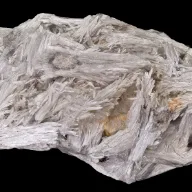 Tremolite
The white amphibole that makes nephrite jade, and, in its fibrous form, asbestos.
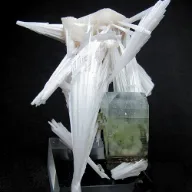 Zeolite
Minerals built like sponges at the atomic scale, which is why industry uses more of them than jewellers do.
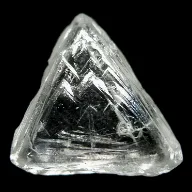 Diamond
Carbon, arranged the hard way, and carried up from two hundred kilometres down.