 Lunarya
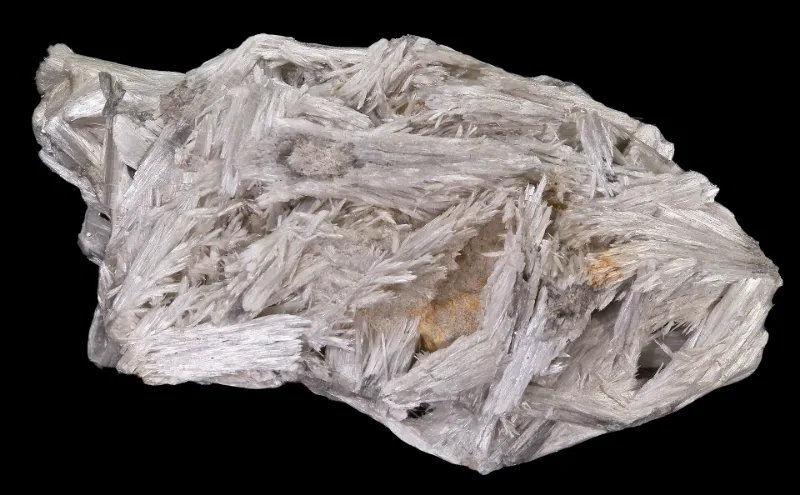
Tremolite
Tremolite is a calcium magnesium amphibole, Ca₂Mg₅Si₈O₂₂(OH)₂, 5 to 6 on the Mohs scale, monoclinic, usually white to pale grey and often glassy. It is the magnesium end of a series whose iron end is actinolite, which has a page of its own here; put enough iron in a tremolite and it turns green and becomes that instead. It grows as blades, as long prisms, and as fibres — and the fibres are the reason this page has a warning on it.
Tremolite has two quite different reputations and they belong to the same mineral. Grown as a dense felted mass of interlocking microscopic fibres, tremolite and actinolite together make nephrite, one of the two jades, and that interlocking is what makes nephrite the toughest natural stone there is. Grown as separate long fibres, the same mineral is tremolite asbestos, one of the six regulated asbestos minerals and among the most dangerous, because amphibole fibres are straight, stiff and stay in the lung. The difference is habit, not chemistry.
In short
- Colour
- Clear and white
- Mineral
- Amphibole
- Formula
- Ca₂Mg₅Si₈O₂₂(OH)₂
- Hardness
- 5–6 on the Mohs scale
- Crystal system
- Monoclinic
- Found in
- Campolungo in Ticino, Switzerland, is the classic locality, and the name comes from the nearby Val Tremola. Also the marbles of St Lawrence County in New York, which produce the pink hexagonite; Ontario, Tanzania, Pakistan, Italy and the Alps generally; and, in fibrous form, in talc and vermiculite deposits all over the world.
- Element
- Earth
- Planet
- Saturn
- Chakra
- Heart
- Handling
- Water and light are both fine
How it forms
Tremolite is what you get when a dolomitic limestone with some silica in it is metamorphosed at moderate temperature: dolomite plus quartz plus water yields tremolite, calcite and carbon dioxide, a reaction so reliable that it is used to read the temperature of a marble. It also forms in altered ultramafic rock. Where it grows in open space it makes blades and sprays; where it grows under stress in a confined seam it makes parallel fibres, and that is asbestos.
In human hands
The mineral was named in 1789. Its asbestos form has no romantic history at all — it is the one that appears in the record of industrial disease. Tremolite is the common contaminant of talc, which is why cosmetic talc has been litigated over for decades, and an amphibole asbestos of this family is what poisoned the vermiculite mine at Libby, Montana, and much of the town with it. Nephrite jade is the same mineral in a different arrangement and has been carved in China for thousands of years.
Varieties and trade names
- Bladed tremolite
- Glassy white to grey blades and sprays in marble; the collector's form, and safe to own as long as it is not crumbling.
- Hexagonite
- Pink to lilac tremolite coloured by manganese, from New York State. The name is a mistake preserved: it was thought to crystallise hexagonally and does not.
- Chrome tremolite
- A bright green chromium-bearing variety from Tanzania, occasionally faceted and often sold as chrome diopside, which it is not.
- Nephrite
- A felted mass of tremolite and actinolite fibres locked together. This is jade, and it has a page of its own here; the toughness comes entirely from the tangle.
- Tremolite asbestos
- Long, straight, separable fibres. This is a regulated hazardous material in most countries, it should not be bought, sold as a specimen or handled, and reputable dealers will not touch it.
Telling it from a fake
Amphiboles cleave at about 120 degrees, which shows as a diamond-shaped cross-section on a broken prism and separates them from the pyroxenes, which cleave near 90. Tremolite is pale, glassy and harder than the calcite it usually sits in. The important distinction is not mineralogical: a specimen that is solid and bladed is one thing, and one that is soft, silky, and separates into hair-fine threads when rubbed is another, and the second should be left alone. If in doubt, do not rub it to find out.
None of this needs a laboratory, and none of it is proof. A shop that will not say whether a stone is treated has answered the question; ask, and have the answer written on the receipt.
What it is said to do
There is very little tradition here, and what exists is mostly attached to hexagonite, which is given to the heart in the way most pink stones are. Tremolite proper is given to quiet and to discernment, and it goes with earth, with Saturn, with Virgo and Capricorn, and with the heart centre. The honest reading for this page is the one the mineral itself suggests: the same substance can be the toughest stone people carve or the thing that kills a mining town, and the difference is invisible without looking closely.
Living with it
Handle solid bladed specimens normally — water and light do them no harm — but do not brush, saw, tumble or grind tremolite, and do not buy it fibrous. Amphibole asbestos fibres are released by abrasion, are invisible in the air, and cause mesothelioma decades later; there is no safe way to make dust from this mineral at home. Keep a specimen in a closed box if it is at all friable, wipe rather than blow the dust off it, and if a piece begins to shed fibres, seal it and dispose of it the way your local rules require.
In magic
Tremolite has little place in practice: hexagonite, its pink form, is used in heart workings, and plain tremolite now and then for quiet and discernment. The rule that matters is physical: fibrous tremolite is asbestos, so it is never brushed, broken, tumbled or used in any ritual that could make dust.
- Energy
- Receptive
- Day
- Saturday
- Worked for
- Calm and peace · Study and clear thinking
More of this colour
 Clear quartz
The plain one, and the one the modern world actually runs on.
 Selenite
Gypsum in satin fibres, soft enough to mark with a fingernail.
 Moonstone
Feldspar with a light inside it that moves when the stone does.
 Amblygonite
A lithium phosphate from the pegmatites, and the palest yellow gem you have never heard of.
 Silver
The metal of the moon, grown in wires and ferns in the veins of the earth.
 Baryte
The heavy stone: barium sulfate, and the reason a rose can grow in the desert.
 Calcite
The commonest carbonate on Earth, and the crystal that showed physicists light has two paths.
 Danburite
A borosilicate that looks exactly like topaz, named after a Connecticut town that paved over the deposit.
 Phenakite
A beryllium silicate so like quartz that it was named the deceiver.
 Halite
Rock salt: perfect cubes that will dissolve in a damp room.
 Howlite
White nodules with black veins, and the most dyed mineral in the trade.
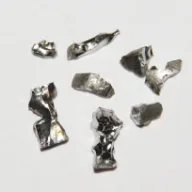 Iridium
The most corrosion-proof metal there is, and the layer that dates the end of the dinosaurs.
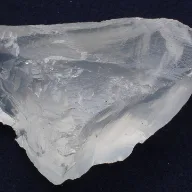 Petalite
The mineral lithium was discovered in, and it looks like nothing at all.
Cradle of Humankind stone
Ordinary grey chalcedony from an extraordinary place outside Johannesburg.
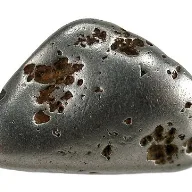 Platinum
Little silver, the Spanish called it, and threw it back in the river.
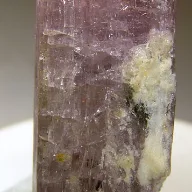 Scapolite
A tetragonal silicate that glows yellow under ultraviolet and fades in the sun.
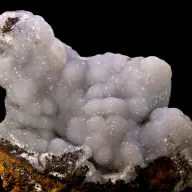 Smithsonite
Zinc carbonate in botryoidal crusts, named after the man who founded the Smithsonian.
Shiva lingam
A Narmada river cobble, ground by hand into an egg and sold as a sacred stone.
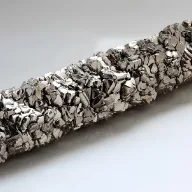 Titanium
The ninth commonest element in the crust, and almost never found as a metal.
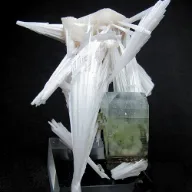 Zeolite
Minerals built like sponges at the atomic scale, which is why industry uses more of them than jewellers do.
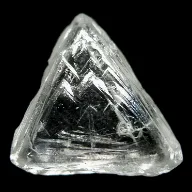 Diamond
Carbon, arranged the hard way, and carried up from two hundred kilometres down.