 Lunarya
Phenakite
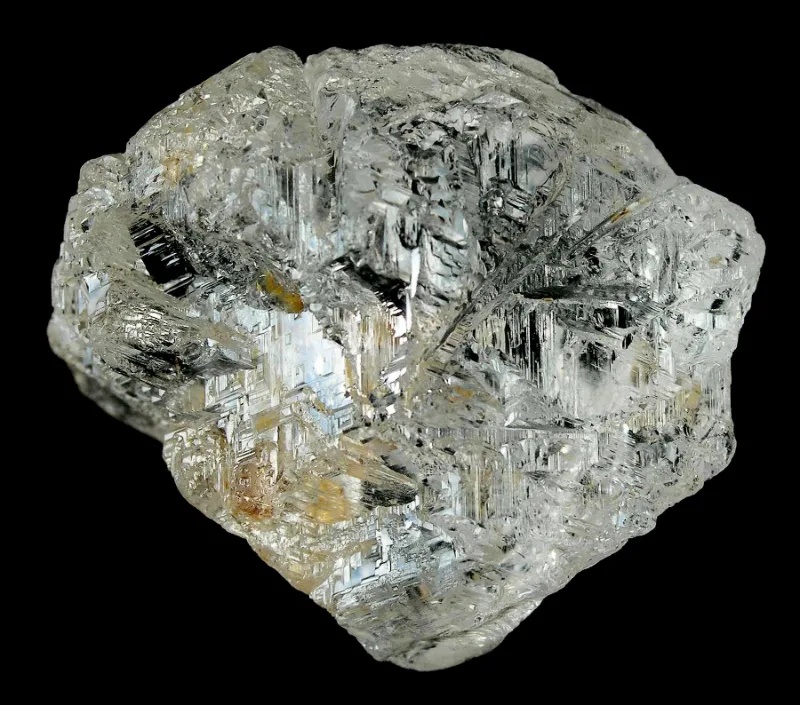
Phenakite, also spelled phenacite, is beryllium silicate, Be₂SiO₄, in colourless glassy crystals that look exactly like quartz and are not. Nils Nordenskiöld named it in 1833 from the Greek phenax, a deceiver, because the crystals he was handed from the Urals had been sold to him as quartz. It is harder than quartz, heavier than quartz, and rarer than quartz by several orders of magnitude.
Hardness 7.5 to 8 and a refractive index well above quartz, so a cut stone has noticeably more life than one expects from something colourless. It shares its chemistry with beryl and chrysoberyl: beryllium is a scarce element that only concentrates where a granite has had a long, wet, late history. The crystals come as stubby rhombohedra, as long prisms, and as flat lens-shaped plates, and twinning is common enough to confuse a beginner. Cutting it releases beryllium dust, which is genuinely hazardous, and no lapidary should grind it dry.
In short
- Colour
- Clear and white
- Mineral
- Silicate
- Formula
- Be₂SiO₄
- Hardness
- 7.5–8 on the Mohs scale
- Crystal system
- Trigonal
- Found in
- The emerald mines near Ekaterinburg in the Urals are the type locality. Minas Gerais in Brazil and the Malagasy pegmatites supply most modern material; others are Nigeria, Namibia, Tanzania, Zimbabwe, Switzerland, and Mount Antero and Crystal Peak in Colorado.
- Element
- Air
- Planet
- Neptune
- Chakra
- Crown
- Handling
- Water and light are both fine
How it forms
It grows in granite pegmatites and in the high-temperature veins and cavities around them, where beryllium-bearing fluid met silica. Topaz, beryl, chrysoberyl, fluorite and mica are its usual neighbours. A second setting is the mica schist around emerald deposits, which is where the Russian crystals came from, and a third is the miarolitic pockets of alpine granite, which is where the Swiss ones did.
In human hands
Named in 1833 and a collector's stone ever since. It has never been a commercial gem: colourless stones are a hard sell against diamond and white sapphire, and the rough is too scarce to build a trade on, though it takes a superb polish and a well-cut phenakite is a beautiful thing. The crystal literature of the 1980s made it famous in a different market, as one of the stones treated as unusually potent, and prices for clean Malagasy crystals have followed that reputation rather than the jewellery trade.
Varieties and trade names
- Russian phenakite
- From the Ural emerald mines: the original material, often in stout twinned crystals.
- Brazilian phenakite
- Minas Gerais pegmatite crystals, some large and water-clear, some faceted.
- Malagasy phenakite
- Small, very clean, brilliant crystals; the ones most often sold loose to collectors.
- Colorado phenakite
- From Mount Antero and Crystal Peak, growing with smoky quartz and amazonite.
- Cut phenakite
- Faceted stones, usually under three carats, colourless or faintly yellow, and rarely seen in a shop.
Telling it from a fake
Against quartz, three tests agree. Phenakite scratches quartz and quartz will not scratch it; it is distinctly heavier for its size, 2.96 against 2.65; and its double refraction is stronger, so a line viewed through a clean crystal doubles more obviously. Topaz is heavier again and splits on a perfect basal cleavage, which phenakite lacks. Glass is softer, warmer to the touch and often bubbled. Beryl is lighter and hexagonal in cross-section.
None of this needs a laboratory, and none of it is proof. A shop that will not say whether a stone is treated has answered the question; ask, and have the answer written on the receipt.
What it is said to do
The modern reading puts it at the crown and treats it as a stone for clear seeing and for meditation, one of a handful — with danburite, moldavite and herkimer quartz — that the crystal literature of the last forty years singles out as strong. Nothing older attaches to it. It is worth knowing that this reputation grew from a small number of books published in the 1980s and repeated since, and that it is the reason the rough costs what it does.
Living with it
Hard, unaffected by water, unaffected by light, and perfectly safe to hold, wear or keep. The one real caution is dust: beryllium dust is toxic to the lungs, so phenakite is cut wet and by somebody who knows that. It is also brittle, and a sharp knock will chip a crystal edge that a scratch never would.
In magic
Phenakite is used in modern practice for meditation and clear seeing, one of the high-vibration stones of the 1980s books: a crystal at the crown, or held before a reading. Nothing older is attached to it. Hard and stable, it can join any ritual, but beryllium dust is toxic, so it is never ground or powdered for a spell.
- Energy
- Projective
- Day
- Thursday
- Worked for
- Divination and intuition · Study and clear thinking
More of this colour
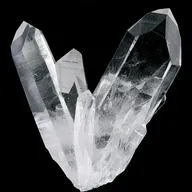 Clear quartz
The plain one, and the one the modern world actually runs on.
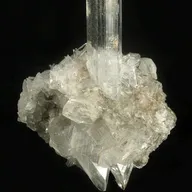 Selenite
Gypsum in satin fibres, soft enough to mark with a fingernail.
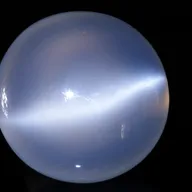 Moonstone
Feldspar with a light inside it that moves when the stone does.
 Amblygonite
A lithium phosphate from the pegmatites, and the palest yellow gem you have never heard of.
 Silver
The metal of the moon, grown in wires and ferns in the veins of the earth.
 Baryte
The heavy stone: barium sulfate, and the reason a rose can grow in the desert.
 Calcite
The commonest carbonate on Earth, and the crystal that showed physicists light has two paths.
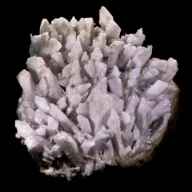 Danburite
A borosilicate that looks exactly like topaz, named after a Connecticut town that paved over the deposit.
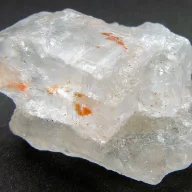 Halite
Rock salt: perfect cubes that will dissolve in a damp room.
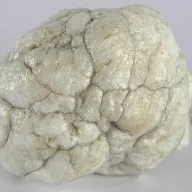 Howlite
White nodules with black veins, and the most dyed mineral in the trade.
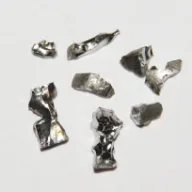 Iridium
The most corrosion-proof metal there is, and the layer that dates the end of the dinosaurs.
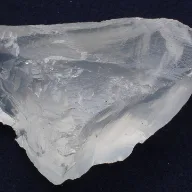 Petalite
The mineral lithium was discovered in, and it looks like nothing at all.
Cradle of Humankind stone
Ordinary grey chalcedony from an extraordinary place outside Johannesburg.
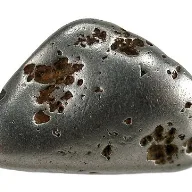 Platinum
Little silver, the Spanish called it, and threw it back in the river.
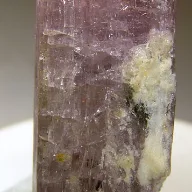 Scapolite
A tetragonal silicate that glows yellow under ultraviolet and fades in the sun.
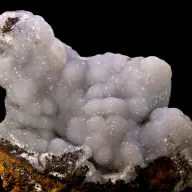 Smithsonite
Zinc carbonate in botryoidal crusts, named after the man who founded the Smithsonian.
Shiva lingam
A Narmada river cobble, ground by hand into an egg and sold as a sacred stone.
 Titanium
The ninth commonest element in the crust, and almost never found as a metal.
 Tremolite
The white amphibole that makes nephrite jade, and, in its fibrous form, asbestos.
 Zeolite
Minerals built like sponges at the atomic scale, which is why industry uses more of them than jewellers do.
 Diamond
Carbon, arranged the hard way, and carried up from two hundred kilometres down.