 Lunarya
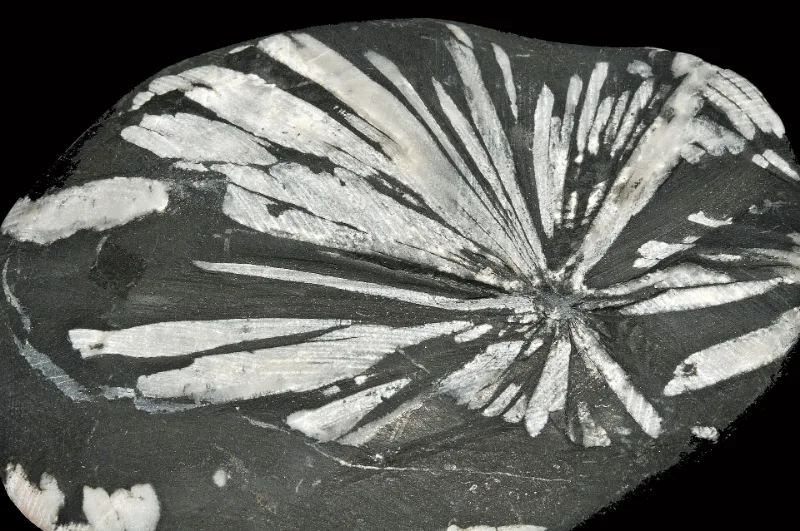
Chrysanthemum stone
Chrysanthemum stone is a dark limestone or shale in which sprays of pale crystals have grown outward from a point, so that a polished face shows what looks convincingly like a white chrysanthemum on black. The flowers are mineral, not biological: depending on the locality they are celestine, calcite, andalusite or feldspar, all of which will grow in radiating clusters given the room.
The Chinese material, which is most of what exists, comes from Permian rocks and its flowers are usually celestine — strontium sulfate — that crystallised in the sediment and was later partly replaced by calcite. The matrix is soft, 3 to 4, and so are the flowers, which means the whole stone is carved and polished rather than worn. Japanese chrysanthemum stone from Gifu has andalusite flowers in a harder hornfels. A slab is cut to put the best flower in the middle and the surface is often waxed.
In short
- Colour
- Dark
- Mineral
- A rock, not one mineral
- Formula
- CaCO₃ + SrSO₄
- Hardness
- 3–4 on the Mohs scale
- Crystal system
- None — it is a rock
- Found in
- Hunan and Hubei provinces in China, especially around Liuyang, supply nearly all of it. Japan has a long-known deposit in Gifu prefecture, protected as a natural monument. Smaller occurrences are reported from Canada and the United States.
- Element
- Earth
- Planet
- Venus
- Chakra
- Heart
- Handling
- Water and light are both fine
How it forms
Fine black mud settled on a quiet sea floor, rich in organic matter, which is why it is dark. As it was buried, strontium-bearing pore water became concentrated enough for celestine to crystallise, and because it nucleated at scattered points in a soft uniform sediment, it grew outward in all directions at once — the bladed habit of celestine turning that growth into petals. Later fluids replaced some of the celestine with calcite without disturbing the shape.
In human hands
Chinese scholars have collected and mounted viewing stones for well over a thousand years, and chrysanthemum stone belongs to that tradition rather than to the gem trade: a good specimen is cut, mounted on a carved wooden stand and looked at. The chrysanthemum is one of the four gentlemen of Chinese painting and the flower of autumn and of long life, which is most of why the stone is valued. It reached western crystal shops in the 1990s.
Varieties and trade names
- Liuyang stone
- The Hunan material, black matrix with white celestine flowers; the standard and the source of most slabs.
- Japanese chrysanthemum stone
- From Gifu, with andalusite flowers in hornfels; older, harder and now largely protected.
- Carved and mounted plaques
- Slabs cut to centre a flower and set on a fitted wooden stand, in the scholar's rock tradition.
- Enhanced stone
- Cheaper pieces where the matrix has been dyed blacker and the flowers whitened; common and easy to miss.
- Flower agate
- A different Malagasy stone with pale plume inclusions in chalcedony, sold under a similar idea.
Telling it from a fake
The flowers should be crystalline where they meet the matrix — under a loupe, blades with flat faces rather than a painted edge — and no two should be identical. Dye shows as a uniform black that sits in the pores and lifts onto a cotton bud with acetone, and as flowers that are too evenly white. A drop of vinegar will fizz on calcite matrix; celestine and andalusite will not. The stone is soft, so a needle marks the back of a genuine piece easily.
None of this needs a laboratory, and none of it is proof. A shop that will not say whether a stone is treated has answered the question; ask, and have the answer written on the receipt.
What it is said to do
The reading follows the flower and the season: something coming into bloom in its own time, patience with a slow process, and the Chinese associations of the chrysanthemum with autumn, retirement and long life. It is given to Venus, to Taurus and Libra, and to the heart. The Chinese tradition here is real and old, though it is a tradition of contemplation and painting rather than of crystal healing.
Living with it
Soft and often waxed, so treat it as a display piece. No water, no ultrasonic and no acids — vinegar, lemon and bathroom cleaners will etch a calcite matrix in seconds. Dust it with a soft dry brush, keep it out of direct sun if it has been dyed, and stand it where it cannot be knocked.
In magic
Chrysanthemum stone comes with a Chinese tradition of contemplation rather than spellwork: the chrysanthemum is the flower of autumn and long life, and the stones were collected as scholar's objects to look at. Modern practice uses it for patience with something that will bloom in its own time, and in workings for long life and calm. It is soft and often waxed, so no water or acids.
- Energy
- Receptive
- Day
- Friday
- Worked for
- Calm and peace · Change and letting go
More of this colour
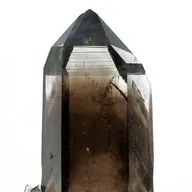 Smoky quartz
Quartz turned brown by the radioactivity of its own bedrock.
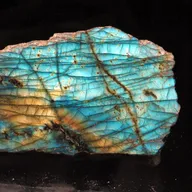 Labradorite
A dull grey stone until you turn it, and then it is peacock blue.
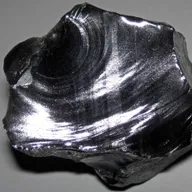 Obsidian
Volcanic glass with an edge finer than a surgical steel blade.
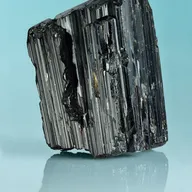 Black tourmaline
The stone that pulls ash out of a pipe when you warm it.
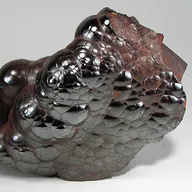 Hematite
Black as a mirror, and it leaves a blood-red line on anything you scratch it against.
Agni manitite
A black glass from Java, sold as a tektite; volcanic, as it turns out.
 Arfvedsonite
A black amphibole with a blue flash, named for the man who found lithium.
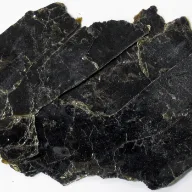 Biotite
Black mica: the flakes in every granite, and sheets big enough to roof a shed.
 Brookite
Titanium dioxide in its rarest shape: thin red-brown blades grown in Alpine cracks.
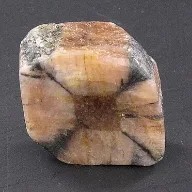 Chiastolite
An andalusite that grows a dark cross inside itself, and was sold for centuries as a Christian charm.
Columbianite
Colombian volcanic glass, sold as a tektite it is not.
 Graphite
Carbon in its soft form: the same element as diamond, stacked in sheets that slide.
 Aegirine
Black pyroxene needles from the strangest rocks on the planet.
 Hypersthene
A bronze-sheened pyroxene whose name the mineralogists retired.
 Fulgurite
Sand struck by lightning and fused, in a second, into hollow glass.
 Jet
Fossil driftwood, black and warm in the hand, and Victorian mourning.
Indigo gabbro
A Madagascan rock sold under a wizard name it was given in 2010.
 Larvikite
Norway's national rock, and the blue flash on half the shop fronts in Europe.
 Magnetite
The most magnetic mineral there is, and the first compass.
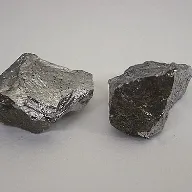 Manganese
The metal that makes steel tough, and that never occurs native.
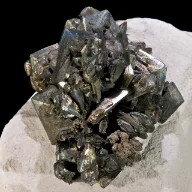 Marcasite
Pyrite's unstable twin, which eats itself in a damp drawer.
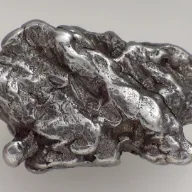 Campo del Cielo
An iron meteorite that fell on the Argentine Chaco four thousand years ago.
 Nuummite
Three-billion-year-old Greenlandic rock that flashes gold and copper.
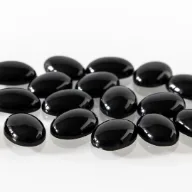 Onyx
Straight-banded chalcedony, and the black stone that is nearly always dyed.
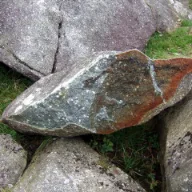 Preseli bluestone
The spotted dolerite of Stonehenge, from a Welsh hillside 250 kilometres away.
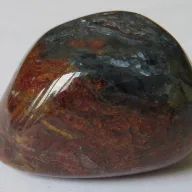 Pietersite
Tiger's eye smashed and cemented back together, so the light swirls.
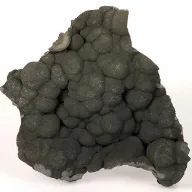 Psilomelane
A field name for the hard black manganese ores, kept alive by lapidaries.
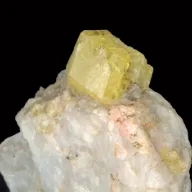 Rhodizite
A caesium borate as hard as topaz, and about as rare as minerals get.
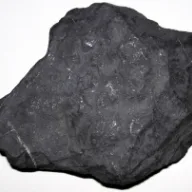 Shungite
Two-billion-year-old carbon rock from Karelia, and a great deal of nonsense.
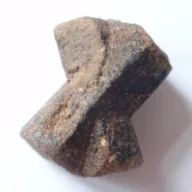 Staurolite
Two crystals grown through each other at sixty degrees, which comes out as a cross.
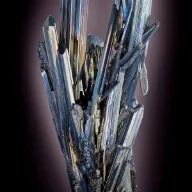 Stibnite
Steel-grey swords in a spray, soft enough to mark with a fingernail, and poisonous.
 Terahertz stone
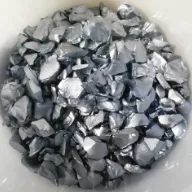
Furnace silicon, cut into beads and sold on a claim about radiation it does not emit.