 Lunarya
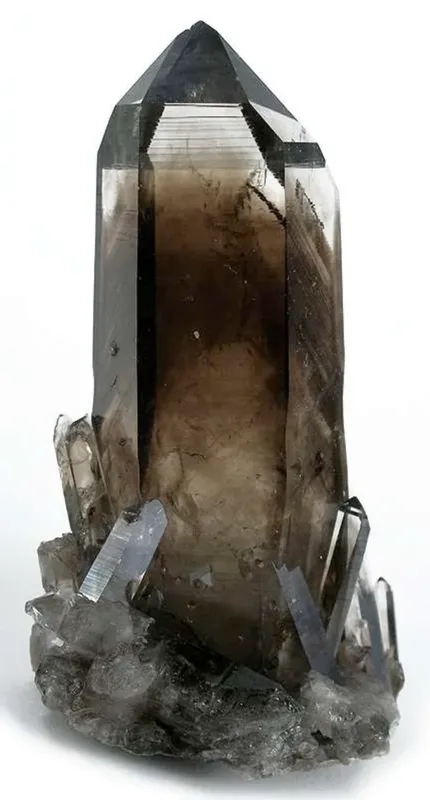
Smoky quartz
Smoky quartz is ordinary quartz whose colour comes from natural radiation: aluminium sits in the lattice in place of silicon, and radiation from the surrounding granite knocks an electron loose, leaving a colour centre that reads as smoke. The deepest, almost black form is called morion, and gentle heat drives the colour off again.
It is the national stone of Scotland, where the Cairngorm mountains gave their name to the yellow-brown Scottish variety set into dirk handles and brooches. Because it is so directly a product of granite, it is the commonest quartz in alpine clefts, and the great Swiss finds — cavities holding tonnes of dark crystals — are smoky. A good deal of very black "morion" in shops is irradiated in a reactor, which is the same process sped up.
In short
- Colour
- Dark
- Mineral
- Quartz
- Formula
- SiO₂
- Hardness
- 7 on the Mohs scale
- Crystal system
- Trigonal
- Found in
- Brazil, Madagascar, Switzerland, Scotland and Colorado.
- Element
- Earth
- Planet
- Saturn
- Chakra
- Root
- Handling
- Fades in sunlight
How it forms
Smoky quartz is quartz that grew with a trace of aluminium in place of silicon and then sat for a few million years next to something radioactive: the radiation knocks an electron loose at each aluminium and the crystal browns, all the way to black. It needs both the aluminium and the granite, so it is the quartz of granite country — the Cairngorms, the Swiss and Austrian Alps, Pikes Peak in Colorado, Brazil, Madagascar. Heat to a few hundred degrees bleaches it again, and a dose of radiation darkens it, which is why depth of colour says nothing about quality: a great deal of the black morion on sale was clear quartz a year ago.
In human hands
It is Scotland's stone. The cairngorms of the Highlands were picked off the plateau by hunters who camped up there for the season, and set in kilt pins, brooches, snuff mulls and the hilt of the sgian-dubh; Queen Victoria's Balmoral made the fashion national. In the Alps it is the prize of the strahler, the crystal hunter who climbs to clefts in the rock, and the finds of the last decades, groups of crystals weighing hundreds of kilos, fill the museums of Switzerland. Chinese judges are said to have worn smoky quartz lenses in the twelfth century, to keep their eyes to themselves.
Varieties and trade names
- Morion
- The black end, opaque or nearly; natural in a few places, and made from clear quartz by irradiation in many more.
- Cairngorm
- The yellow-brown Scottish kind, between smoky quartz and citrine, and the stone of Highland dress.
- Elestial
- A skeletal crystal with layered, stepped faces and hollows, from Brazil; a smoky quartz that grew fast and untidily.
- Champagne quartz
- A trade name for the pale end, where the smoke is only a tint.
Telling it from a fake
As a quartz it is told from glass the same way as any other, by bubbles, warmth and the scratch of a knife. The thing peculiar to it is the irradiated crystal: perfectly even, jet black, large and cheap, which is real quartz whose colour was made in a laboratory and which is sold as though it were not. Natural smoky quartz is uneven, darker at the tip, and often has a smoky phantom inside a clearer outer layer. Some smoky quartz is heated into the greenish-yellow sold as lemon quartz, and is then labelled citrine.
None of this needs a laboratory, and none of it is proof. A shop that will not say whether a stone is treated has answered the question; ask, and have the answer written on the receipt.
What it is said to do
The grounding stone: given for anxiety, for coming back down after something, and for putting a thing behind you. It is filed under Saturn, which in this tradition is the planet of limits, weight and getting on with it.
Living with it
As hard-wearing as any quartz and fine in water, but the colour fades in sunlight and disappears entirely with heat — never leave one in a car in summer.
In magic
Smoky quartz is the modern witch's grounding stone: held at the end of a ritual to come back down, set by the door to take the weight off a homecoming, and used in workings for putting something behind you, often as the moon wanes. Some practitioners keep it for protection as well. In Scotland, as cairngorm, it was set in kilt pins and dirk handles, which is as close as it comes to an older use. Keep it out of the sun and away from heat.
- Energy
- Receptive
- Day
- Saturday
- Worked for
- Grounding and endurance · Change and letting go · Protection
More of this colour
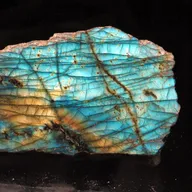 Labradorite
A dull grey stone until you turn it, and then it is peacock blue.
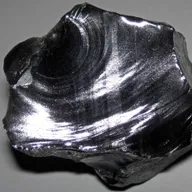 Obsidian
Volcanic glass with an edge finer than a surgical steel blade.
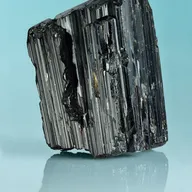 Black tourmaline
The stone that pulls ash out of a pipe when you warm it.
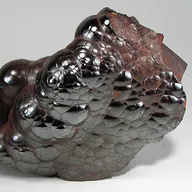 Hematite
Black as a mirror, and it leaves a blood-red line on anything you scratch it against.
Agni manitite
A black glass from Java, sold as a tektite; volcanic, as it turns out.
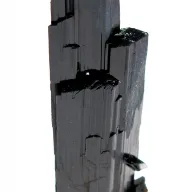 Arfvedsonite
A black amphibole with a blue flash, named for the man who found lithium.
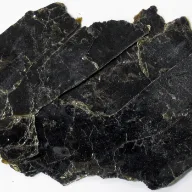 Biotite
Black mica: the flakes in every granite, and sheets big enough to roof a shed.
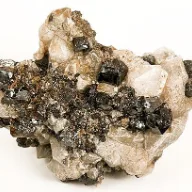 Brookite
Titanium dioxide in its rarest shape: thin red-brown blades grown in Alpine cracks.
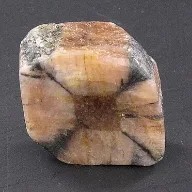 Chiastolite
An andalusite that grows a dark cross inside itself, and was sold for centuries as a Christian charm.
Columbianite
Colombian volcanic glass, sold as a tektite it is not.
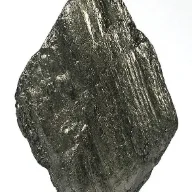 Graphite
Carbon in its soft form: the same element as diamond, stacked in sheets that slide.
 Aegirine
Black pyroxene needles from the strangest rocks on the planet.
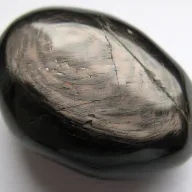 Hypersthene
A bronze-sheened pyroxene whose name the mineralogists retired.
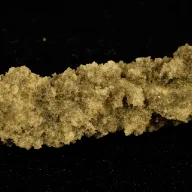 Fulgurite
Sand struck by lightning and fused, in a second, into hollow glass.
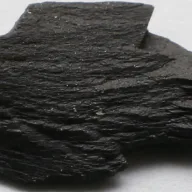 Jet
Fossil driftwood, black and warm in the hand, and Victorian mourning.
Indigo gabbro
A Madagascan rock sold under a wizard name it was given in 2010.
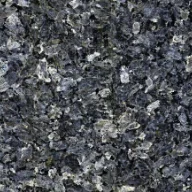 Larvikite
Norway's national rock, and the blue flash on half the shop fronts in Europe.
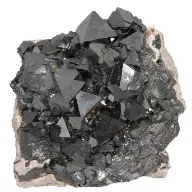 Magnetite
The most magnetic mineral there is, and the first compass.
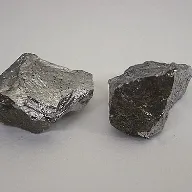 Manganese
The metal that makes steel tough, and that never occurs native.
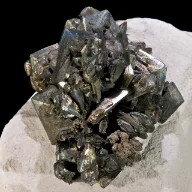 Marcasite
Pyrite's unstable twin, which eats itself in a damp drawer.
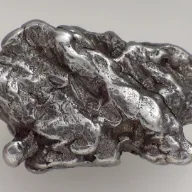 Campo del Cielo
An iron meteorite that fell on the Argentine Chaco four thousand years ago.
 Nuummite
Three-billion-year-old Greenlandic rock that flashes gold and copper.
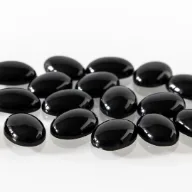 Onyx
Straight-banded chalcedony, and the black stone that is nearly always dyed.
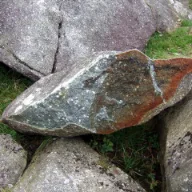 Preseli bluestone
The spotted dolerite of Stonehenge, from a Welsh hillside 250 kilometres away.
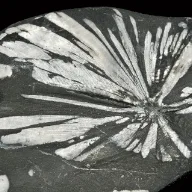 Chrysanthemum stone
Black rock with white mineral flowers that are not fossils.
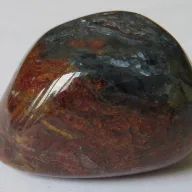 Pietersite
Tiger's eye smashed and cemented back together, so the light swirls.
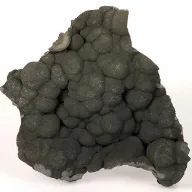 Psilomelane
A field name for the hard black manganese ores, kept alive by lapidaries.
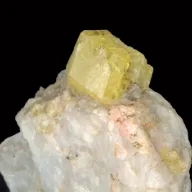 Rhodizite
A caesium borate as hard as topaz, and about as rare as minerals get.
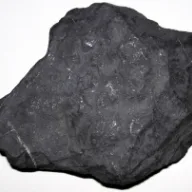 Shungite
Two-billion-year-old carbon rock from Karelia, and a great deal of nonsense.
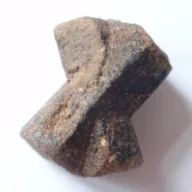 Staurolite
Two crystals grown through each other at sixty degrees, which comes out as a cross.
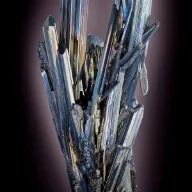 Stibnite
Steel-grey swords in a spray, soft enough to mark with a fingernail, and poisonous.
 Terahertz stone
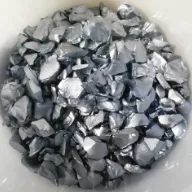
Furnace silicon, cut into beads and sold on a claim about radiation it does not emit.