 Lunarya
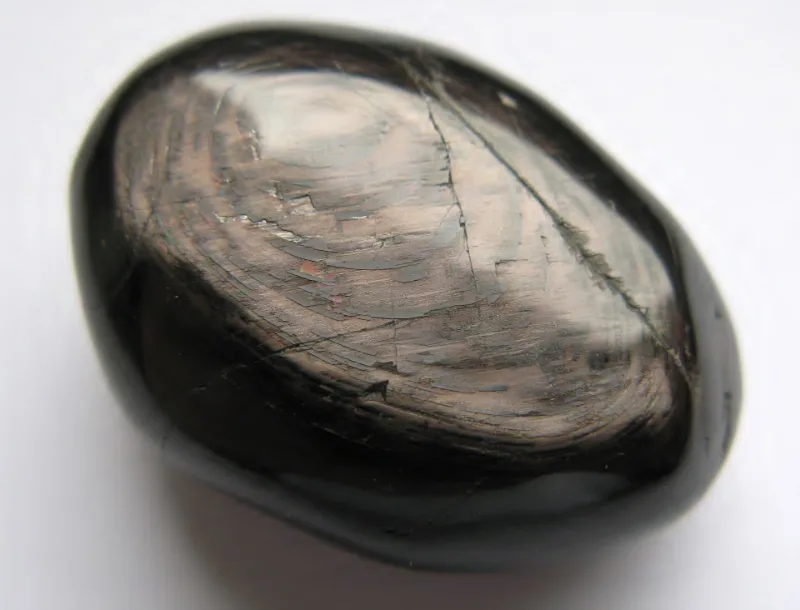
Hypersthene
Hypersthene is the old name for an orthopyroxene sitting about halfway between enstatite, the magnesium end, and ferrosilite, the iron end: (Mg,Fe)SiO₃. It is dark grey to black, and what makes it worth polishing is the schiller — a metallic bronze or coppery sheen that runs across the stone in one direction and vanishes when it is turned, thrown back by microscopic plates of iron oxide that separated out inside the crystal as it cooled.
The International Mineralogical Association discarded the name in 1988. What used to be hypersthene is now called enstatite or ferrosilite depending on which side of the halfway point its iron content falls, and the word survives on museum labels, in older textbooks and throughout the crystal trade. The schiller is the same effect that makes bronzite bronzy — bronzite is the more magnesian member of the same series, and the two stones are cousins in every sense. Like all pyroxenes it has two cleavages meeting at nearly ninety degrees.
In short
- Colour
- Dark
- Mineral
- Pyroxene
- Formula
- (Mg,Fe)SiO₃
- Hardness
- 5–6 on the Mohs scale
- Crystal system
- Orthorhombic
- Found in
- Labrador and Quebec in Canada, where it sits in the same anorthosites as labradorite; southern India, where charnockite is defined by it; Sri Lanka, Norway, Greenland, Finland, the Eifel in Germany, and the Bushveld complex in South Africa. Most tumbled material is Indian or Brazilian.
- Element
- Earth
- Planet
- Saturn
- Chakra
- Third eye
- Handling
- Water and light are both fine
How it forms
Orthopyroxene crystallises early and at high temperature from basaltic magma, so it is a rock-forming mineral of gabbro, norite and anorthosite — the deep crust rather than the surface. It also grows in granulites, the metamorphic rocks of the lower crust, which is why the charnockite of Tamil Nadu is full of it. The iron-oxide plates that give the sheen come out of solution inside the crystal on slow cooling, so the sheen is a record of how unhurried that cooling was.
In human hands
Haüy named it in 1804 from the Greek for over-strength, because it is a little harder than the hornblende it was being confused with. It has never had an industrial use of note. The tumbled stone entered the crystal trade in the 2000s, usually from India and often sold alongside labradorite, which is honest enough since the two are frequently cut from the same rock.
Varieties and trade names
- Indian hypersthene
- The tumbled trade stone, black with a strong bronze flash; from the charnockites of the south.
- Labradorite with hypersthene
- Canadian anorthosite where blue flash and bronze flash sit side by side in one slab.
- Bronzite
- The magnesium-rich member of the same series, browner and with a softer sheen; it has a page here.
- Enstatite
- The magnesian end member, pale green to brown, and the current name for much old hypersthene.
- Ferrosilite
- The iron end member, rare as a pure mineral and dark; the other name the 1988 decision left in place.
Telling it from a fake
Turn it in the light. A bronze sheen that appears along one direction and disappears along another is the mark; black tourmaline has no sheen at all, and obsidian has none either unless it is the sheen variety, which is silvery rather than bronze. Nuummite, which has a page of its own here, flashes in several colours from needle-shaped crystals rather than in one bronze plane. Labradorite flashes blue and is softer. A pyroxene also breaks on two flat cleavages at a right angle, which is visible on a chipped edge.
None of this needs a laboratory, and none of it is proof. A shop that will not say whether a stone is treated has answered the question; ask, and have the answer written on the receipt.
What it is said to do
The crystal literature calls it the magician stone and reads it as being about finding the way through a problem, about clear decisions and about saying no without a fuss. It is given to Saturn, to Scorpio and Capricorn, and to the third eye. Like most of the pyroxenes on this site, the reading is recent and takes its cue from the stone looking like a dark mirror.
Living with it
Water and sunlight are harmless. The cleavage is the weakness: a dropped tumble can split cleanly rather than chip, and the polished sheen dulls if it is stored loose with quartz or agate. Keep it wrapped or in its own compartment, and clean it with a cloth rather than a brush, which scratches the polish that the sheen depends on.
In magic
Hypersthene, sold as the magician stone, is used in modern practice for clear decisions and for saying no without a fuss: held before a hard conversation, or set on the altar in a working for a boundary. The reputation for magical skill it owes to its trade name alone. It is safe in water and light.
- Energy
- Receptive
- Day
- Saturday
- Worked for
- Study and clear thinking
More of this colour
 Smoky quartz
Quartz turned brown by the radioactivity of its own bedrock.
 Labradorite
A dull grey stone until you turn it, and then it is peacock blue.
 Obsidian
Volcanic glass with an edge finer than a surgical steel blade.
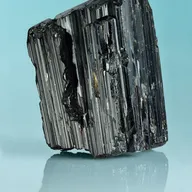 Black tourmaline
The stone that pulls ash out of a pipe when you warm it.
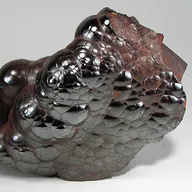 Hematite
Black as a mirror, and it leaves a blood-red line on anything you scratch it against.
Agni manitite
A black glass from Java, sold as a tektite; volcanic, as it turns out.
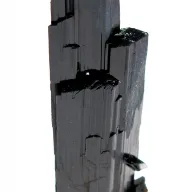 Arfvedsonite
A black amphibole with a blue flash, named for the man who found lithium.
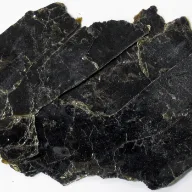 Biotite
Black mica: the flakes in every granite, and sheets big enough to roof a shed.
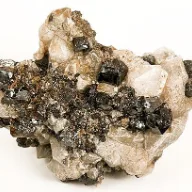 Brookite
Titanium dioxide in its rarest shape: thin red-brown blades grown in Alpine cracks.
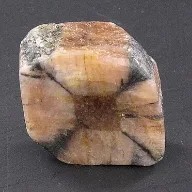 Chiastolite
An andalusite that grows a dark cross inside itself, and was sold for centuries as a Christian charm.
Columbianite
Colombian volcanic glass, sold as a tektite it is not.
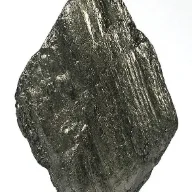 Graphite
Carbon in its soft form: the same element as diamond, stacked in sheets that slide.
 Aegirine
Black pyroxene needles from the strangest rocks on the planet.
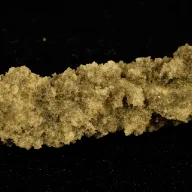 Fulgurite
Sand struck by lightning and fused, in a second, into hollow glass.
 Jet
Fossil driftwood, black and warm in the hand, and Victorian mourning.
Indigo gabbro
A Madagascan rock sold under a wizard name it was given in 2010.
 Larvikite
Norway's national rock, and the blue flash on half the shop fronts in Europe.
 Magnetite
The most magnetic mineral there is, and the first compass.
 Manganese
The metal that makes steel tough, and that never occurs native.
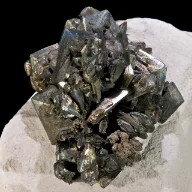 Marcasite
Pyrite's unstable twin, which eats itself in a damp drawer.
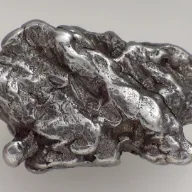 Campo del Cielo
An iron meteorite that fell on the Argentine Chaco four thousand years ago.
 Nuummite
Three-billion-year-old Greenlandic rock that flashes gold and copper.
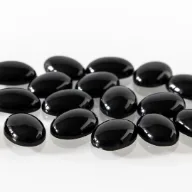 Onyx
Straight-banded chalcedony, and the black stone that is nearly always dyed.
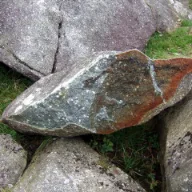 Preseli bluestone
The spotted dolerite of Stonehenge, from a Welsh hillside 250 kilometres away.
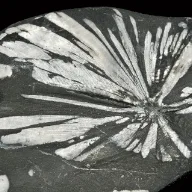 Chrysanthemum stone
Black rock with white mineral flowers that are not fossils.
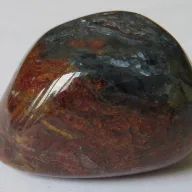 Pietersite
Tiger's eye smashed and cemented back together, so the light swirls.
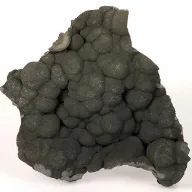 Psilomelane
A field name for the hard black manganese ores, kept alive by lapidaries.
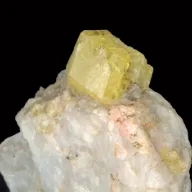 Rhodizite
A caesium borate as hard as topaz, and about as rare as minerals get.
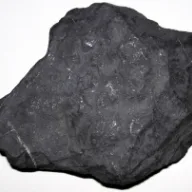 Shungite
Two-billion-year-old carbon rock from Karelia, and a great deal of nonsense.
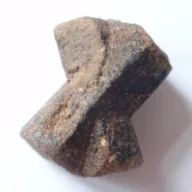 Staurolite
Two crystals grown through each other at sixty degrees, which comes out as a cross.
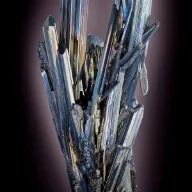 Stibnite
Steel-grey swords in a spray, soft enough to mark with a fingernail, and poisonous.
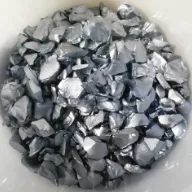 Terahertz stone
Furnace silicon, cut into beads and sold on a claim about radiation it does not emit.