 Lunarya
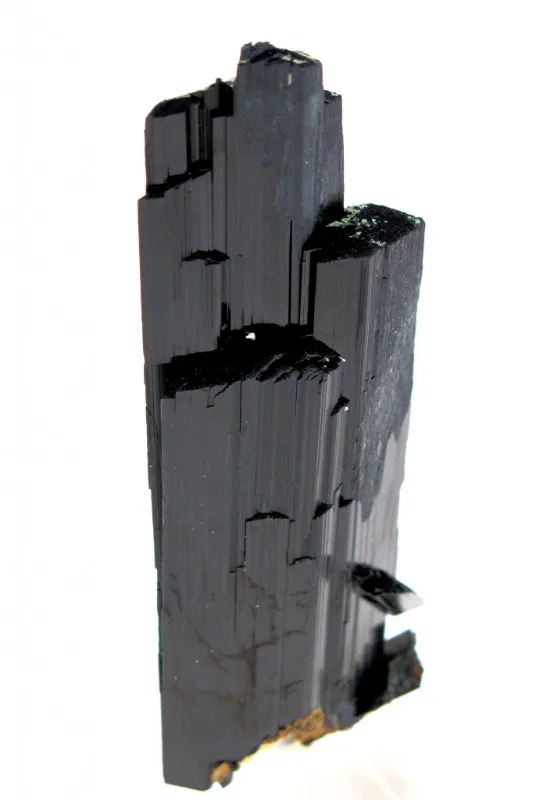
Arfvedsonite
Arfvedsonite is a sodium-iron amphibole, a black, bladed mineral of the unusual rocks that form when a magma runs out of aluminium before it runs out of alkali. In a polished piece it shows a blue or silver sheen along the blades, which is why it sells, and why it is so often mistaken for other black stones with a flash in them.
It was found on the coast of Greenland in 1823, in the great alkaline intrusion of Ilímaussaq that has given the world more new minerals than almost any other place, and named for Johan August Arfwedson, the Swedish chemist who had discovered lithium six years earlier. The crystals come from the syenites of Greenland, the Kola peninsula, Mont Saint-Hilaire in Quebec and Mount Malosa in Malawi; the polished stone in the shops comes from the same kind of rock in Russia and is usually sold under one of several wrong names.
In short
- Colour
- Dark
- Mineral
- Amphibole
- Formula
- Na₃(Fe²⁺₄Fe³⁺)Si₈O₂₂(OH)₂
- Hardness
- 5–6 on the Mohs scale
- Crystal system
- Monoclinic
- Found in
- Greenland (Ilímaussaq), Russia (the Kola peninsula), Quebec (Mont Saint-Hilaire), Malawi, Norway.
- Element
- Air
- Planet
- Neptune
- Chakra
- Third eye
- Handling
- Water and light are both fine
How it forms
Most magmas have more aluminium than alkali, and their feldspars use up both. A few — the peralkaline ones, rich in sodium and poor in aluminium — are left with sodium to spare, and the spare sodium goes into minerals nobody else has: aegirine, eudialyte, and arfvedsonite, which takes it with iron. These magmas make the nepheline syenites and alkali granites of a handful of places on earth, and arfvedsonite grows in them as black prisms and radiating blades, sometimes in a felt that gives a polished slab its sheen. The flash is light reflected off the cleavage of thousands of small blades lying in one direction.
In human hands
The English mineralogist Henry James Brooke named it in 1823 from specimens sent home from Greenland, and arfvedsonite was one of the first of the two hundred minerals the place has produced since; the naming honoured Arfwedson, who had found lithium in petalite in 1817 and never got a mineral of his own until then. Mont Saint-Hilaire, a quarry in a hill outside Montreal, gave the best crystals in the 1970s and 1980s, and Malawi in the 2000s. The polished stone is a creature of the Russian mineral trade of the 1990s, when slabs of arfvedsonite-rich syenite from Kola came west and acquired trade names.
Varieties and trade names
- Crystals
- Black prisms from Greenland, Quebec and Malawi, sharp-edged and lustrous, for collectors rather than shops.
- Polished arfvedsonite
- Slabs and tumbles of the Russian syenite, black with blue and silver flashes, sold as a stone in its own right.
- 'Astrophyllite' arfvedsonite
- The same Russian material sold under the name of a golden mineral it sometimes contains, and often does not.
- 'Nuummite' arfvedsonite
- Sold as the Greenland stone it resembles; nuummite is older, rarer and flashes gold, and this flashes blue.
Telling it from a fake
Three black stones with a flash in them get sold as each other, and telling them apart is the whole game. Arfvedsonite flashes blue and silver from long straight blades; nuummite flashes gold and bronze from a finer, more tangled weave and costs several times as much; astrophyllite shows golden star-shaped sprays in a dark ground, and the polished slabs that mix the two are usually mostly arfvedsonite. A knife scratches none of them easily. Black tourmaline has no flash at all, and hematite is far heavier. Buy it as arfvedsonite and the price will be honest; buy it as nuummite and it may not be.
None of this needs a laboratory, and none of it is proof. A shop that will not say whether a stone is treated has answered the question; ask, and have the answer written on the receipt.
What it is said to do
A recent tradition, made in the shops that sell it: the stone of the night sky, on the strength of the blue flash, given for seeing a way through and for the reorganising that follows a decision. It is filed under Pisces in the lists that file it at all, and read as a stone for moving on, with the past put down.
Living with it
Wash it in water and dry it, since the iron can stain if left wet; keep the polished pieces from knocks, because the blades cleave. The crystals are for a shelf.
In magic
Arfvedsonite has no older magic. Modern practice uses it, for the blue flash in its black, as a stone of the night sky: for finding a way through, for moving on after a decision, and in workings done under the stars. It is safe in water, though the iron in it can stain if it is left wet.
- Energy
- Projective
- Day
- Thursday
- Worked for
- Change and letting go · Divination and intuition
More of this colour
 Smoky quartz
Quartz turned brown by the radioactivity of its own bedrock.
 Labradorite
A dull grey stone until you turn it, and then it is peacock blue.
 Obsidian
Volcanic glass with an edge finer than a surgical steel blade.
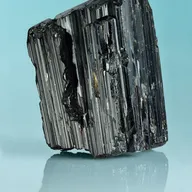 Black tourmaline
The stone that pulls ash out of a pipe when you warm it.
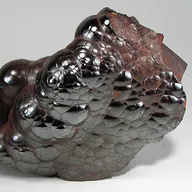 Hematite
Black as a mirror, and it leaves a blood-red line on anything you scratch it against.
Agni manitite
A black glass from Java, sold as a tektite; volcanic, as it turns out.
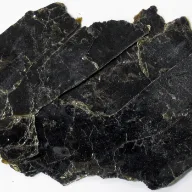 Biotite
Black mica: the flakes in every granite, and sheets big enough to roof a shed.
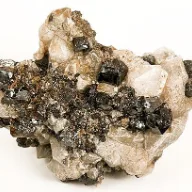 Brookite
Titanium dioxide in its rarest shape: thin red-brown blades grown in Alpine cracks.
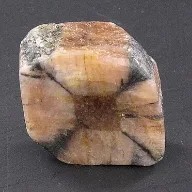 Chiastolite
An andalusite that grows a dark cross inside itself, and was sold for centuries as a Christian charm.
Columbianite
Colombian volcanic glass, sold as a tektite it is not.
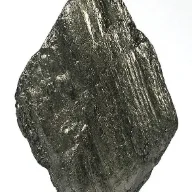 Graphite
Carbon in its soft form: the same element as diamond, stacked in sheets that slide.
 Aegirine
Black pyroxene needles from the strangest rocks on the planet.
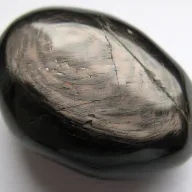 Hypersthene
A bronze-sheened pyroxene whose name the mineralogists retired.
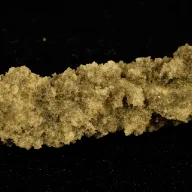 Fulgurite
Sand struck by lightning and fused, in a second, into hollow glass.
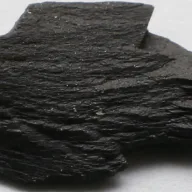 Jet
Fossil driftwood, black and warm in the hand, and Victorian mourning.
Indigo gabbro
A Madagascan rock sold under a wizard name it was given in 2010.
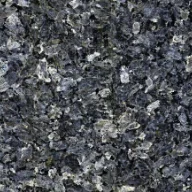 Larvikite
Norway's national rock, and the blue flash on half the shop fronts in Europe.
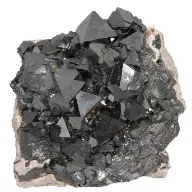 Magnetite
The most magnetic mineral there is, and the first compass.
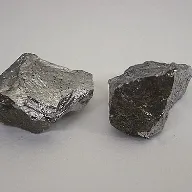 Manganese
The metal that makes steel tough, and that never occurs native.
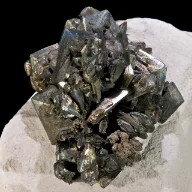 Marcasite
Pyrite's unstable twin, which eats itself in a damp drawer.
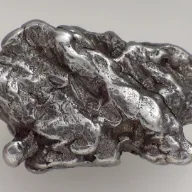 Campo del Cielo
An iron meteorite that fell on the Argentine Chaco four thousand years ago.
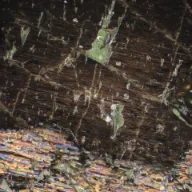 Nuummite
Three-billion-year-old Greenlandic rock that flashes gold and copper.
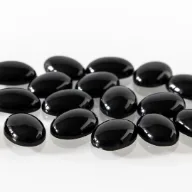 Onyx
Straight-banded chalcedony, and the black stone that is nearly always dyed.
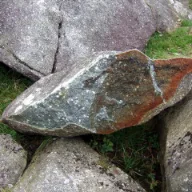 Preseli bluestone
The spotted dolerite of Stonehenge, from a Welsh hillside 250 kilometres away.
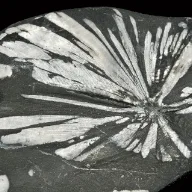 Chrysanthemum stone
Black rock with white mineral flowers that are not fossils.
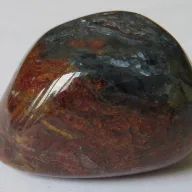 Pietersite
Tiger's eye smashed and cemented back together, so the light swirls.
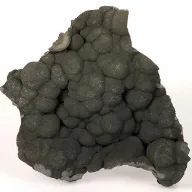 Psilomelane
A field name for the hard black manganese ores, kept alive by lapidaries.
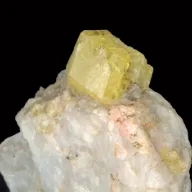 Rhodizite
A caesium borate as hard as topaz, and about as rare as minerals get.
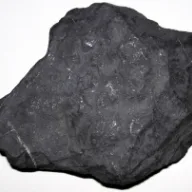 Shungite
Two-billion-year-old carbon rock from Karelia, and a great deal of nonsense.
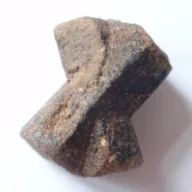 Staurolite
Two crystals grown through each other at sixty degrees, which comes out as a cross.
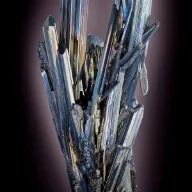 Stibnite
Steel-grey swords in a spray, soft enough to mark with a fingernail, and poisonous.
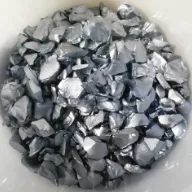 Terahertz stone
Furnace silicon, cut into beads and sold on a claim about radiation it does not emit.