 Lunarya
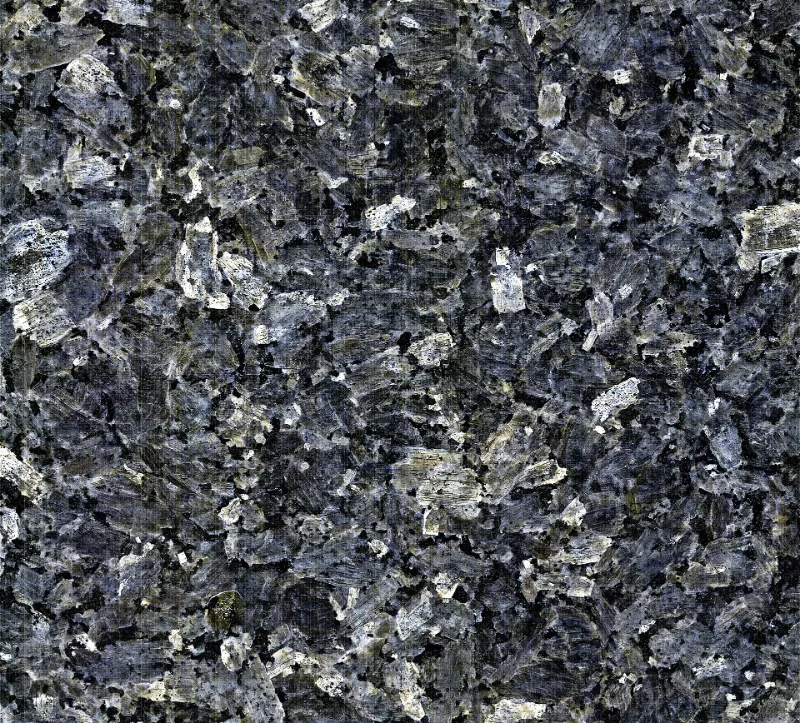
Larvikite
Larvikite is a rock, not a mineral: a coarse monzonite made almost entirely of feldspar, with pyroxene, amphibole, biotite and a little magnetite between the grains. Polished, the feldspars flash silver-blue as the light moves across them, each crystal lighting separately, and a slab of it looks like a night sky seen through frost. It takes its name from the town of Larvik in Vestfold, where it is quarried.
The flash is called schiller and it works the way labradorite's does: the feldspar unmixed as it cooled into microscopically thin alternating layers, and light bouncing between those layers interferes with itself and comes back blue. Larvikite's feldspar is a ternary one, carrying sodium, potassium and calcium at once, which is unusual and is why the rock has a name of its own. It is hard-wearing at 6 to 6.5, it takes a mirror polish, and it has been the world's default dark facing stone for a century — sold as Blue Pearl and Emerald Pearl.
In short
- Colour
- Dark
- Mineral
- A rock, not one mineral
- Formula
- (Na,K)AlSi₃O₈ + (Mg,Fe)SiO₃
- Hardness
- 6–6.5 on the Mohs scale
- Crystal system
- None — it is a rock
- Found in
- The Larvik batholith in southern Norway, a body of rock about 290 million years old that formed in the Oslo Rift. The quarries around Larvik and Tvedalen supply the world; nothing else quite like it is worked anywhere. Norway named it the national rock in 2008.
- Element
- Water
- Planet
- Neptune
- Chakra
- Third eye
- Handling
- Water and light are both fine
How it forms
The Oslo Rift tore the crust apart in the early Permian, and magma pooled in chambers below the surface. Larvikite crystallised slowly in one of those chambers, slowly enough for feldspar crystals a centimetre or more across to grow and pack against one another. As the rock cooled further, each of those crystals unmixed internally into the fine layers that make the flash, so the schiller is a record of the last, slowest part of the cooling.
In human hands
Quarried since the 1880s, and in the building trade almost immediately: Blue Pearl went into bank fronts, station facings, shop surrounds and gravestones across Europe and North America, and the odds are good that a dark, sparkling shop front on a nineteenth-century street is Norwegian. The crystal trade came to it much later, in the 2000s, and sells it tumbled and as spheres under the name black moonstone, which it is not, or as falcon eye, which it also is not.
Varieties and trade names
- Blue Pearl
- The commercial grade with the strongest blue flash; the stone most building fronts are faced in.
- Emerald Pearl
- A darker, greener variant from a different part of the batholith, with a colder sheen.
- Tumbled larvikite
- The crystal trade's version, often mislabelled black moonstone; the flash survives tumbling well.
- Labradorite
- The single mineral that gives larvikite its flash, and a far more colourful stone on its own; it has a page here.
- Indigo gabbro
- The Malagasy rock sold as mystic merlinite: the same idea in a different rock, and it has a page here too.
Telling it from a fake
Look for the grain. Larvikite is crystals a few millimetres to a centimetre across, packed together with no banding, and the flash comes from individual crystals rather than the whole face at once — tilt it and the blue moves from grain to grain. Labradorite flashes across a whole cleavage plane in a sheet. Black granite has no flash. Glass imitations flash from a coating rather than from inside.
None of this needs a laboratory, and none of it is proof. A shop that will not say whether a stone is treated has answered the question; ask, and have the answer written on the receipt.
What it is said to do
The crystal trade reads it as a stone of patience and of seeing what is really there, which is a reasonable thing to say about a rock that is 290 million years old and shows one thing from one angle and another from the next. It is given to Neptune, to Scorpio and Aquarius, and to the third eye. None of this is Norwegian folklore; the associations are recent and were built on labradorite's.
Living with it
As robust as stone gets. Water, sunlight, heat and daily handling do nothing to it, which is why it is used outdoors on buildings. The polish scratches like any polish, so keep a tumbled piece away from quartz, and that is the whole of the care.
In magic
Larvikite is used in modern practice for seeing what is really there, and for grounding: a palm stone held in meditation, a slab on the altar under the candles. It is Norway's national rock and faces banks and petrol stations across Europe, which practitioners take as proof of how well it holds. Nothing in a ritual can hurt it.
- Energy
- Receptive
- Day
- Thursday
- Worked for
- Study and clear thinking · Grounding and endurance
More of this colour
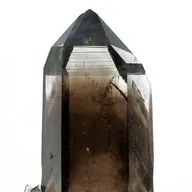 Smoky quartz
Quartz turned brown by the radioactivity of its own bedrock.
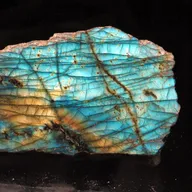 Labradorite
A dull grey stone until you turn it, and then it is peacock blue.
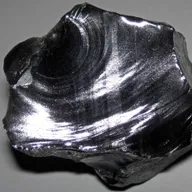 Obsidian
Volcanic glass with an edge finer than a surgical steel blade.
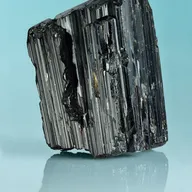 Black tourmaline
The stone that pulls ash out of a pipe when you warm it.
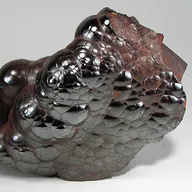 Hematite
Black as a mirror, and it leaves a blood-red line on anything you scratch it against.
Agni manitite
A black glass from Java, sold as a tektite; volcanic, as it turns out.
 Arfvedsonite
A black amphibole with a blue flash, named for the man who found lithium.
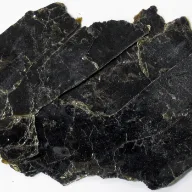 Biotite
Black mica: the flakes in every granite, and sheets big enough to roof a shed.
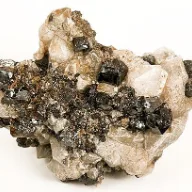 Brookite
Titanium dioxide in its rarest shape: thin red-brown blades grown in Alpine cracks.
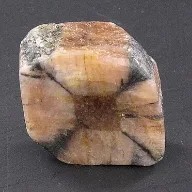 Chiastolite
An andalusite that grows a dark cross inside itself, and was sold for centuries as a Christian charm.
Columbianite
Colombian volcanic glass, sold as a tektite it is not.
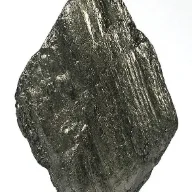 Graphite
Carbon in its soft form: the same element as diamond, stacked in sheets that slide.
 Aegirine
Black pyroxene needles from the strangest rocks on the planet.
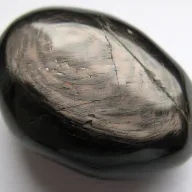 Hypersthene
A bronze-sheened pyroxene whose name the mineralogists retired.
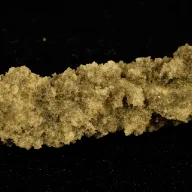 Fulgurite
Sand struck by lightning and fused, in a second, into hollow glass.
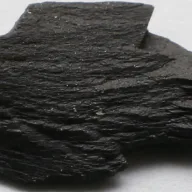 Jet
Fossil driftwood, black and warm in the hand, and Victorian mourning.
Indigo gabbro
A Madagascan rock sold under a wizard name it was given in 2010.
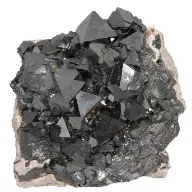 Magnetite
The most magnetic mineral there is, and the first compass.
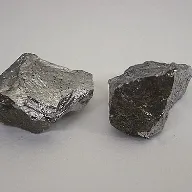 Manganese
The metal that makes steel tough, and that never occurs native.
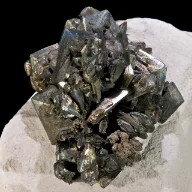 Marcasite
Pyrite's unstable twin, which eats itself in a damp drawer.
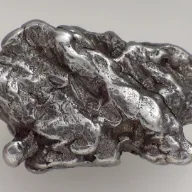 Campo del Cielo
An iron meteorite that fell on the Argentine Chaco four thousand years ago.
 Nuummite
Three-billion-year-old Greenlandic rock that flashes gold and copper.
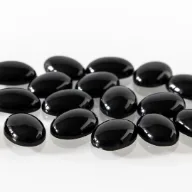 Onyx
Straight-banded chalcedony, and the black stone that is nearly always dyed.
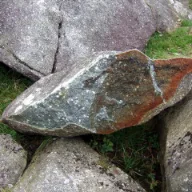 Preseli bluestone
The spotted dolerite of Stonehenge, from a Welsh hillside 250 kilometres away.
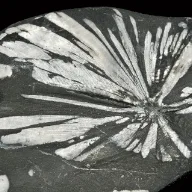 Chrysanthemum stone
Black rock with white mineral flowers that are not fossils.
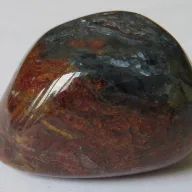 Pietersite
Tiger's eye smashed and cemented back together, so the light swirls.
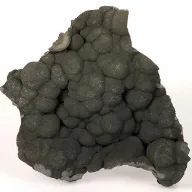 Psilomelane
A field name for the hard black manganese ores, kept alive by lapidaries.
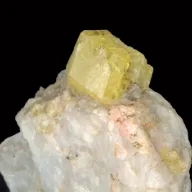 Rhodizite
A caesium borate as hard as topaz, and about as rare as minerals get.
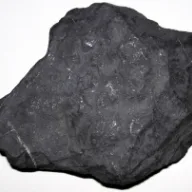 Shungite
Two-billion-year-old carbon rock from Karelia, and a great deal of nonsense.
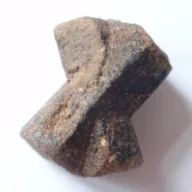 Staurolite
Two crystals grown through each other at sixty degrees, which comes out as a cross.
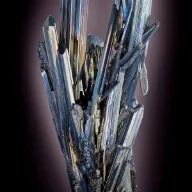 Stibnite
Steel-grey swords in a spray, soft enough to mark with a fingernail, and poisonous.
 Terahertz stone
Furnace silicon, cut into beads and sold on a claim about radiation it does not emit.