 Lunarya
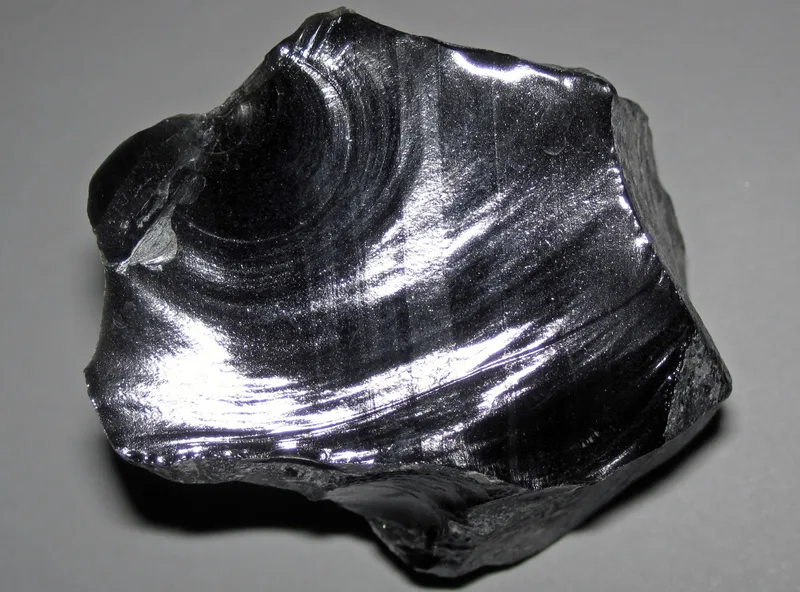
Obsidian
Obsidian is not a mineral at all: it is lava that cooled too fast to crystallise, so it has no internal structure, only glass. That is why it breaks in those smooth curved conchoidal flakes, and why the edge of a fresh flake can come down to a few nanometres — far finer than anything that can be ground into steel.
People have been making blades from it for the better part of a million years, and because each volcano's glass has its own chemical fingerprint, archaeologists can trace a flake found in one place back to the exact flow it came from, which has mapped prehistoric trade across whole seas. The Aztec macuahuitl was obsidian set into wood, and modern surgeons have occasionally used obsidian scalpels for the quality of the scar. Glass slowly devitrifies, so obsidian more than a few tens of millions of years old is rare, and none is known from before the Cretaceous. The snowflakes in snowflake obsidian are spherulites — the first crystals, starting to form after all.
In short
- Colour
- Dark
- Mineral
- Volcanic glass
- Formula
- SiO₂
- Hardness
- 5–5.5 on the Mohs scale
- Crystal system
- None — it is a glass
- Found in
- Mexico, the American West, Iceland, Turkey, Armenia and Italy (Lipari).
- Element
- Earth
- Planet
- Pluto
- Chakra
- Root
- Handling
- Water and light are both fine
How it forms
Obsidian is silica-rich lava that cooled too fast for crystals, on the edges of rhyolite flows and domes — Newberry and Glass Buttes in Oregon, Obsidian Cliff in Yellowstone, the Sierra de Pachuca in Mexico, Lipari, Milos, Iceland, Armenia, Anatolia. Black comes from iron and magnesium in specks too small to see, mahogany from hematite, the gold and silver sheens from layers of gas bubbles, the rainbow from layers of magnetite finer still, and the snowflakes from the first crystals starting to form. Given time, glass always crystallises, so old obsidian is rare — none is known from before the Cretaceous — and in wet climates it lasts far less.
In human hands
Hand axes of obsidian were being made in Kenya seven hundred thousand years ago, and the world's oldest mirrors, polished discs from Çatalhöyük in Anatolia, are eight thousand years old. Because every volcano's glass has its own chemical signature, a flake can be traced to the flow it came from, and since the 1960s that has mapped Neolithic trade across the Mediterranean and the Pacific. The Aztecs edged their swords with it and mirrored their god Tezcatlipoca in it; the black mirror that John Dee used to call spirits, now in the British Museum, was shown in 2021 to be Aztec glass from Pachuca. Surgeons have used obsidian scalpels for the quality of the scar.
Varieties and trade names
- Black obsidian
- The plain glass, with nothing in it but iron enough to stop the light; the commonest kind and the one knapped into blades for most of human prehistory.
- Snowflake obsidian
- Black glass with grey-white rosettes of cristobalite in it: the crystals it would all become, given a few million years.
- Mahogany obsidian
- Black swirled with red-brown, from hematite in the flow; Mexico and the American West.
- Silver sheen obsidian
- A misty silver-grey flash across the whole surface, thrown back by a layer of microscopic gas bubbles frozen into the flow.
- Gold sheen obsidian
- The same effect in warm gold, from bubbles with a thin film of iron on them; Mexico produces nearly all of it.
- Rainbow obsidian
- Bands of green, violet and bronze at one angle only, from nanometre-thin layers of magnetite crystals aligned by the flowing lava.
- Apache tears
- Rounded nodules weathered out of perlite in Arizona, black in the hand and smoky brown against the light.
Telling it from a fake
Manufactured glass, including a great deal of what is sold as obsidian, is either too clear or has round bubbles; natural obsidian is faintly translucent at a thin edge, with a grey-brown or olive cast, and under a loupe shows streams of tiny crystallites and stretched, not round, bubbles, following the flow. Clear blue, green or red obsidian is bottle glass — there is a natural green from Pachuca, but it is a dull olive. Sheen, rainbow, snowflake and mahogany are all natural. A bag of obsidian arrowheads from a tourist shop is usually knapped glass, and gives itself away by being uniform.
None of this needs a laboratory, and none of it is proof. A shop that will not say whether a stone is treated has answered the question; ask, and have the answer written on the receipt.
What it is said to do
The unflinching stone: traditionally a mirror and a shield, and in the modern reading a stone that shows you the thing you have been avoiding rather than comforting you about it. The Aztecs polished it into the mirrors of Tezcatlipoca, whose name means smoking mirror.
Living with it
Safe in water, but brittle — a dropped piece can break into genuinely sharp flakes, so sweep, do not wipe. Raw knapped edges are as dangerous as they sound and are not for handling.
In magic
Obsidian is the scryer's black mirror. The Aztecs polished it into mirrors for divination, sacred to Tezcatlipoca, the smoking mirror, and one of them ended up with John Dee, Elizabeth I's astrologer and magician; it is now in the British Museum. Modern practice keeps obsidian for scrying, for protection and for facing what one would rather not. Its flakes are razor-sharp, so a broken piece is cleared away, not kept on the altar.
- Energy
- Receptive
- Day
- Tuesday
- Worked for
- Divination and intuition · Protection
More of this colour
 Smoky quartz
Quartz turned brown by the radioactivity of its own bedrock.
 Labradorite
A dull grey stone until you turn it, and then it is peacock blue.
 Black tourmaline
The stone that pulls ash out of a pipe when you warm it.
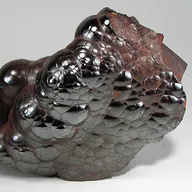 Hematite
Black as a mirror, and it leaves a blood-red line on anything you scratch it against.
Agni manitite
A black glass from Java, sold as a tektite; volcanic, as it turns out.
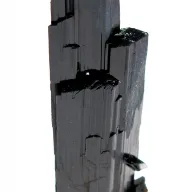 Arfvedsonite
A black amphibole with a blue flash, named for the man who found lithium.
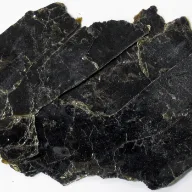 Biotite
Black mica: the flakes in every granite, and sheets big enough to roof a shed.
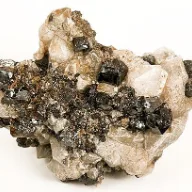 Brookite
Titanium dioxide in its rarest shape: thin red-brown blades grown in Alpine cracks.
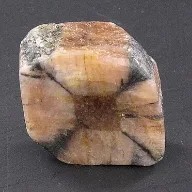 Chiastolite
An andalusite that grows a dark cross inside itself, and was sold for centuries as a Christian charm.
Columbianite
Colombian volcanic glass, sold as a tektite it is not.
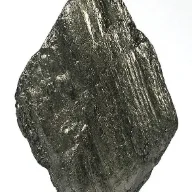 Graphite
Carbon in its soft form: the same element as diamond, stacked in sheets that slide.
 Aegirine
Black pyroxene needles from the strangest rocks on the planet.
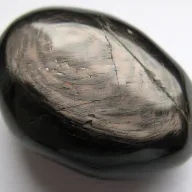 Hypersthene
A bronze-sheened pyroxene whose name the mineralogists retired.
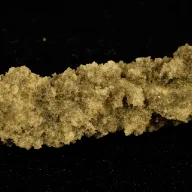 Fulgurite
Sand struck by lightning and fused, in a second, into hollow glass.
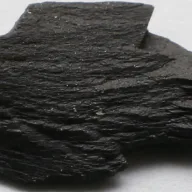 Jet
Fossil driftwood, black and warm in the hand, and Victorian mourning.
Indigo gabbro
A Madagascan rock sold under a wizard name it was given in 2010.
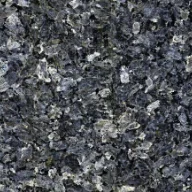 Larvikite
Norway's national rock, and the blue flash on half the shop fronts in Europe.
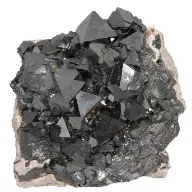 Magnetite
The most magnetic mineral there is, and the first compass.
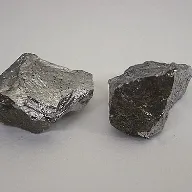 Manganese
The metal that makes steel tough, and that never occurs native.
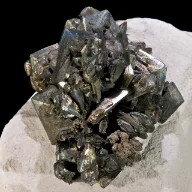 Marcasite
Pyrite's unstable twin, which eats itself in a damp drawer.
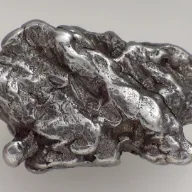 Campo del Cielo
An iron meteorite that fell on the Argentine Chaco four thousand years ago.
 Nuummite
Three-billion-year-old Greenlandic rock that flashes gold and copper.
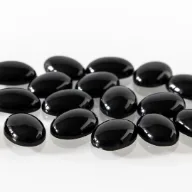 Onyx
Straight-banded chalcedony, and the black stone that is nearly always dyed.
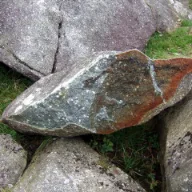 Preseli bluestone
The spotted dolerite of Stonehenge, from a Welsh hillside 250 kilometres away.
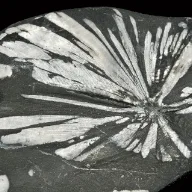 Chrysanthemum stone
Black rock with white mineral flowers that are not fossils.
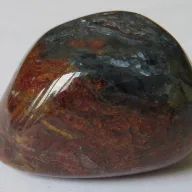 Pietersite
Tiger's eye smashed and cemented back together, so the light swirls.
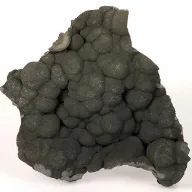 Psilomelane
A field name for the hard black manganese ores, kept alive by lapidaries.
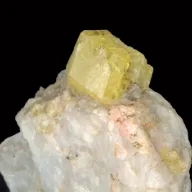 Rhodizite
A caesium borate as hard as topaz, and about as rare as minerals get.
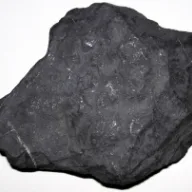 Shungite
Two-billion-year-old carbon rock from Karelia, and a great deal of nonsense.
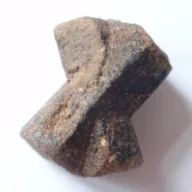 Staurolite
Two crystals grown through each other at sixty degrees, which comes out as a cross.
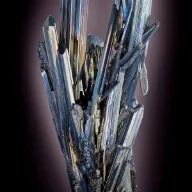 Stibnite
Steel-grey swords in a spray, soft enough to mark with a fingernail, and poisonous.
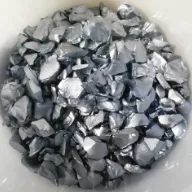 Terahertz stone
Furnace silicon, cut into beads and sold on a claim about radiation it does not emit.