 Lunarya
Agni manitite
Agni manitite is a dark, glassy stone dug from the soil of Java, in Indonesia, and sold since the 2010s as the pearl of fire — a tektite, a fragment of the earth's crust melted and flung into the sky by a meteorite. Hold it to a lamp and the black turns a smoky grey-brown, which is what tells you it is glass and not an ordinary pebble.
The romance did not survive the laboratory. Analyses published in 2022 — scanning electron microscopy and X-ray diffraction on pieces bought as agni manitite — found ordinary obsidian: silica with alumina, iron, magnesium, calcium and potassium in the proportions a volcano leaves, and none of the signature of a meteorite impact. The stone is real and natural; only the story was borrowed. The name is Sanskrit, agni mani, jewel of fire, and it is sold under it, and as cintamani, whatever the analysis says.
In short
- Colour
- Dark
- Mineral
- Volcanic glass
- Formula
- SiO₂
- Hardness
- 5.5–6 on the Mohs scale
- Crystal system
- None — it is a glass
- Found in
- Java, Indonesia; nowhere else under this name.
- Element
- Fire
- Planet
- Mars
- Chakra
- Solar plexus
- Handling
- Water and light are both fine
How it forms
Obsidian forms when lava rich in silica cools so fast that no crystals have time to grow, and the melt sets as a glass. Java sits on one of the most active volcanic arcs on earth, and a violent eruption can throw molten rock high into the air, where the pieces cool in flight and rain down as blobs and drops with a rough, pitted skin. That is what these are, and it is why they look so much like tektites, which are glass made the same way from a different kind of heat. A tektite is dry glass melted by an impact; agni manitite holds the water a volcanic melt does, and it is the water that gives it away.
In human hands
It has no history to speak of before about 2012, when pieces began to appear on the mineral fairs of Europe and America out of Indonesia, with the name and the meteorite story attached. It rode the vogue for tektites — moldavite from Bohemia, the golden glass of the Libyan desert, the black indochinites of the same region — as the new and rarer one, and was sold as a pseudotektite even by dealers who suspected otherwise, until the 2022 papers settled it. The story of the cintamani, the wish-granting jewel of Hindu and Buddhist legend, was attached along the way, on no better grounds than the colour of the stone and the country it came from.
Varieties and trade names
- Raw drops
- The stone as it is dug: black, pitted, rounded by its flight through the air and the centuries in the ground.
- Translucent grade
- Pieces thin or clear enough to glow amber-grey against a lamp, which sell for more; the colour is the same glass, thinner.
- Polished cabochons
- Cut and domed, when it looks like any other dark obsidian and is worth what obsidian is worth.
- Cintamani
- The same stone under the name of the legendary jewel, sold at a higher price for the legend.
Telling it from a fake
It is obsidian, so the checks are obsidian's: it breaks in curved shells with sharp edges, it is warm in the hand compared with quartz, and a lamp behind it shows smoky brown rather than the bottle green of moldavite. A tektite of the same colour would be drier, denser and more evenly pitted. The fraud to watch for is not an imitation but a substitution — any black obsidian from anywhere can be sold under this name, and there is no test short of a laboratory that tells Javanese glass from Mexican. Buy it as a pretty volcanic glass and the price will be right.
None of this needs a laboratory, and none of it is proof. A shop that will not say whether a stone is treated has answered the question; ask, and have the answer written on the receipt.
What it is said to do
New enough that its tradition was written by the people selling it: a stone of fire, on the strength of the name, for will, appetite and starting things, and of a kind of quick, impatient courage. The cintamani story lends it wish-granting, which the stone would be the first to disown.
Living with it
Wash it in water, keep it from the edges of harder stones, and enjoy it for what it is. It needs no more care than a bottle.
In magic
Agni manitite reached the craft in the 2000s with a fiery name and a borrowed legend, that of the cintamani, the wish-fulfilling jewel of Hindu and Buddhist tradition. Practitioners use it for will, drive and starting things, beside a red candle on a Tuesday. As a glass it is safe in water and light, and chips at a knock.
- Energy
- Projective
- Day
- Tuesday
- Worked for
- Courage and drive
More of this colour
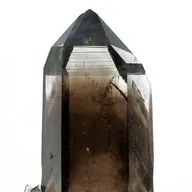 Smoky quartz
Quartz turned brown by the radioactivity of its own bedrock.
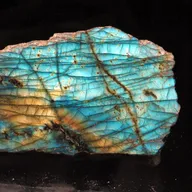 Labradorite
A dull grey stone until you turn it, and then it is peacock blue.
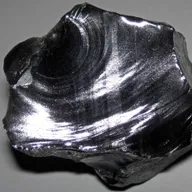 Obsidian
Volcanic glass with an edge finer than a surgical steel blade.
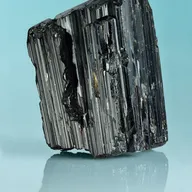 Black tourmaline
The stone that pulls ash out of a pipe when you warm it.
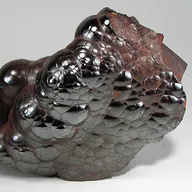 Hematite
Black as a mirror, and it leaves a blood-red line on anything you scratch it against.
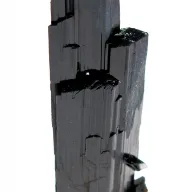 Arfvedsonite
A black amphibole with a blue flash, named for the man who found lithium.
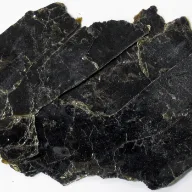 Biotite
Black mica: the flakes in every granite, and sheets big enough to roof a shed.
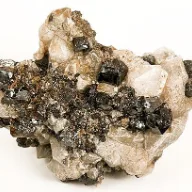 Brookite
Titanium dioxide in its rarest shape: thin red-brown blades grown in Alpine cracks.
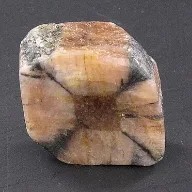 Chiastolite
An andalusite that grows a dark cross inside itself, and was sold for centuries as a Christian charm.
Columbianite
Colombian volcanic glass, sold as a tektite it is not.
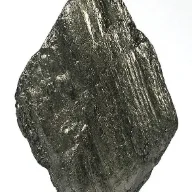 Graphite
Carbon in its soft form: the same element as diamond, stacked in sheets that slide.
 Aegirine
Black pyroxene needles from the strangest rocks on the planet.
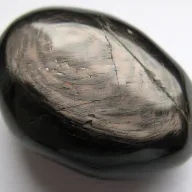 Hypersthene
A bronze-sheened pyroxene whose name the mineralogists retired.
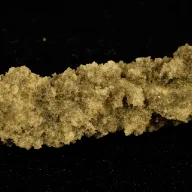 Fulgurite
Sand struck by lightning and fused, in a second, into hollow glass.
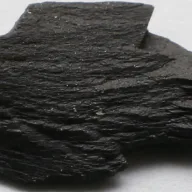 Jet
Fossil driftwood, black and warm in the hand, and Victorian mourning.
Indigo gabbro
A Madagascan rock sold under a wizard name it was given in 2010.
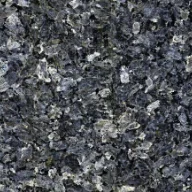 Larvikite
Norway's national rock, and the blue flash on half the shop fronts in Europe.
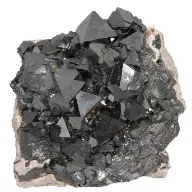 Magnetite
The most magnetic mineral there is, and the first compass.
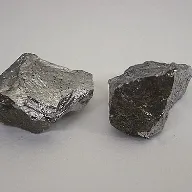 Manganese
The metal that makes steel tough, and that never occurs native.
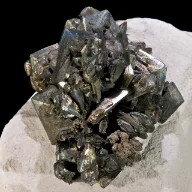 Marcasite
Pyrite's unstable twin, which eats itself in a damp drawer.
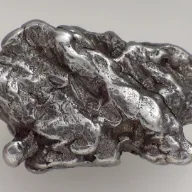 Campo del Cielo
An iron meteorite that fell on the Argentine Chaco four thousand years ago.
 Nuummite
Three-billion-year-old Greenlandic rock that flashes gold and copper.
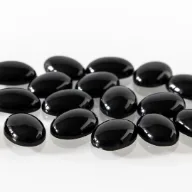 Onyx
Straight-banded chalcedony, and the black stone that is nearly always dyed.
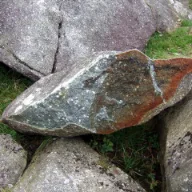 Preseli bluestone
The spotted dolerite of Stonehenge, from a Welsh hillside 250 kilometres away.
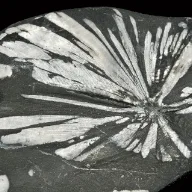 Chrysanthemum stone
Black rock with white mineral flowers that are not fossils.
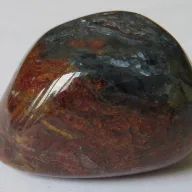 Pietersite
Tiger's eye smashed and cemented back together, so the light swirls.
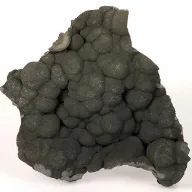 Psilomelane
A field name for the hard black manganese ores, kept alive by lapidaries.
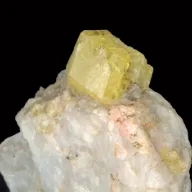 Rhodizite
A caesium borate as hard as topaz, and about as rare as minerals get.
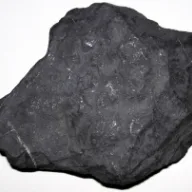 Shungite
Two-billion-year-old carbon rock from Karelia, and a great deal of nonsense.
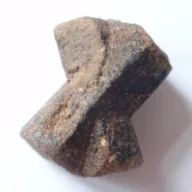 Staurolite
Two crystals grown through each other at sixty degrees, which comes out as a cross.
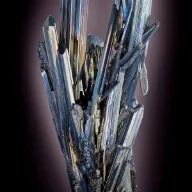 Stibnite
Steel-grey swords in a spray, soft enough to mark with a fingernail, and poisonous.
 Terahertz stone
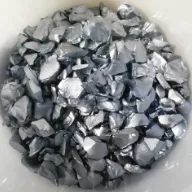
Furnace silicon, cut into beads and sold on a claim about radiation it does not emit.