 Lunarya
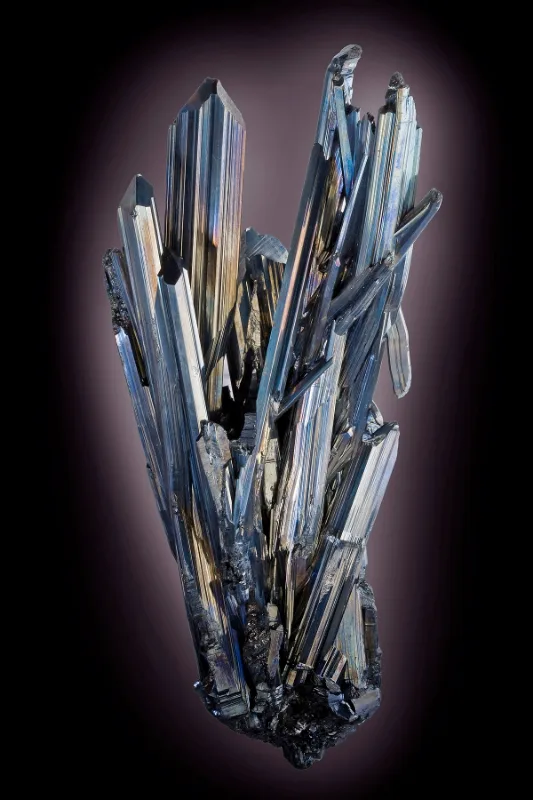
Stibnite
Stibnite is antimony sulfide, Sb₂S₃, and the principal ore of antimony. It grows in long bladed prisms with vertical grooves, in bunches and sheaves and radiating sprays, with a brilliant lead-grey metallic lustre. It is also 2 on the Mohs scale — as soft as gypsum, softer than a fingernail is hard — so a fine group is one of the most fragile things a collector can own. Antimony compounds are toxic; this is a stone to look at and not to handle much.
It melts at about 550 degrees, low enough that a candle flame will do it, which is why antimony was one of the first metals people worked and why stibnite turns up in the earliest metallurgy. It tarnishes: a bright silver spray will dull to grey and then to black over years in ordinary air, and it goes faster where fingers have touched it. The blades bend rather than snap, and old specimens are often gently curved from their own weight.
In short
- Colour
- Dark
- Mineral
- Sulfide
- Formula
- Sb₂S₃
- Hardness
- 2 on the Mohs scale
- Crystal system
- Orthorhombic
- Found in
- Xikuangshan in Hunan, China, which produces most of the world's antimony; the Ichinokawa mine on Shikoku in Japan, closed since 1957, whose metre-long crystals are the finest ever found and sit in museums everywhere; Baia Sprie and Herja in Maramureș, Romania, long known for good stibnite; Slovakia, Bolivia, Peru and Mexico.
- Element
- Earth
- Planet
- Pluto
- Chakra
- Root
- Handling
- Keep out of water
How it forms
Stibnite is a low-temperature hydrothermal mineral. It crystallises from the coolest, last fluids of a vein system, usually below 250 degrees, in the upper parts of gold and mercury deposits — antimony and gold travel together, and a stibnite vein is often a sign to look for gold nearby. It grows in open cavities where there is room, which is why the crystals are so long and so well formed, and it can still be seen precipitating today in active geothermal fields in New Zealand and Japan.
In human hands
Ground stibnite was one of the ancient eye paints, and the Arabic name for it, al-kuhl, travelled through Latin into alcohol, by way of the idea of a very fine powder and then of a distilled essence. Antimony was the alchemists' metal above all others: the Triumphal Chariot of Antimony, printed in 1604 under the name Basil Valentine, made it the subject of a whole literature. Seventeenth-century physicians prescribed it as an emetic, and the perpetual pill — a swallowed antimony bead, recovered and reused — was a real household object. Today antimony goes into flame retardants and batteries.
Varieties and trade names
- Bladed sprays
- The classic specimen: dozens of striated blades radiating from a base, usually on quartz. Japanese and Chinese material sets the standard.
- Massive stibnite
- Grey, fine-grained, unremarkable ore rock; this is nearly all of what is mined.
- Tarnished stibnite
- Blackened or iridescent with age; it is the same mineral with a skin of oxide, and no amount of cleaning will bring the silver back.
- Stibiconite
- The yellow-white antimony oxide that replaces stibnite as it weathers, sometimes preserving the shape of the original blades exactly.
- Gilded stibnite
- Sprays sold with a gold or rainbow coating applied in a vacuum chamber. The coating is not natural and the seller should say so; many do not.
Telling it from a fake
Softness and shape together are conclusive: nothing else grows in long grooved steel-grey blades that a fingernail will mark. Galena is heavier, cubic and cleaves into little boxes. Hematite is harder and gives a red streak; stibnite's streak is grey. The lustre on a fresh face is unusually bright, almost mirror-like, and dulls within days once exposed. A spray that is suspiciously colourful has been coated.
None of this needs a laboratory, and none of it is proof. A shop that will not say whether a stone is treated has answered the question; ask, and have the answer written on the receipt.
What it is said to do
The tradition gives stibnite transformation of the drastic kind — cutting a thing off rather than easing out of it — and the descent and return. It is assigned to Pluto, to Scorpio and Capricorn, to earth and to the root centre. The alchemical literature is part of the appeal: antimony was the metal supposed to purify gold, and that image has been carried across intact. It is one of the stones most often recommended to be worked with at a distance rather than held, which here is also the correct handling advice.
Living with it
Do not handle it more than you must, and wash your hands afterwards. Antimony sulfide is toxic if swallowed and the dust is worse, so never grind, tumble or make elixirs with it. It is a display mineral: 2 on the Mohs scale means a cloth will scratch it and a knock will shear the blades off. Keep it dry, dust it with a soft blower rather than a brush, and never wash it.
In magic
Stibnite, antimony sulfide, was the stibium of the ancients, and powdered it lined eyes as kohl across the Near East, against the glare and the evil eye. The alchemists made antimony the grey wolf that purifies gold. Modern practice uses it for drastic transformation and for letting go, set on the altar and worked with at a distance. It is toxic: never ground, never in water, never in an elixir, and hands washed afterwards.
- Energy
- Receptive
- Day
- Tuesday
- Worked for
- Change and letting go
More of this colour
 Smoky quartz
Quartz turned brown by the radioactivity of its own bedrock.
 Labradorite
A dull grey stone until you turn it, and then it is peacock blue.
 Obsidian
Volcanic glass with an edge finer than a surgical steel blade.
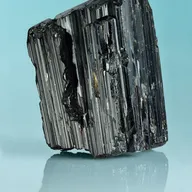 Black tourmaline
The stone that pulls ash out of a pipe when you warm it.
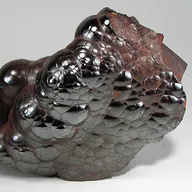 Hematite
Black as a mirror, and it leaves a blood-red line on anything you scratch it against.
Agni manitite
A black glass from Java, sold as a tektite; volcanic, as it turns out.
 Arfvedsonite
A black amphibole with a blue flash, named for the man who found lithium.
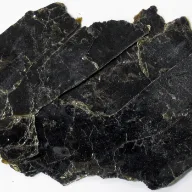 Biotite
Black mica: the flakes in every granite, and sheets big enough to roof a shed.
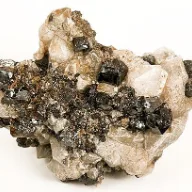 Brookite
Titanium dioxide in its rarest shape: thin red-brown blades grown in Alpine cracks.
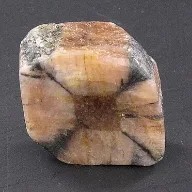 Chiastolite
An andalusite that grows a dark cross inside itself, and was sold for centuries as a Christian charm.
Columbianite
Colombian volcanic glass, sold as a tektite it is not.
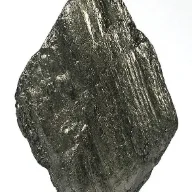 Graphite
Carbon in its soft form: the same element as diamond, stacked in sheets that slide.
 Aegirine
Black pyroxene needles from the strangest rocks on the planet.
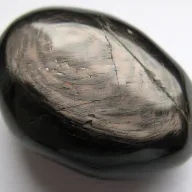 Hypersthene
A bronze-sheened pyroxene whose name the mineralogists retired.
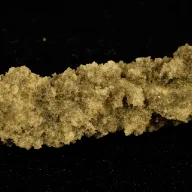 Fulgurite
Sand struck by lightning and fused, in a second, into hollow glass.
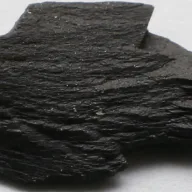 Jet
Fossil driftwood, black and warm in the hand, and Victorian mourning.
Indigo gabbro
A Madagascan rock sold under a wizard name it was given in 2010.
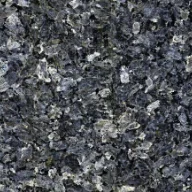 Larvikite
Norway's national rock, and the blue flash on half the shop fronts in Europe.
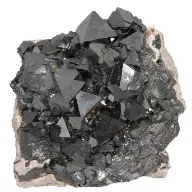 Magnetite
The most magnetic mineral there is, and the first compass.
 Manganese
The metal that makes steel tough, and that never occurs native.
 Marcasite
Pyrite's unstable twin, which eats itself in a damp drawer.
 Campo del Cielo
An iron meteorite that fell on the Argentine Chaco four thousand years ago.
 Nuummite
Three-billion-year-old Greenlandic rock that flashes gold and copper.
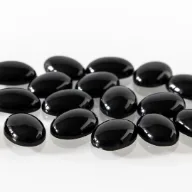 Onyx
Straight-banded chalcedony, and the black stone that is nearly always dyed.
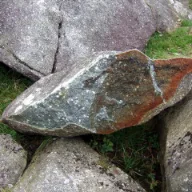 Preseli bluestone
The spotted dolerite of Stonehenge, from a Welsh hillside 250 kilometres away.
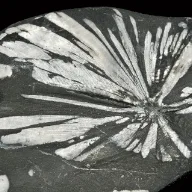 Chrysanthemum stone
Black rock with white mineral flowers that are not fossils.
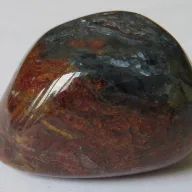 Pietersite
Tiger's eye smashed and cemented back together, so the light swirls.
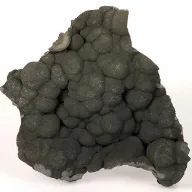 Psilomelane
A field name for the hard black manganese ores, kept alive by lapidaries.
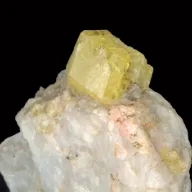 Rhodizite
A caesium borate as hard as topaz, and about as rare as minerals get.
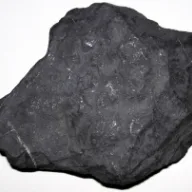 Shungite
Two-billion-year-old carbon rock from Karelia, and a great deal of nonsense.
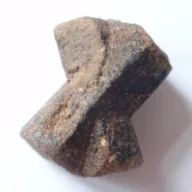 Staurolite
Two crystals grown through each other at sixty degrees, which comes out as a cross.
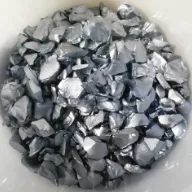 Terahertz stone
Furnace silicon, cut into beads and sold on a claim about radiation it does not emit.