 Lunarya
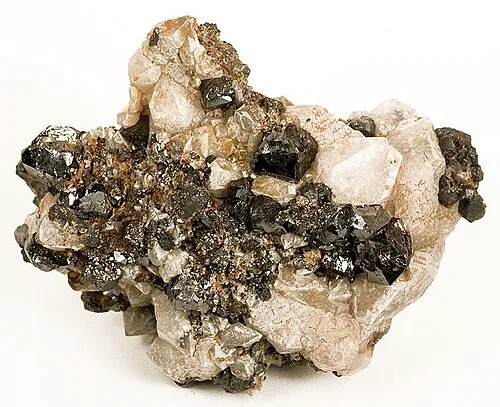
Brookite
Brookite is titanium dioxide, TiO₂ — the same chemistry as rutile and anatase, packed a third way. It forms thin, sharply striated tabular blades, brown to red-brown to black, with a lustre between glassy and metallic. Heat it above about seven hundred and fifty degrees and it rearranges itself into rutile and stays that way, which is why brookite is the rarest of the three and why it is found in cool cracks rather than deep rock.
Held to a lamp, a thin blade is a clear deep red-brown; the black opaque ones from Arkansas were thought to be a different mineral for years and were called arkansite. The crystals are strongly striated along their length and often warped, and they grow flat against the wall of a cavity or perched on quartz. Industrially the three polymorphs matter enormously — titanium dioxide is the white in paint, sunscreen and paper — but the pigment is made from ilmenite, not from crystals like these.
In short
- Colour
- Dark
- Mineral
- Oxide
- Formula
- TiO₂
- Hardness
- 5.5–6 on the Mohs scale
- Crystal system
- Orthorhombic
- Found in
- Alpine fissures in Switzerland, Austria and Italy; Snowdonia in Wales, where it was first described; Kharan in Balochistan, Pakistan; Magnet Cove in Arkansas; the Urals.
- Element
- Air
- Planet
- Uranus
- Chakra
- Crown
- Handling
- Water and light are both fine
How it forms
Brookite is an Alpine-cleft mineral. When a mountain belt is squeezed and heated, water gets into the fractures, dissolves a little of everything out of the wall rock and grows it back in the cavity as well-formed crystals: quartz, adularia, titanite, anatase, rutile and brookite. The titanium comes from ordinary rock-forming minerals a few centimetres away. Temperature decides which polymorph you get, and brookite takes the middle of the range, so a single cleft can hold brookite blades and anatase pyramids side by side, grown a few degrees apart.
In human hands
Armand Lévy named it in 1825 for Henry James Brooke, the English crystallographer, from Welsh material. The Alpine strahler — cleft hunters who have worked the Swiss high country for three centuries, still with hammer and rope — supplied the classic specimens, and the Pakistani blades on quartz that flooded the market in the 1990s are the ones most collectors own. The three polymorphs became famous again in the 1970s when anatase turned out to be a photocatalyst, which is why they turn up in papers about splitting water with sunlight.
Varieties and trade names
- Arkansite
- Black, blocky brookite from Magnet Cove, Arkansas; the name is old and the mineral is the same.
- Rutile
- The stable polymorph, tetragonal, red to black, common; the golden needles in rutilated quartz.
- Anatase
- The third polymorph, steep blue-black pyramids, growing in the same clefts at a lower temperature.
- Brookite in quartz
- Blades enclosed in a crystal of quartz, from Balochistan; much of what is sold under the name is rutile or anatase.
Telling it from a fake
Flat blades with fine lengthwise striations, brown by reflection and red-brown against a lamp, sitting on quartz or adularia: that combination is brookite and little else. Hematite is heavier and grey-red and its plates are curved into rosettes; ilmenite is opaque black and faintly magnetic; goethite is fibrous. Nobody counterfeits it, but Pakistani specimens are often relabelled optimistically, and a "brookite" that is a hair-fine golden needle is rutile.
None of this needs a laboratory, and none of it is proof. A shop that will not say whether a stone is treated has answered the question; ask, and have the answer written on the receipt.
What it is said to do
A newcomer to the lists, with no old tradition at all: it arrived in crystal books in the 1990s as a stone of higher perspective, given for stepping back far enough to see the shape of a problem. The Alpine origin gets worked into the reading — a mineral of thin air and high places — and that is about as far as the folklore goes.
Living with it
Brittle, with blades that snap at a knock, so it is a cabinet mineral rather than a pocket one. Water and light do it no harm; dust it with a soft brush and keep it where it cannot be swept off a shelf.
In magic
Brookite has no older magic. Modern books use it for perspective, for stepping back far enough to see the shape of a problem, often alongside quartz. It is brittle, so it is set down and looked at rather than handled through a ritual.
- Energy
- Projective
- Day
- Saturday
- Worked for
- Study and clear thinking
More of this colour
 Smoky quartz
Quartz turned brown by the radioactivity of its own bedrock.
 Labradorite
A dull grey stone until you turn it, and then it is peacock blue.
 Obsidian
Volcanic glass with an edge finer than a surgical steel blade.
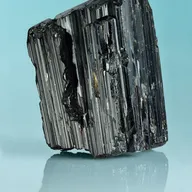 Black tourmaline
The stone that pulls ash out of a pipe when you warm it.
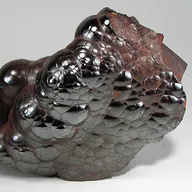 Hematite
Black as a mirror, and it leaves a blood-red line on anything you scratch it against.
Agni manitite
A black glass from Java, sold as a tektite; volcanic, as it turns out.
 Arfvedsonite
A black amphibole with a blue flash, named for the man who found lithium.
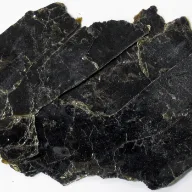 Biotite
Black mica: the flakes in every granite, and sheets big enough to roof a shed.
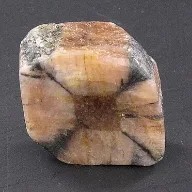 Chiastolite
An andalusite that grows a dark cross inside itself, and was sold for centuries as a Christian charm.
Columbianite
Colombian volcanic glass, sold as a tektite it is not.
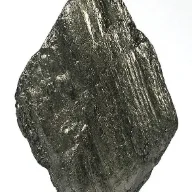 Graphite
Carbon in its soft form: the same element as diamond, stacked in sheets that slide.
 Aegirine
Black pyroxene needles from the strangest rocks on the planet.
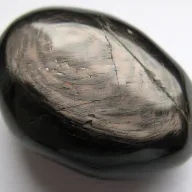 Hypersthene
A bronze-sheened pyroxene whose name the mineralogists retired.
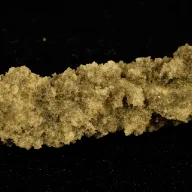 Fulgurite
Sand struck by lightning and fused, in a second, into hollow glass.
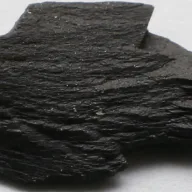 Jet
Fossil driftwood, black and warm in the hand, and Victorian mourning.
Indigo gabbro
A Madagascan rock sold under a wizard name it was given in 2010.
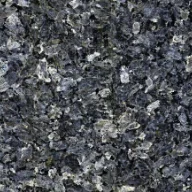 Larvikite
Norway's national rock, and the blue flash on half the shop fronts in Europe.
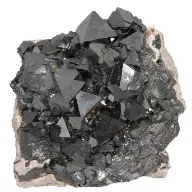 Magnetite
The most magnetic mineral there is, and the first compass.
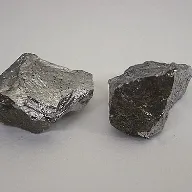 Manganese
The metal that makes steel tough, and that never occurs native.
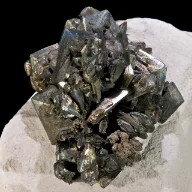 Marcasite
Pyrite's unstable twin, which eats itself in a damp drawer.
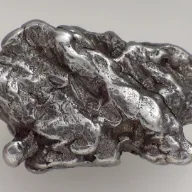 Campo del Cielo
An iron meteorite that fell on the Argentine Chaco four thousand years ago.
 Nuummite
Three-billion-year-old Greenlandic rock that flashes gold and copper.
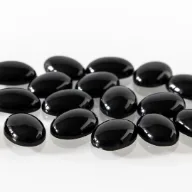 Onyx
Straight-banded chalcedony, and the black stone that is nearly always dyed.
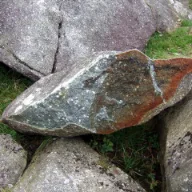 Preseli bluestone
The spotted dolerite of Stonehenge, from a Welsh hillside 250 kilometres away.
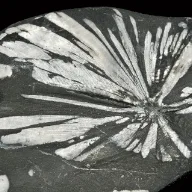 Chrysanthemum stone
Black rock with white mineral flowers that are not fossils.
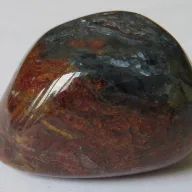 Pietersite
Tiger's eye smashed and cemented back together, so the light swirls.
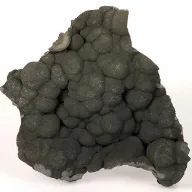 Psilomelane
A field name for the hard black manganese ores, kept alive by lapidaries.
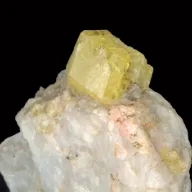 Rhodizite
A caesium borate as hard as topaz, and about as rare as minerals get.
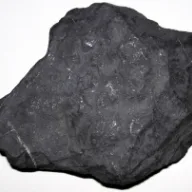 Shungite
Two-billion-year-old carbon rock from Karelia, and a great deal of nonsense.
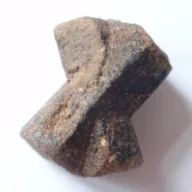 Staurolite
Two crystals grown through each other at sixty degrees, which comes out as a cross.
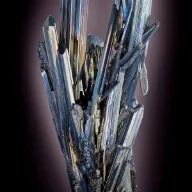 Stibnite
Steel-grey swords in a spray, soft enough to mark with a fingernail, and poisonous.
 Terahertz stone
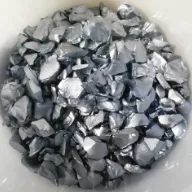
Furnace silicon, cut into beads and sold on a claim about radiation it does not emit.