 Lunarya
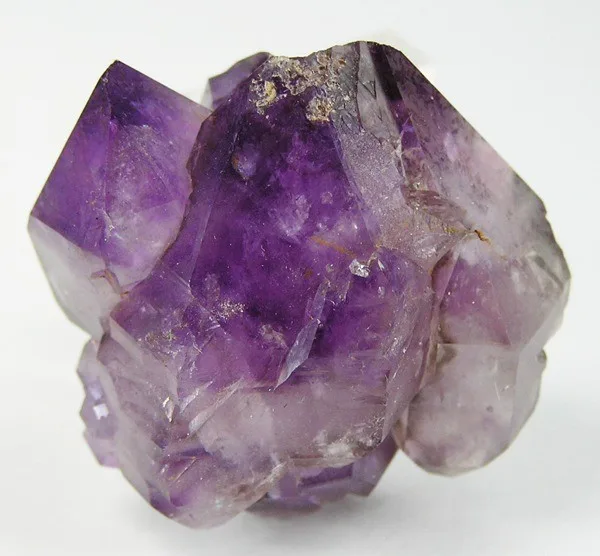
Amethyst
Amethyst is ordinary quartz that took up a trace of iron as it grew and was then coloured by natural radiation from the rock around it. The purple sits in the lattice itself rather than in any inclusion, which is why it runs right through the stone, and why heating it drives the colour off to yellow or green.
It was a cardinal gem for most of recorded history — set beside diamond, ruby, emerald and sapphire — until enormous deposits were found in Brazil and Uruguay in the nineteenth century and the price collapsed inside a generation. The name is Greek, amethystos, not drunk: cups were carved from it in the belief that wine drunk from purple stone could not go to your head. The best of it still comes out of the great hollow geodes of South America, some of them tall enough to stand inside.
In short
- Colour
- Violet and pink
- Mineral
- Quartz
- Formula
- SiO₂
- Hardness
- 7 on the Mohs scale
- Crystal system
- Trigonal
- Found in
- Brazil, Uruguay, Zambia, and in deep violet from the Urals and Siberia.
- Birthstone of
- February
- Element
- Air
- Planet
- Jupiter
- Chakra
- Crown
- Handling
- Fades in sunlight
How it forms
Amethyst grows in the gas bubbles of old lava. As a basalt flow cools, the bubbles are left as hollows; silica-rich water seeps in over millions of years and lines them with quartz, and where that water carried a trace of iron and the surrounding rock was faintly radioactive, the quartz grew purple. The geodes of southern Brazil and Uruguay formed this way in flows that erupted around 130 million years ago, as South America pulled away from Africa. The colour concentrates at the tips of the crystals, which is why a geode is darkest at its points and pale at the base.
In human hands
The Egyptians carved it into scarabs and the Romans into cups, and Pliny already doubted that the cups did anything about the wine. For the Church it was the bishop's stone, worn in the episcopal ring for the sobriety it stood for. Until the nineteenth century the finest came from the Urals, mined for Catherine the Great in a red-flashed violet that is still the standard the trade calls Siberian. Then Brazil's geodes were opened and a cardinal gem became a stone sold by the kilo, and the largest of them — the Empress of Uruguay, over three metres tall — now stands in a museum in Queensland.
Varieties and trade names
- Chevron amethyst
- Purple and white quartz in V-shaped bands, from a crystal that grew in alternating layers; nearly always sold cut and polished.
- Ametrine
- Amethyst and citrine in one crystal, half purple and half gold, from a single mine at Anahí in Bolivia.
- Siberian
- Now a grade, not a place: the deepest violet with flashes of red and blue, whichever country it came out of.
- Brandberg
- From Namibia, with smoky and clear phantoms inside the purple, and one of the few amethysts prized as a specimen rather than a gem.
Telling it from a fake
Natural amethyst is never evenly coloured: hold it to the light and the purple sits in patches and bands, deepest at the tip. Glass shows round bubbles, feels warm in the hand and takes a scratch from a steel blade, which quartz does not. Synthetic amethyst is grown in quantity and is real quartz, chemically identical; in a faceted stone the only clue is a colour too perfect and a clarity too clean, and only a laboratory can be sure. The commoner fraud runs the other way: most of the bright orange citrine in shops is amethyst that has been heated.
None of this needs a laboratory, and none of it is proof. A shop that will not say whether a stone is treated has answered the question; ask, and have the answer written on the receipt.
What it is said to do
Traditionally the sober stone: it is given for clear thinking, for the tail end of a habit, and for sleep, which is why so many of them end up on bedside tables. Older sources put it under Jupiter and read it as the stone of temperance — not of having less, but of being able to stop.
Living with it
Kept by the bed or held while doing nothing in particular. Wash it in soapy water like any quartz, and keep it out of the sun, which turns a deep purple stone grey-brown in a season and never gives it back.
In magic
The witch's sleep stone. Spellbooks put a tumble under the pillow, or in a dream pillow with mugwort and lavender, against nightmares and for dreams worth remembering, and hold a point in meditation or before a reading of the cards. The Greek charm against drunkenness survives as a working for breaking a habit, begun as the moon wanes. Since it fades, any rite that calls for a night on the windowsill should be a night under the moon and never a day in the sun.
- Energy
- Projective
- Day
- Thursday
- Worked for
- Sleep and dreams · Divination and intuition · Calm and peace
More of this colour
 Fluorite
The stone that gave fluorescence its name, in every colour at once.
 Rose quartz
The pink one, given away more often than it is bought.
 Ametrine
Amethyst and citrine in the same crystal, from one mine in the Bolivian jungle.
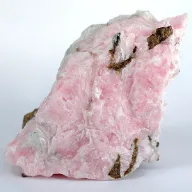 Bustamite
A pale pink manganese silicate from the world's strangest ore bodies, and rhodonite's quieter cousin.
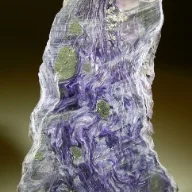 Charoite
A violet rock that exists in one valley in Siberia and nowhere else on Earth.
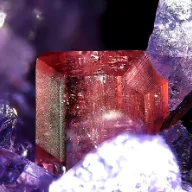 Phosphosiderite
A soft lilac iron phosphate, named after the two things in it.
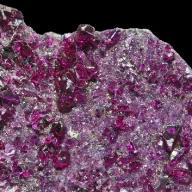 Kämmererite
Chlorite with chromium in it, in a magenta nothing else reaches.
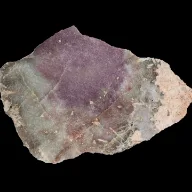 Lepidolite
Lilac mica, and the rock the world's lithium was first found in.
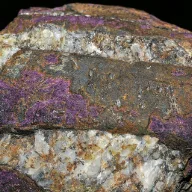 Purpurite
A pegmatite phosphate that rusted purple instead of brown.
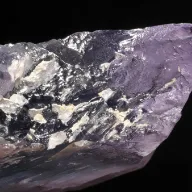 Spodumene
The lithium ore that turns up as pink gem crystals the length of a man.
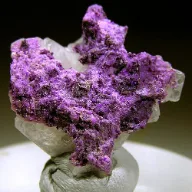 Sugilite
A purple that only exists because one manganese mine in the Kalahari flooded the right way.
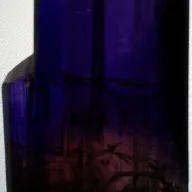 Tanzanite
One hill in Tanzania has all of it, and it was only found in 1967.
 Tourmaline
Thirty-odd minerals sharing one crystal shape, and every colour there is.