 Lunarya

Bustamite
Bustamite is a calcium manganese silicate, pale pink to brownish rose, that grows as bladed masses and, rarely, as sharp triclinic crystals. It is a pyroxenoid rather than a pyroxene: the chain of silica tetrahedra that runs through it is kinked, repeating every three links instead of every two, as in wollastonite, which is what happens when manganese and calcium of different sizes have to share the same chain.
The colour is manganese, the same element that makes rhodochrosite red and rhodonite rose, and it is easily bleached to grey-brown by oxidation at the surface. Bustamite from Franklin in New Jersey fluoresces a deep red under short-wave ultraviolet, which is how the collectors there sort it from the willemite glowing green beside it. Good crystals are uncommon enough that the mineral is known mostly as a massive stone, cut into cabochons or sold as rough slabs with dark oxide veins running through the pink.
In short
- Colour
- Violet and pink
- Mineral
- Silicate
- Formula
- CaMnSi₂O₆
- Hardness
- 5.5–6.5 on the Mohs scale
- Crystal system
- Triclinic
- Found in
- Franklin and Sterling Hill in New Jersey, Broken Hill in New South Wales, the N'Chwaning and Wessels mines in the Kalahari, Långban in Sweden, and Tetela de Ocampo in Mexico.
- Element
- Water
- Planet
- Venus
- Chakra
- Heart
- Handling
- Water and light are both fine
How it forms
It needs manganese, calcium and heat: metamorphosed manganese-rich sediments, or the contact between a limestone and an intrusion that has cooked it. At Franklin a zinc-manganese ore body was buried and metamorphosed a billion years ago into an assemblage of minerals found almost nowhere else on Earth, and bustamite grew there with willemite, franklinite and calcite. In the Kalahari manganese field it lines cavities in the sedimentary manganese ore with rosettes of pink blades, sometimes with sugilite, and those specimens are the finest known.
In human hands
Alexandre Brongniart described it in 1826 and named it for Anastasio Bustamante, then a general and later president of Mexico, from material at Tetela de Ocampo. Franklin and Sterling Hill made it familiar to collectors — those two mines produced some four hundred mineral species and thirty-odd found nowhere else — and the Kalahari finds of the 1970s and 1980s produced the crystals. It has never been an ore of anything; manganese comes from oxides, not from silicates like this one.
Varieties and trade names
- Ferrobustamite
- The iron-rich end of the same structure, browner and duller; the two grade into each other.
- Rhodonite
- The other pink pyroxenoid, deeper rose and usually veined with black manganese oxide; harder and far commoner.
- Pectolite
- A white calcium pyroxenoid with the same kinked chain, whose blue Dominican variety is larimar.
- Kalahari bustamite
- Pink blades from N'Chwaning, sometimes grown through purple sugilite, which has a page of its own here; the best specimens in the world.
- Franklin bustamite
- Massive, salmon pink, and fluorescent deep red under short-wave ultraviolet.
Telling it from a fake
Paler and pinker than rhodonite, and without rhodonite's black dendritic veining as a rule; softer than quartz, harder than calcite, and bladed rather than granular where it is massive. Under short-wave ultraviolet the Franklin material answers red. What is sold as bustamite in bead shops is frequently rhodonite, dyed howlite or a pink-stained marble, and any perfectly even pink with no grain at all should be treated as dyed.
None of this needs a laboratory, and none of it is proof. A shop that will not say whether a stone is treated has answered the question; ask, and have the answer written on the receipt.
What it is said to do
A modern entry, given for lightness of heart: the books pair it with the heart chakra and recommend it for coming out of a low patch, and it is often sold as a gentler rhodonite. None of this is older than the twentieth century, and the recommendation follows the colour, as it usually does with pink stones.
Living with it
Hard enough for a cabochon but brittle along its cleavages. Water is fine, acids are not — it is a manganese silicate and vinegar will etch the calcite it grows with. Keep polished pieces out of the sun only insofar as the dark veins can dull; the pink itself is stable.
In magic
Too new to have any place in older magic, bustamite turns up in modern practice as a gentler rhodonite, on altars for the end of a hard season: a pink stone beside a white candle and a written note of what is being put down. The books that use it say little more than that, and it is better to admit it than to invent a lineage. It is safe in water, so it can go into a ritual bath.
- Energy
- Receptive
- Day
- Friday
- Worked for
- Comfort and recovery
More of this colour
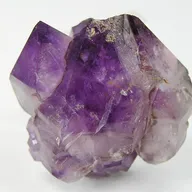 Amethyst
Quartz that grew purple in the dark, and the stone everyone starts with.
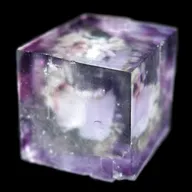 Fluorite
The stone that gave fluorescence its name, in every colour at once.
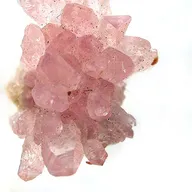 Rose quartz
The pink one, given away more often than it is bought.
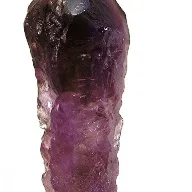 Ametrine
Amethyst and citrine in the same crystal, from one mine in the Bolivian jungle.
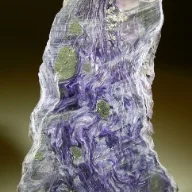 Charoite
A violet rock that exists in one valley in Siberia and nowhere else on Earth.
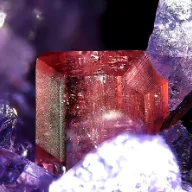 Phosphosiderite
A soft lilac iron phosphate, named after the two things in it.
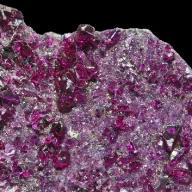 Kämmererite
Chlorite with chromium in it, in a magenta nothing else reaches.
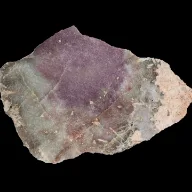 Lepidolite
Lilac mica, and the rock the world's lithium was first found in.
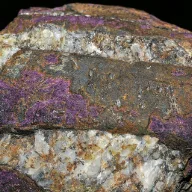 Purpurite
A pegmatite phosphate that rusted purple instead of brown.
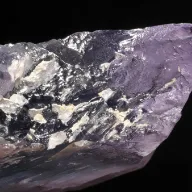 Spodumene
The lithium ore that turns up as pink gem crystals the length of a man.
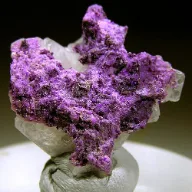 Sugilite
A purple that only exists because one manganese mine in the Kalahari flooded the right way.
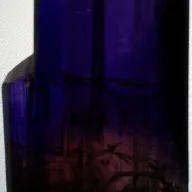 Tanzanite
One hill in Tanzania has all of it, and it was only found in 1967.
 Tourmaline
Thirty-odd minerals sharing one crystal shape, and every colour there is.