 Lunarya
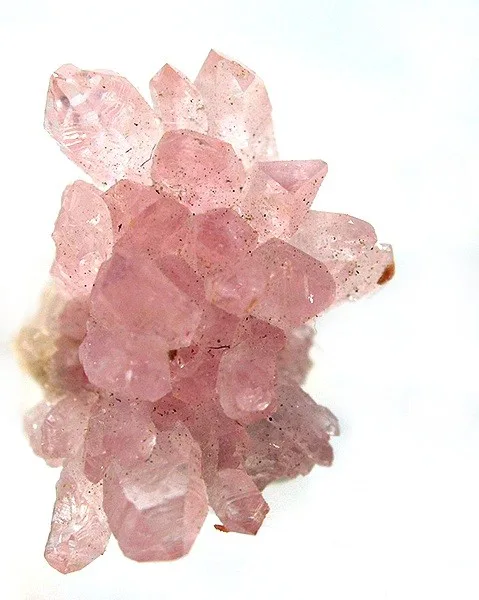
Rose quartz
Massive pink quartz, usually cloudy rather than clear and almost never in well-formed crystals. The pink comes from microscopic pink fibres threaded through the stone — a borosilicate mineral related to dumortierite — which is also why the colour is milky and why it scatters light into a soft star when a bead is cut round.
It is one of the commonest decorative stones on earth and has been cut into beads for more than four thousand years. The mineral fibres responsible for the colour were only identified in the last thirty years; before that the pink was blamed on titanium, which turned out to be wrong for the massive material. Rare crystallised rose quartz, in actual six-sided points, comes from a handful of pegmatites in Brazil and is coloured differently again, by phosphate and aluminium.
In short
- Colour
- Violet and pink
- Mineral
- Quartz
- Formula
- SiO₂
- Hardness
- 7 on the Mohs scale
- Crystal system
- Trigonal
- Found in
- Brazil, Madagascar, India and South Dakota.
- Element
- Water
- Planet
- Venus
- Chakra
- Heart
- Handling
- Fades in sunlight
How it forms
Nearly all rose quartz grows in the cores of granite pegmatites as a solid mass without crystal faces, and its pink turned out, in 2001, to come from microscopic fibres of a mineral related to dumortierite dispersed through the quartz. Because the colour is in fibres and not in the lattice, the stone is always cloudy, and a piece with the fibres well aligned shows a six-rayed star when cut into a sphere. Rose quartz with actual crystal faces, like the cluster in the photograph, is rare, comes from a handful of pockets in Minas Gerais, Brazil, and is coloured by something else — aluminium and phosphorus, with natural radiation — which fades in light.
In human hands
Beads of it have been found in Mesopotamia from before 2000 BC, and the Romans carved it, but it was never a stone of great price: too cloudy to facet and too common to be rare. It came into its own once big blocks could be sawn and polished, from the pegmatites of South Dakota, where it is the state mineral, and then from Brazil and Madagascar, which supply the spheres, hearts, towers and bathroom basins of the present trade. Since the 1980s it has been the most bought stone in the metaphysical shops, given so often that it has become the shorthand for the whole shelf.
Varieties and trade names
- Star rose quartz
- A sphere or cabochon with a six-pointed star floating on it, from light reflecting off the aligned fibres inside.
- Crystallised rose quartz
- The rare kind with faces, from Brazil, in small pink clusters; keep it out of the sun, because its colour is the kind that fades.
- Madagascar rose quartz
- Generally deeper and more even in colour than the Brazilian, and the source of most large polished pieces.
- Strawberry quartz
- Quartz with red inclusions of hematite or goethite. Genuine pieces exist; the bright, bubbly, cheap ones are glass.
Telling it from a fake
Rose quartz is cheap, so it is not often faked, but pink glass is sold under the name: look for round bubbles and swirls, and for a clear, bright, even pink, which no natural piece has. Real rose quartz is cloudy, with milky patches and veils, and is cold in the hand. Dyed quartz concentrates its colour in cracks and gives it up to a cotton bud dipped in acetone. A pale piece is not a treated one — some rose quartz is pale, and a lot of it has simply faded on a windowsill.
None of this needs a laboratory, and none of it is proof. A shop that will not say whether a stone is treated has answered the question; ask, and have the answer written on the receipt.
What it is said to do
The stone of affection in all its forms, and the one most often given rather than chosen: for reconciliation, for grief, and — in the modern reading that has more or less taken over — for being kinder to yourself than you have been.
Living with it
Washes in soapy water like any quartz. It fades badly in sunlight: a window-shelf rose quartz goes grey-white within a few months, so keep it where you actually sit rather than where the light is.
In magic
The first stone most people buy for a spell, and the default in modern love magic: a tumble in a pink charm bag with dried rose petals, set beside a pink candle on a Friday as the moon waxes. The more careful books aim it at self-regard before romance, and most of them warn against workings aimed at a named person, which is a matter of ethics rather than of geology. It also sits on altars of grief. Keep the bag out of the window: the pink fades.
- Energy
- Receptive
- Day
- Friday
- Worked for
- Love and friendship · Comfort and recovery · Calm and peace
More of this colour
 Amethyst
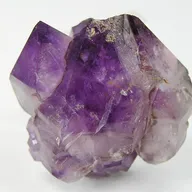
Quartz that grew purple in the dark, and the stone everyone starts with.
 Fluorite
The stone that gave fluorescence its name, in every colour at once.
 Ametrine
Amethyst and citrine in the same crystal, from one mine in the Bolivian jungle.
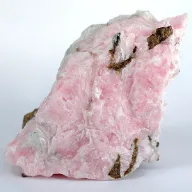 Bustamite
A pale pink manganese silicate from the world's strangest ore bodies, and rhodonite's quieter cousin.
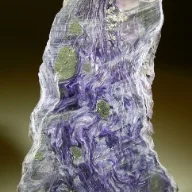 Charoite
A violet rock that exists in one valley in Siberia and nowhere else on Earth.
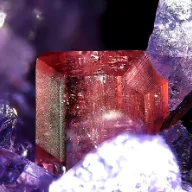 Phosphosiderite
A soft lilac iron phosphate, named after the two things in it.
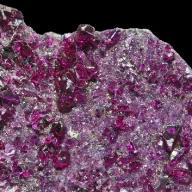 Kämmererite
Chlorite with chromium in it, in a magenta nothing else reaches.
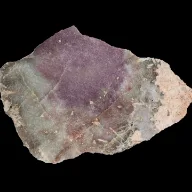 Lepidolite
Lilac mica, and the rock the world's lithium was first found in.
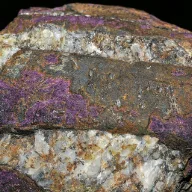 Purpurite
A pegmatite phosphate that rusted purple instead of brown.
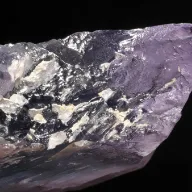 Spodumene
The lithium ore that turns up as pink gem crystals the length of a man.
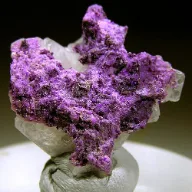 Sugilite
A purple that only exists because one manganese mine in the Kalahari flooded the right way.
 Tanzanite
One hill in Tanzania has all of it, and it was only found in 1967.
 Tourmaline
Thirty-odd minerals sharing one crystal shape, and every colour there is.