 Lunarya
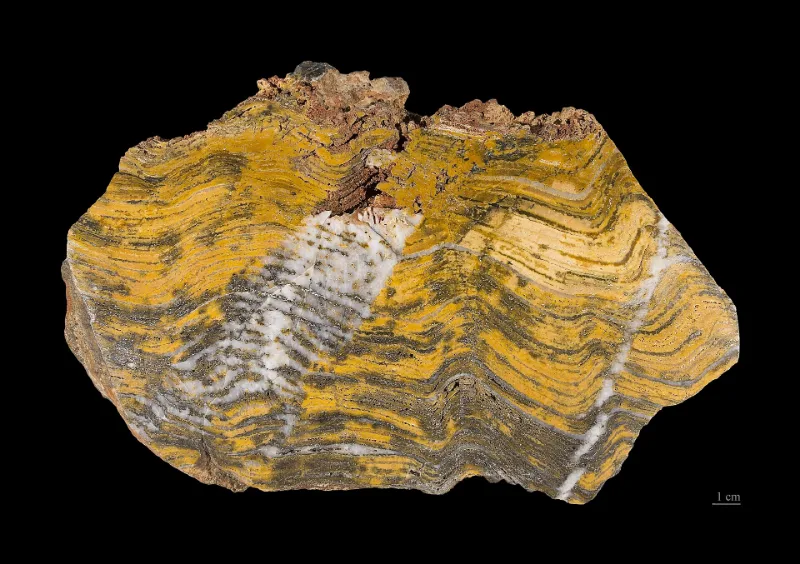
Stromatolite
A stromatolite is not a mineral. It is a structure: layer on layer of carbonate built up under a mat of cyanobacteria, which grew towards the light, trapped the sediment that settled on them, and grew again. Cut and polished, the layers show as fine wavy bands stacked into domes and columns. It is mostly calcium carbonate, so 3 to 4 on the Mohs scale, unless silica has replaced it, in which case it can reach 7.
These are the oldest visible traces of life on earth. Stromatolites from the Pilbara in Western Australia are about 3.48 billion years old, and there are contested candidates some two hundred million years older than that in Greenland. The organisms that made them changed the planet: cyanobacteria photosynthesise, and over a billion years or so they put enough oxygen into the air and the oceans to rust the world's dissolved iron out of the sea and make animal life possible. Almost everything breathing today is downstream of that.
In short
- Colour
- Red, orange and gold
- Mineral
- A fossil, not a mineral
- Formula
- CaCO₃ + SiO₂
- Hardness
- 3–7 on the Mohs scale
- Crystal system
- None — it is a fossil
- Found in
- Fossil stromatolites are worldwide and mostly Precambrian: Western Australia, Bolivia, Morocco, the Canadian Shield, Siberia, and the Transvaal in South Africa. Living ones are rare and confined to water too salty or too strange for the animals that would otherwise eat them — Hamelin Pool in Shark Bay, Western Australia; the Exuma Cays in the Bahamas; Cuatro Ciénegas in Mexico; and a few alkaline lakes.
- Element
- Earth
- Planet
- Saturn
- Chakra
- Root
- Handling
- Keep out of water
How it forms
A cyanobacterial mat is sticky. Fine sediment drifting past adheres to it, and calcium carbonate precipitates in and around the mat as the bacteria draw carbon dioxide out of the water. That buries the colony, which grows up through the new layer towards the light, and the cycle repeats — a millimetre or so in a good year. Over thousands of years the mats build domes, columns and cabbage-shaped heads. What is preserved is the sediment structure, not the organisms.
In human hands
Stromatolites dominated the shallow seas for some two billion years, through a stretch so uneventful that geologists call the middle of it the boring billion. They collapsed in the Neoproterozoic, and the usual explanation is grazing: once animals evolved that could eat a bacterial mat, the mats survived only where the animals could not follow. Their scientific importance dates from 1956, when living stromatolites were recognised at Shark Bay and it became clear that the fossils had modern counterparts.
Varieties and trade names
- Columnar stromatolite
- Stacked columns in cross-section, the classic polished slab; Bolivian and Moroccan material is common in shops.
- Domal stromatolite
- Broad low domes, cut across to show nested arcs like the rings of a tree.
- Silicified stromatolite
- Chert has replaced the carbonate; harder, glassier, takes a better polish, and often keeps far finer detail.
- Thrombolite
- The clotted rather than layered version, built by a different arrangement of the same organisms; sold as stromatolite and geologically a separate thing.
- Kambaba jasper
- Sold everywhere as fossil stromatolite. It is a green and black rhyolite from Madagascar, an igneous rock, with no fossil in it at all — the same point the jasper page makes.
Telling it from a fake
Look for layers that are continuous, wavy and parallel, thickening over the crests of domes and thinning between them; that is a mat growing, and agate banding does not do it. Banded agate fills a cavity from the outside in and its bands close on themselves. A rhyolite like kambaba has orbs and blotches rather than stacked layers. Real stromatolite is usually limestone or dolomite and will fizz under a drop of vinegar unless it has been silicified.
None of this needs a laboratory, and none of it is proof. A shop that will not say whether a stone is treated has answered the question; ask, and have the answer written on the receipt.
What it is said to do
The tradition gives it the long view — patience, continuity, the sense of being one item in a very long sequence — and it is handed to people doing work whose results are not going to be visible for a while. It goes with earth, with Saturn, with Capricorn and Taurus, and with the root centre. For once the reading follows from the object: a stone that took ten thousand years to grow a hand's breadth is a reasonable emblem for slow work.
Living with it
Carbonate stromatolite is soft and will not take a knock or an acid; keep it off vinegar, lemon and descaler, and wash it in plain water without soaking. Silicified pieces are hard enough to treat like any agate. Sunlight is not a problem for either. Polished slabs sometimes have a resin fill in cracks, which softens in hot water, so wash cool. If yours fizzes under vinegar it is limestone, and it should be kept away from anything acidic for good.
In magic
Stromatolites, the oldest record of life on Earth, are used in modern practice for ancestor work on the largest scale and for patience: a slice on the altar through a long working, a piece held in a meditation on deep time. No older magic is attached to them. Carbonate pieces should be kept away from salt and vinegar washes.
- Energy
- Receptive
- Day
- Saturday
- Worked for
- Grounding and endurance
More of this colour
 Garnet
Not one mineral but a whole family, and half of it ends up as sandpaper.
 Carnelian
Orange chalcedony, and the stone hot wax will not stick to.
 Citrine
Yellow quartz, except that most of it is amethyst that has been in an oven.
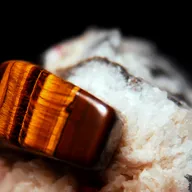 Tiger's eye
A stripe of light that slides across the stone when you tilt it.
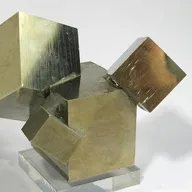 Pyrite
Fool's gold, in cubes so sharp they look machined.
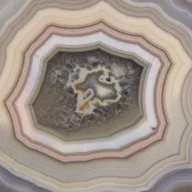 Agate
Chalcedony laid down in bands, one over the next, inside a bubble in old lava.
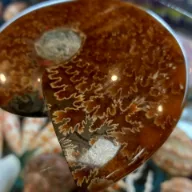 Ammonite
A shell that spiralled through the seas for three hundred million years, turned to stone.
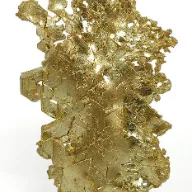 Gold
The one metal that comes out of the ground already finished.
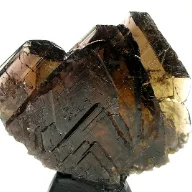 Axinite
Clove-brown wedges of a boron silicate, sharp enough to be named for an axe.
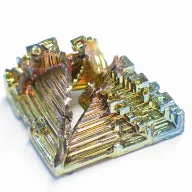 Bismuth
A metal that grows in rainbow staircases — in a saucepan, mostly.
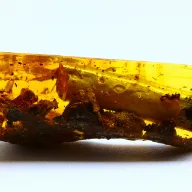 Amber
Not a stone at all: tree resin that leaked out forty million years ago and went hard.
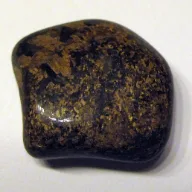 Bronzite
A dark pyroxene with a bronze sheen, from the same family the meteorites are full of.
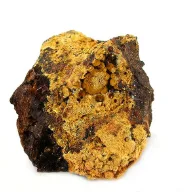 Cacoxenite
Golden needles in iron ore, named the bad guest because they ruined the smelt.
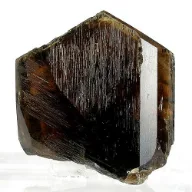 Chrysoberyl
The third hardest gem there is, no relation to beryl, and the only true cat's eye.
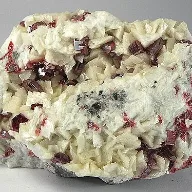 Cinnabar
Mercury ore, the red of every Chinese seal, and the most dangerous mineral in the cabinet.
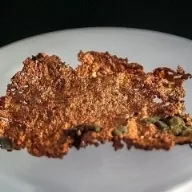 Copper
The first metal anyone ever worked, and one of the few that turns up ready to use.
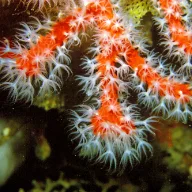 Red coral
The skeleton of a slow-growing animal, worn as a gem for five thousand years.
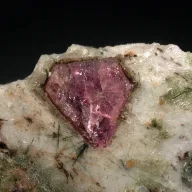 Eudialyte
Raspberry grains in grey Arctic rock, named for dissolving easily.
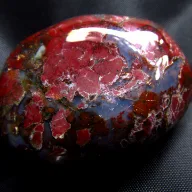 Jasper
Opaque chalcedony, stained by whatever the sediment happened to hold.
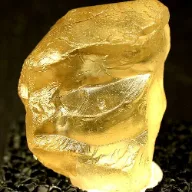 Golden labradorite
Bytownite: a calcium feldspar that cuts into clear champagne gold.
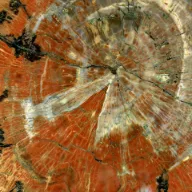 Petrified wood
A tree that became quartz cell by cell, and kept its grain.
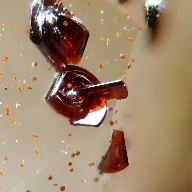 Lepidocrocite
The red half of rust, and the red flecks inside amethyst.
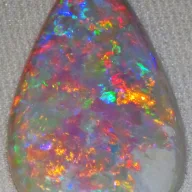 Opal
Water and silica in tiny stacked spheres, splitting light into colour.
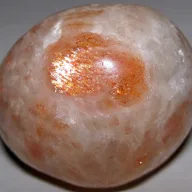 Sunstone
Feldspar full of metal flakes, throwing back the light in orange sparks.
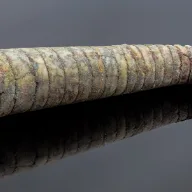 Orthoceras
A straight-shelled squid relative that died four hundred million years ago.
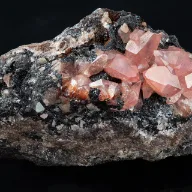 Rhodochrosite
Manganese carbonate in rose red, banded in caves and crystallised in mines.
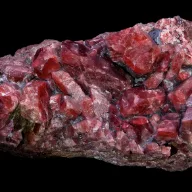 Rhodonite
Pink manganese silicate veined with the black oxide it turns into.
 Ruby
Corundum with chromium in it, and for centuries the most expensive stone on earth.
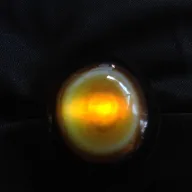 Sardonyx
Red-brown and white in straight bands, and the Roman world's seal stone.
 Scheelite
The tungsten ore that glows electric blue under a lamp in the dark.
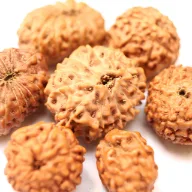 Rudraksha
The stone of a fruit, not of the ground, and the oldest prayer bead in India.
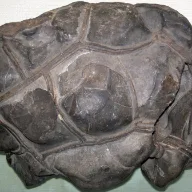 Septarian
A mud nodule that cracked from the inside and filled its own cracks with calcite.
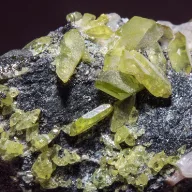 Sphene
Titanite, which throws more fire than a diamond and is far too soft to wear.
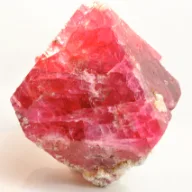 Spinel
Eight hundred years of crown jewels called it a ruby.
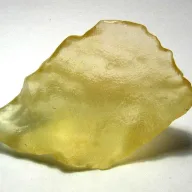 Libyan desert glass
Pale yellow glass lying loose in the Sahara, and a scarab in Tutankhamun's tomb cut from it.
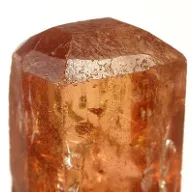 Topaz
Eight on the Mohs scale by definition, and it splits like slate if you hit it right.
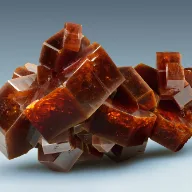 Vanadinite
Hexagonal barrels of orange-red lead vanadate, and the mineral vanadium was found in.
 Zircon
The oldest thing on earth is a grain of it, and no, it is not cubic zirconia.