 Lunarya

Sphene
Sphene is calcium titanium silicate, CaTiSiO₅, and mineralogists call it titanite, which is the official name. Gemmologists and dealers kept sphene, from the Greek sphenos, a wedge, for the flattened wedge-shaped crystals it grows in. The colour runs from honey yellow through chartreuse to a rich green and brown, and the best stones have a strong yellow-green that looks lit from inside.
Its distinguishing quality is dispersion — the ability to split white light into colours. Sphene's is 0.051, higher than diamond's 0.044, so a well-cut stone throws flashes of red, orange and blue that are more conspicuous than a diamond's because the body colour is not white. It also has very strong double refraction, so the back facets appear doubled when you look through it. Against all that, it is 5 to 5.5 on the Mohs scale and has distinct cleavage, which rules out rings.
In short
- Colour
- Red, orange and gold
- Mineral
- Silicate
- Formula
- CaTiSiO₅
- Hardness
- 5–5.5 on the Mohs scale
- Crystal system
- Monoclinic
- Found in
- Madagascar and Pakistan supply most gem material; the Tyrol in Austria and the Alps for classic crystals; also Brazil, Mexico, Russia on the Kola Peninsula, Canada at Renfrew in Ontario, Sri Lanka and Myanmar.
- Element
- Fire
- Planet
- The Sun
- Chakra
- Solar plexus
- Handling
- Water and light are both fine
How it forms
Titanite is a common accessory mineral — it turns up in small grains in a great many granites, syenites, schists and gneisses, and geologists date rocks with it because it takes up uranium and can be used as a clock. Crystals worth looking at come from alpine clefts, from skarns where a granite has cooked a limestone, and from pegmatites, wherever titanium and calcium met with room to grow.
In human hands
Named sphene by Haüy in 1801 and titanite by Klaproth in 1795; the International Mineralogical Association settled on titanite, and the gem trade ignored it, which is why a shop and a museum will label the same stone differently. Cut sphene has been a connoisseur's gem since the nineteenth century without ever becoming popular, for the good reason that a stone this soft belongs in a pendant and most people want rings.
Varieties and trade names
- Gem sphene
- Faceted yellow-green stones, usually Malagasy or Pakistani, cut to show the dispersion; rarely over five carats.
- Chrome sphene
- Material coloured a strong green by chromium, from Madagascar; the most valuable colour.
- Alpine titanite
- Wedge-shaped brown crystals from clefts in the Alps, on adularia and chlorite; classic specimens.
- Titanite in skarn
- Small honey crystals in contact-metamorphosed limestone, with garnet, diopside and scheelite.
- Accessory titanite
- The grains in ordinary granite that nobody sees and geochronologists live on.
Telling it from a fake
Double the facets. Look through a cut sphene with a loupe at the back edges and they appear clearly doubled; almost no other yellow-green gem does that so strongly. The dispersion is the other tell — flashes of spectral colour from a stone that is not white. Peridot has doubling too but far less fire and no cleavage; chrysoberyl is much harder; demantoid garnet is singly refractive and shows no doubling at all.
None of this needs a laboratory, and none of it is proof. A shop that will not say whether a stone is treated has answered the question; ask, and have the answer written on the receipt.
What it is said to do
A recent reading built on the brilliance: attention, quick understanding, the spark of seeing how something works. It is given to the Sun, to Leo and Gemini, and to the solar plexus. Sphene had no folklore before it was cut, since it was an accessory mineral nobody but a petrographer looked at, and the crystal trade has only taken it up in the last twenty years.
Living with it
Soft and cleavable. A sphene ring will be scratched and chipped within a year; a pendant or earrings will last a lifetime. Water is fine, sunlight is fine, ultrasonic and steam cleaners are not. Store it apart from quartz and harder stones, and clean it with a soft cloth and warm soapy water.
In magic
Sphene, or titanite, is too recent a gem to have older magic. Those who use it treat it as a stone of quick understanding, worn while studying or set beside a yellow candle on a Wednesday before an exam. Its fire, stronger than diamond's, is the image the workings lean on: light split into its colours, a muddle split into its parts.
- Energy
- Projective
- Day
- Sunday
- Worked for
- Study and clear thinking
More of this colour
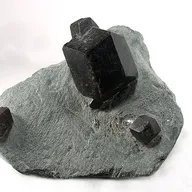 Garnet
Not one mineral but a whole family, and half of it ends up as sandpaper.
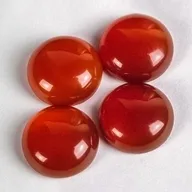 Carnelian
Orange chalcedony, and the stone hot wax will not stick to.
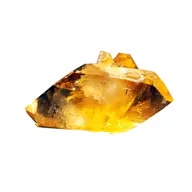 Citrine
Yellow quartz, except that most of it is amethyst that has been in an oven.
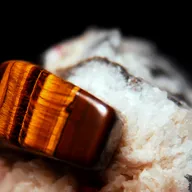 Tiger's eye
A stripe of light that slides across the stone when you tilt it.
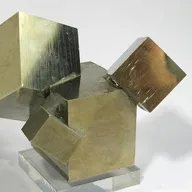 Pyrite
Fool's gold, in cubes so sharp they look machined.
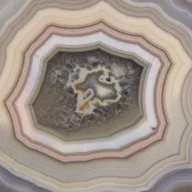 Agate
Chalcedony laid down in bands, one over the next, inside a bubble in old lava.
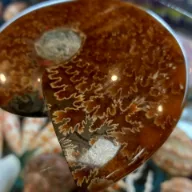 Ammonite
A shell that spiralled through the seas for three hundred million years, turned to stone.
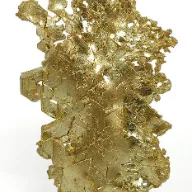 Gold
The one metal that comes out of the ground already finished.
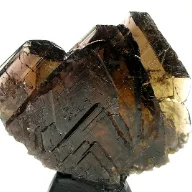 Axinite
Clove-brown wedges of a boron silicate, sharp enough to be named for an axe.
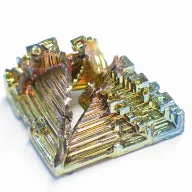 Bismuth
A metal that grows in rainbow staircases — in a saucepan, mostly.
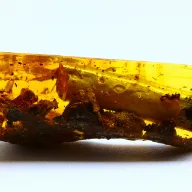 Amber
Not a stone at all: tree resin that leaked out forty million years ago and went hard.
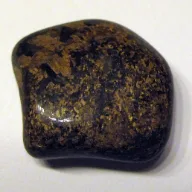 Bronzite
A dark pyroxene with a bronze sheen, from the same family the meteorites are full of.
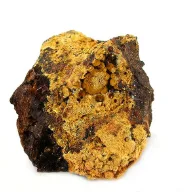 Cacoxenite
Golden needles in iron ore, named the bad guest because they ruined the smelt.
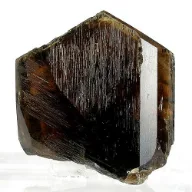 Chrysoberyl
The third hardest gem there is, no relation to beryl, and the only true cat's eye.
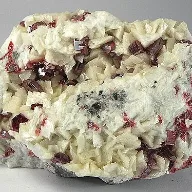 Cinnabar
Mercury ore, the red of every Chinese seal, and the most dangerous mineral in the cabinet.
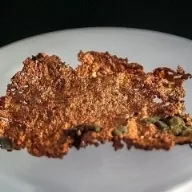 Copper
The first metal anyone ever worked, and one of the few that turns up ready to use.
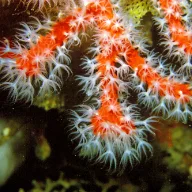 Red coral
The skeleton of a slow-growing animal, worn as a gem for five thousand years.
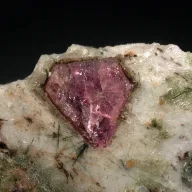 Eudialyte
Raspberry grains in grey Arctic rock, named for dissolving easily.
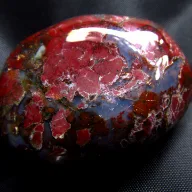 Jasper
Opaque chalcedony, stained by whatever the sediment happened to hold.
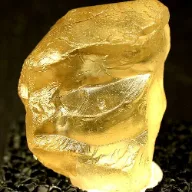 Golden labradorite
Bytownite: a calcium feldspar that cuts into clear champagne gold.
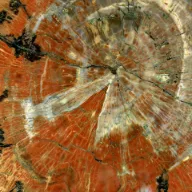 Petrified wood
A tree that became quartz cell by cell, and kept its grain.
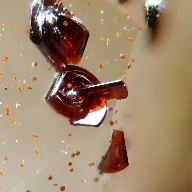 Lepidocrocite
The red half of rust, and the red flecks inside amethyst.
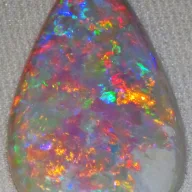 Opal
Water and silica in tiny stacked spheres, splitting light into colour.
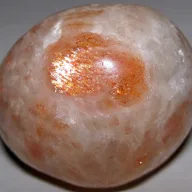 Sunstone
Feldspar full of metal flakes, throwing back the light in orange sparks.
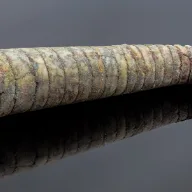 Orthoceras
A straight-shelled squid relative that died four hundred million years ago.
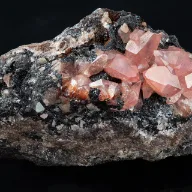 Rhodochrosite
Manganese carbonate in rose red, banded in caves and crystallised in mines.
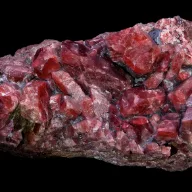 Rhodonite
Pink manganese silicate veined with the black oxide it turns into.
 Ruby
Corundum with chromium in it, and for centuries the most expensive stone on earth.
 Sardonyx
Red-brown and white in straight bands, and the Roman world's seal stone.
 Scheelite
The tungsten ore that glows electric blue under a lamp in the dark.
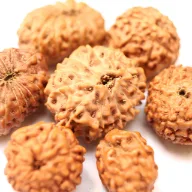 Rudraksha
The stone of a fruit, not of the ground, and the oldest prayer bead in India.
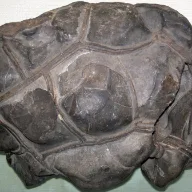 Septarian
A mud nodule that cracked from the inside and filled its own cracks with calcite.
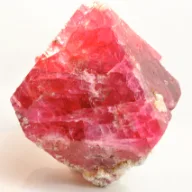 Spinel
Eight hundred years of crown jewels called it a ruby.
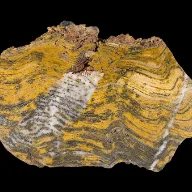 Stromatolite
Three and a half billion years of bacterial mats, turned to stone in layers.
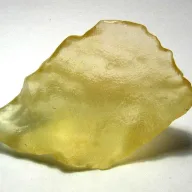 Libyan desert glass
Pale yellow glass lying loose in the Sahara, and a scarab in Tutankhamun's tomb cut from it.
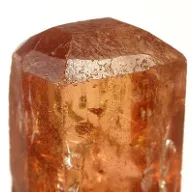 Topaz
Eight on the Mohs scale by definition, and it splits like slate if you hit it right.
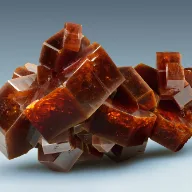 Vanadinite
Hexagonal barrels of orange-red lead vanadate, and the mineral vanadium was found in.
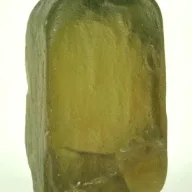 Zircon
The oldest thing on earth is a grain of it, and no, it is not cubic zirconia.