 Lunarya
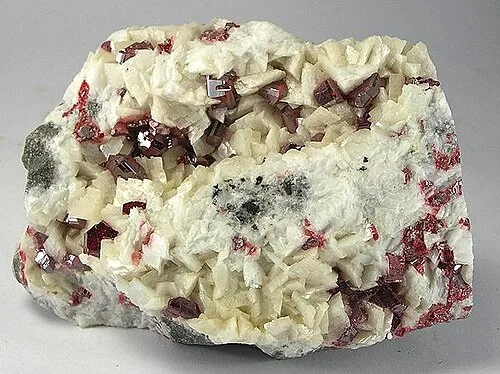
Cinnabar
Cinnabar is mercury sulfide, HgS, and the only ore of mercury worth mining. It is scarlet — the purest red of any common mineral — soft enough to scratch with a fingernail, and startlingly heavy: a small piece weighs about as much as a lump of iron the same size, and three times as much as a pebble of quartz. Ground up, it is the pigment vermilion. Heated in air, it gives off liquid mercury and sulfur dioxide, which is how the metal has been made for three thousand years and why the mineral needs handling with respect.
The danger is real but manageable. Solid cinnabar is not absorbed through intact skin and is poorly taken up if swallowed; the harm comes from dust and from vapour, which means grinding, sawing, tumbling and heating are the things never to do with it. Mercury vapour damages the nervous system permanently, and the mines that produced it — Almadén, Idrija, Huancavelica — have some of the worst occupational health records in history. Keep a specimen whole, in a case, and wash your hands after handling it, and it is no more hazardous than a jar of paint.
In short
- Colour
- Red, orange and gold
- Mineral
- Sulfide
- Formula
- HgS
- Hardness
- 2–2.5 on the Mohs scale
- Crystal system
- Trigonal
- Found in
- Almadén in Spain, Idrija in Slovenia, Wanshan and Tongren in China, New Almaden in California, Huancavelica in Peru, and Nikitovka in Ukraine.
- Element
- Fire
- Planet
- Mars
- Chakra
- Sacral
- Handling
- Keep out of water and sunlight
How it forms
Cinnabar is a shallow, cool mineral: it comes out of hydrothermal solutions at a hundred to two hundred degrees, close to the surface, in the plumbing of hot springs and around young volcanoes. Mercury is carried in the fluid as a complex and drops out as the sulfide where the solution cools or meets sulfur, filling fractures and cementing sandstones, usually with pyrite, stibnite, realgar and opal. Almadén is the extreme case: a Silurian quartzite that was flooded with mercury-bearing fluid until the rock was a third cinnabar by weight, the richest mercury deposit on Earth by a wide margin.
In human hands
Almadén has been worked for at least two thousand three hundred years and has produced roughly a third of all the mercury ever used; Rome sent convicts there, and a sentence to the mercury mines was understood as a death sentence. Spain used Almadén's mercury, and later Huancavelica's, to extract silver at Potosí by amalgamation, which tied the two mines to the deaths of a great many forced labourers. In China cinnabar has coloured seal paste, lacquer and Daoist alchemy since the Han; the elixirs of immortality compounded from it killed several emperors, very probably including the first.
Varieties and trade names
- Vermilion
- Cinnabar ground as a pigment, natural or synthetic; the red of Pompeii, of Chinese seals and of medieval manuscripts.
- Metacinnabar
- The black cubic form of the same chemistry, stable at higher temperatures and much less pretty.
- Cinnabar in quartz
- Red specks and veinlets through white quartz, cut as an ornamental stone under the name cinnabrite.
- Carved Chinese cinnabar
- Almost always layered lacquer tinted with the pigment, built up and carved; the mineral itself is far too soft to carve.
- Native mercury
- Droplets of liquid metal in cavities in the ore, common at Almadén and Idrija.
Telling it from a fake
The weight gives it away before anything else: cinnabar is about twice as dense as most red minerals. The streak on unglazed porcelain is scarlet, and the crystals are soft, with an adamantine to dull lustre. Realgar is orange-red, lighter and crumbles in light; red jasper is hard; hematite is grey-red and much harder. Almost everything sold as "cinnabar jewellery" is dyed resin or lacquer, which in this instance is a mercy.
None of this needs a laboratory, and none of it is proof. A shop that will not say whether a stone is treated has answered the question; ask, and have the answer written on the receipt.
What it is said to do
The Chinese tradition is the substantial one: cinnabar is the mineral of alchemical transformation, of the elixir, of the seal that makes a document real, and it is given in the crystal books for wealth, persuasion and the merchant's kind of luck. The older alchemy took it literally, and people died of it. Modern practice keeps the symbolism and leaves the chemistry alone, which is the only sensible arrangement.
Living with it
Never grind, saw, tumble, heat or lick it, and never make an elixir with it; do not keep it loose in a pocket or a child's collection. A specimen in a closed case, dusted with a brush and handled with washed hands afterwards, is safe. It darkens in strong light, so keep it out of the sun, and out of water, which is no use to it at all.
In magic
Cinnabar is the red of magic in China: Daoist talismans, fu, are written in vermilion ground from it, and seals pressed in red paste made a document real. Modern practice uses a specimen in workings for prosperity and transformation, set beside a red candle rather than touched. That is the important part: cinnabar is mercury sulfide, and it is never ground, heated, put in water or worn on the skin, whatever an old recipe says.
- Energy
- Projective
- Day
- Tuesday
- Worked for
- Money and luck · Change and letting go
More of this colour
 Garnet
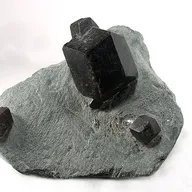
Not one mineral but a whole family, and half of it ends up as sandpaper.
 Carnelian
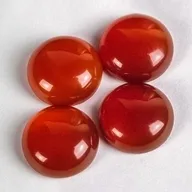
Orange chalcedony, and the stone hot wax will not stick to.
 Citrine
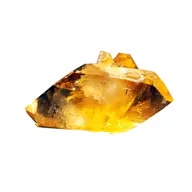
Yellow quartz, except that most of it is amethyst that has been in an oven.
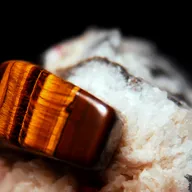 Tiger's eye
A stripe of light that slides across the stone when you tilt it.
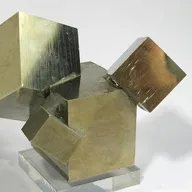 Pyrite
Fool's gold, in cubes so sharp they look machined.
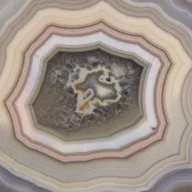 Agate
Chalcedony laid down in bands, one over the next, inside a bubble in old lava.
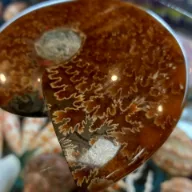 Ammonite
A shell that spiralled through the seas for three hundred million years, turned to stone.
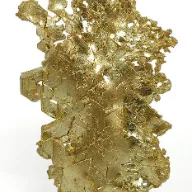 Gold
The one metal that comes out of the ground already finished.
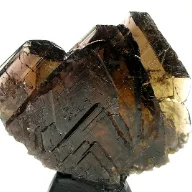 Axinite
Clove-brown wedges of a boron silicate, sharp enough to be named for an axe.
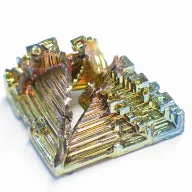 Bismuth
A metal that grows in rainbow staircases — in a saucepan, mostly.
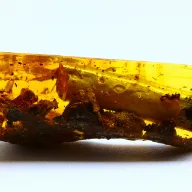 Amber
Not a stone at all: tree resin that leaked out forty million years ago and went hard.
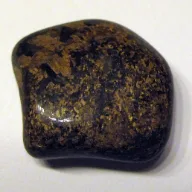 Bronzite
A dark pyroxene with a bronze sheen, from the same family the meteorites are full of.
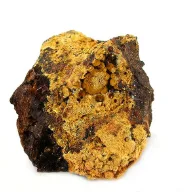 Cacoxenite
Golden needles in iron ore, named the bad guest because they ruined the smelt.
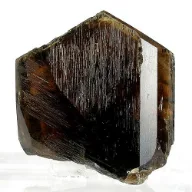 Chrysoberyl
The third hardest gem there is, no relation to beryl, and the only true cat's eye.
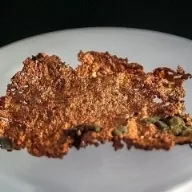 Copper
The first metal anyone ever worked, and one of the few that turns up ready to use.
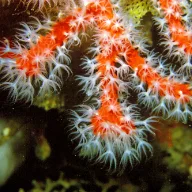 Red coral
The skeleton of a slow-growing animal, worn as a gem for five thousand years.
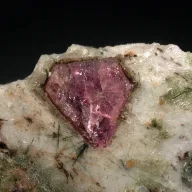 Eudialyte
Raspberry grains in grey Arctic rock, named for dissolving easily.
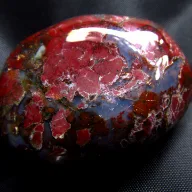 Jasper
Opaque chalcedony, stained by whatever the sediment happened to hold.
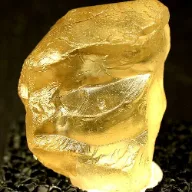 Golden labradorite
Bytownite: a calcium feldspar that cuts into clear champagne gold.
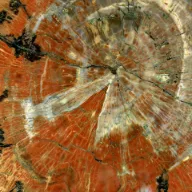 Petrified wood
A tree that became quartz cell by cell, and kept its grain.
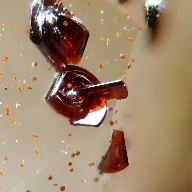 Lepidocrocite
The red half of rust, and the red flecks inside amethyst.
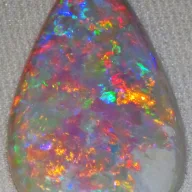 Opal
Water and silica in tiny stacked spheres, splitting light into colour.
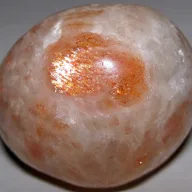 Sunstone
Feldspar full of metal flakes, throwing back the light in orange sparks.
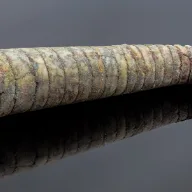 Orthoceras
A straight-shelled squid relative that died four hundred million years ago.
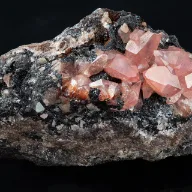 Rhodochrosite
Manganese carbonate in rose red, banded in caves and crystallised in mines.
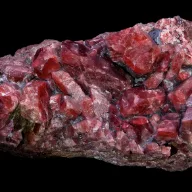 Rhodonite
Pink manganese silicate veined with the black oxide it turns into.
 Ruby
Corundum with chromium in it, and for centuries the most expensive stone on earth.
 Sardonyx
Red-brown and white in straight bands, and the Roman world's seal stone.
 Scheelite
The tungsten ore that glows electric blue under a lamp in the dark.
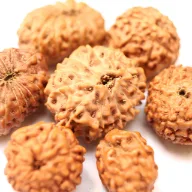 Rudraksha
The stone of a fruit, not of the ground, and the oldest prayer bead in India.
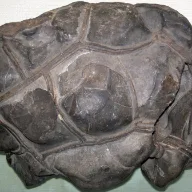 Septarian
A mud nodule that cracked from the inside and filled its own cracks with calcite.
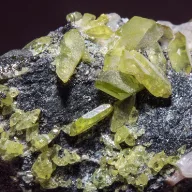 Sphene
Titanite, which throws more fire than a diamond and is far too soft to wear.
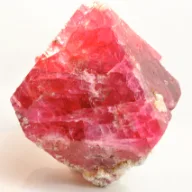 Spinel
Eight hundred years of crown jewels called it a ruby.
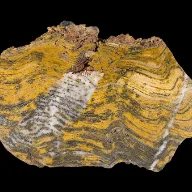 Stromatolite
Three and a half billion years of bacterial mats, turned to stone in layers.
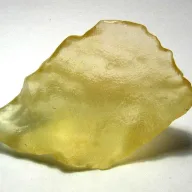 Libyan desert glass
Pale yellow glass lying loose in the Sahara, and a scarab in Tutankhamun's tomb cut from it.
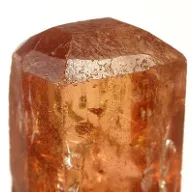 Topaz
Eight on the Mohs scale by definition, and it splits like slate if you hit it right.
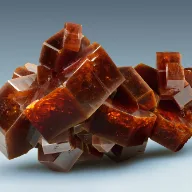 Vanadinite
Hexagonal barrels of orange-red lead vanadate, and the mineral vanadium was found in.
 Zircon
The oldest thing on earth is a grain of it, and no, it is not cubic zirconia.