 Lunarya
Bismuth
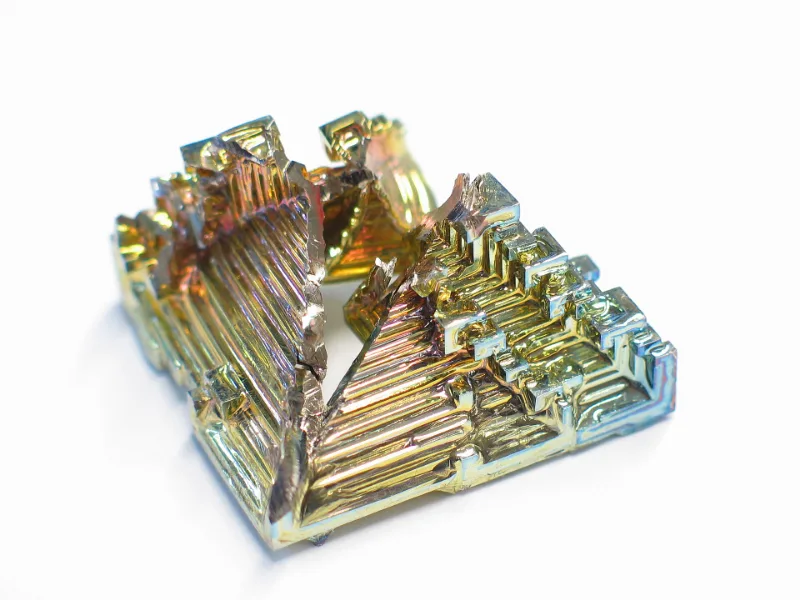
Bismuth is an element, a brittle silvery metal with a pink cast, and in the ground it occurs as itself in small grey-white grains among the ores of tin and cobalt. The rainbow-coloured staircases sold in every shop are the same metal grown from a melt in a pan, cooled just fast enough that the crystal edges grow before the faces fill in, and coloured by a film of oxide too thin to see except as interference.
It is the most diamagnetic element, one of the few substances that expands as it freezes, and very faintly radioactive: its one natural isotope has a half-life of twenty billion billion years, which was measured in 2003 and matters to nobody. The alchemists knew it and confused it with tin and lead; Agricola set it apart in 1546 and Claude Geoffroy proved it was its own metal in 1753. It is in the pink medicine for upset stomachs, in the shot that has replaced lead, and in the alloys that melt in hot water and hold fire sprinklers shut.
In short
- Colour
- Red, orange and gold
- Mineral
- Native element
- Formula
- Bi
- Hardness
- 2–2.5 on the Mohs scale
- Crystal system
- Trigonal
- Found in
- Natural crystals from Bolivia, Saxony (Schneeberg), Cornwall and Australia; the rainbow ones from a kitchen, mostly in Germany.
- Element
- Air
- Planet
- Uranus
- Chakra
- Crown
- Handling
- Keep out of water
How it forms
Native bismuth grows in the same hot veins as tin, tungsten and the cobalt and nickel ores of the old silver districts, dropping out of the fluid as the metal where there was not enough sulfur to make bismuthinite. Those crystals are small and dull, and rare enough that the hopper crystal — the stepped, hollow form that happens when a crystal grows faster along its edges than across its faces — is nearly always artificial. Melt bismuth at 271°C, let it cool a little, pour off the liquid, and the crystals left behind are the staircases; the colours are a skin of bismuth oxide a few hundred nanometres thick, thicker where the metal was hotter, and they are the same physics as oil on a puddle.
In human hands
The miners of the Erzgebirge had it in the fifteenth century as a metal in its own right, wismut, from the Saxon for white mass or perhaps from the meadow it was found in, and it went into printers' type and pewter, where its expanding on cooling filled the mould. Chemistry made it an element in 1753, medicine took it up in the nineteenth century as a salve and a stomach remedy, and the modern age gave it fusible alloys and, after lead was banned from shot and solder, a use as the safe heavy metal. The crystals are a hobby: the first rainbow bismuth appeared at mineral shows in the 1980s, made by German dealers in their kitchens, and it has been the most photographed 'mineral' on the internet since.
Varieties and trade names
- Hopper crystals
- The lab-grown staircases, iridescent from their oxide skin; every one in a shop is one of these, whatever the label says.
- Native bismuth
- Small grey-white grains and dendrites from Bolivia and Saxony, dull, heavy and genuinely rare.
- Bismuthinite
- Not the metal but its sulfide, in lead-grey needles; the ore most bismuth comes from, and a mineral collectors keep beside it.
- Bismuth ingot
- The metal cast plain, pinkish-silver and brittle; sold to people who want to grow the crystals themselves.
Telling it from a fake
A rainbow hopper crystal is man-made, always, and a dealer who says otherwise is either lying or wrong; the natural metal is dull grey-white with a pink tinge and grows as blebs and small crystals in rock, never as stepped pyramids. That said, a hopper crystal is real bismuth and worth what it costs for the pleasure. It is heavy, brittle — it snaps rather than bends — and a scratch shows the pink metal under the colour. Painted or anodised metals sold as bismuth are lighter and bend; the test is to break a corner, which nobody in a shop will let you do.
None of this needs a laboratory, and none of it is proof. A shop that will not say whether a stone is treated has answered the question; ask, and have the answer written on the receipt.
What it is said to do
New enough to have been written by the internet: a stone of transformation, for the way a grey metal comes out of the pan in colours, and of order out of chaos, for the geometry of the steps. The lists give it for focus and for play, and, since the rainbow covers all of them, for every chakra at once, which is the kind of claim a lab-grown stone can afford.
Living with it
Handle it gently; the steps snap off. Keep it out of water, which dulls the oxide film over time, and dust it with a soft brush. It needs no more than that, and is not toxic to hold.
In magic
Lab-grown bismuth is a thoroughly modern altar piece. Its stepped crystals are a focus for workings of transformation and for clearing a cluttered mind, and the rainbow of its oxide film, which anybody can watch appear over a pan of molten grey metal, makes it a favourite emblem of change. It is safe to handle but dislikes water, so it stays out of ritual baths and moon water.
- Energy
- Projective
- Day
- Saturday
- Worked for
- Change and letting go · Study and clear thinking
More of this colour
 Garnet
Not one mineral but a whole family, and half of it ends up as sandpaper.
 Carnelian
Orange chalcedony, and the stone hot wax will not stick to.
 Citrine
Yellow quartz, except that most of it is amethyst that has been in an oven.
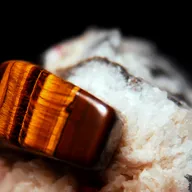 Tiger's eye
A stripe of light that slides across the stone when you tilt it.
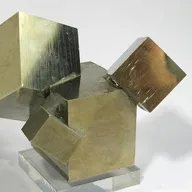 Pyrite
Fool's gold, in cubes so sharp they look machined.
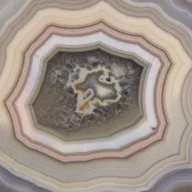 Agate
Chalcedony laid down in bands, one over the next, inside a bubble in old lava.
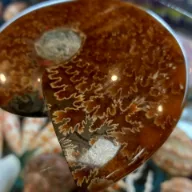 Ammonite
A shell that spiralled through the seas for three hundred million years, turned to stone.
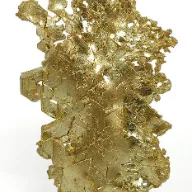 Gold
The one metal that comes out of the ground already finished.
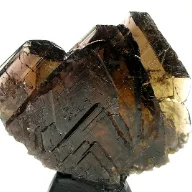 Axinite
Clove-brown wedges of a boron silicate, sharp enough to be named for an axe.
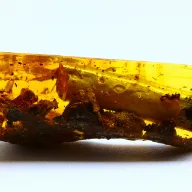 Amber
Not a stone at all: tree resin that leaked out forty million years ago and went hard.
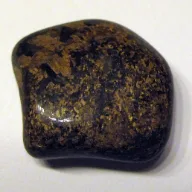 Bronzite
A dark pyroxene with a bronze sheen, from the same family the meteorites are full of.
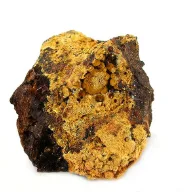 Cacoxenite
Golden needles in iron ore, named the bad guest because they ruined the smelt.
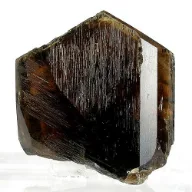 Chrysoberyl
The third hardest gem there is, no relation to beryl, and the only true cat's eye.
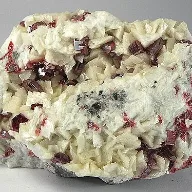 Cinnabar
Mercury ore, the red of every Chinese seal, and the most dangerous mineral in the cabinet.
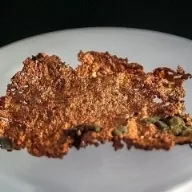 Copper
The first metal anyone ever worked, and one of the few that turns up ready to use.
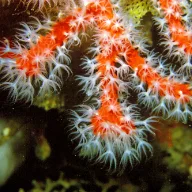 Red coral
The skeleton of a slow-growing animal, worn as a gem for five thousand years.
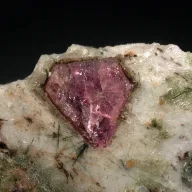 Eudialyte
Raspberry grains in grey Arctic rock, named for dissolving easily.
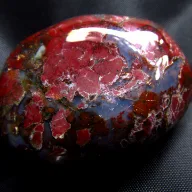 Jasper
Opaque chalcedony, stained by whatever the sediment happened to hold.
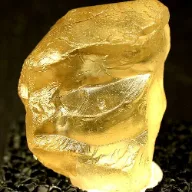 Golden labradorite
Bytownite: a calcium feldspar that cuts into clear champagne gold.
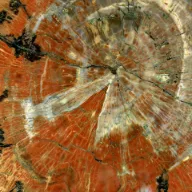 Petrified wood
A tree that became quartz cell by cell, and kept its grain.
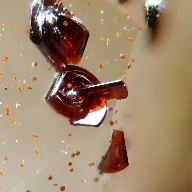 Lepidocrocite
The red half of rust, and the red flecks inside amethyst.
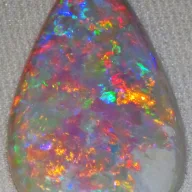 Opal
Water and silica in tiny stacked spheres, splitting light into colour.
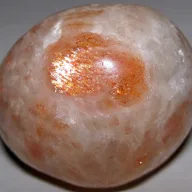 Sunstone
Feldspar full of metal flakes, throwing back the light in orange sparks.
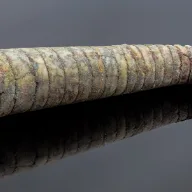 Orthoceras
A straight-shelled squid relative that died four hundred million years ago.
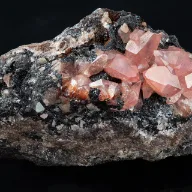 Rhodochrosite
Manganese carbonate in rose red, banded in caves and crystallised in mines.
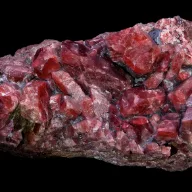 Rhodonite
Pink manganese silicate veined with the black oxide it turns into.
 Ruby
Corundum with chromium in it, and for centuries the most expensive stone on earth.
 Sardonyx
Red-brown and white in straight bands, and the Roman world's seal stone.
 Scheelite
The tungsten ore that glows electric blue under a lamp in the dark.
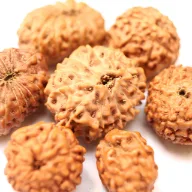 Rudraksha
The stone of a fruit, not of the ground, and the oldest prayer bead in India.
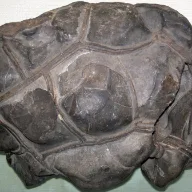 Septarian
A mud nodule that cracked from the inside and filled its own cracks with calcite.
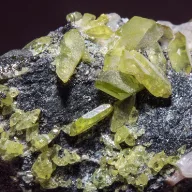 Sphene
Titanite, which throws more fire than a diamond and is far too soft to wear.
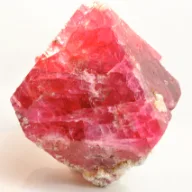 Spinel
Eight hundred years of crown jewels called it a ruby.
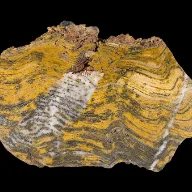 Stromatolite
Three and a half billion years of bacterial mats, turned to stone in layers.
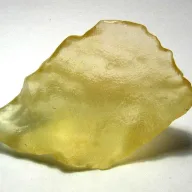 Libyan desert glass
Pale yellow glass lying loose in the Sahara, and a scarab in Tutankhamun's tomb cut from it.
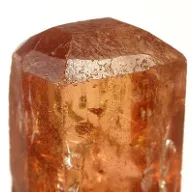 Topaz
Eight on the Mohs scale by definition, and it splits like slate if you hit it right.
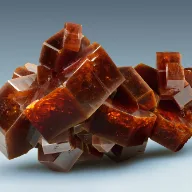 Vanadinite
Hexagonal barrels of orange-red lead vanadate, and the mineral vanadium was found in.
 Zircon
The oldest thing on earth is a grain of it, and no, it is not cubic zirconia.