 Lunarya
Red coral
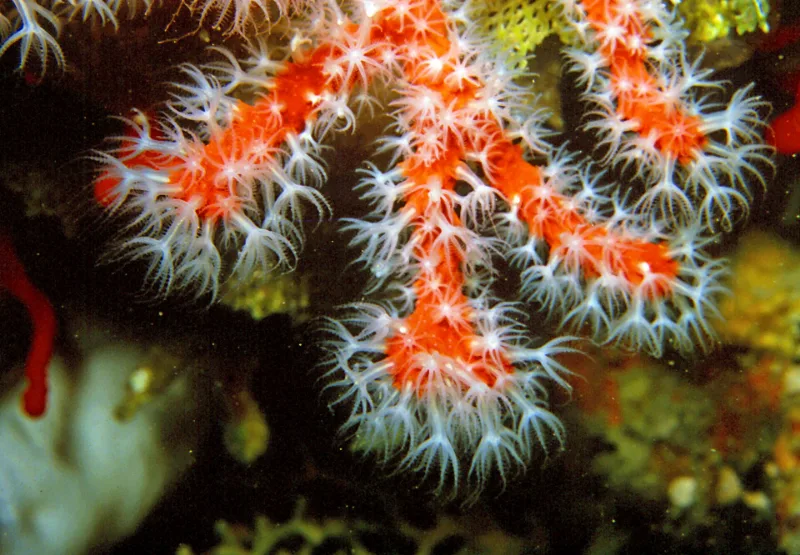
Red coral is not a mineral and not a plant: it is the skeleton of Corallium rubrum, a colonial animal of the Mediterranean, built of calcite with a few per cent of magnesium and a little protein. The colony looks like a small leafless tree, scarlet under a skin of white polyps, and it grows a millimetre or two a year in caves and under overhangs between ten and three hundred metres down. What is sold as coral jewellery is the branch, cleaned and polished.
Each polyp has eight feathery tentacles — this is an octocoral, a different branch of the family from the reef-builders — and the colony lays down its red axis from the inside out, in concentric layers with fine lengthwise striations, which is the structure you can see under a lens on any cut piece. Because the skeleton is calcite, coral is soft, dissolves in acid and dulls in anything harsh. It has no zooxanthellae and does not need light, which is how it lives in the dark and how the deeper colonies have survived the harvesting of the shallow ones.
In short
- Colour
- Red, orange and gold
- Mineral
- Organic, not a mineral
- Formula
- CaCO₃
- Hardness
- 3–4 on the Mohs scale
- Crystal system
- None — it is organic
- Found in
- The western Mediterranean — Sardinia, Corsica, Sicily, the Spanish and North African coasts — and the eastern Atlantic near the Strait of Gibraltar.
- Element
- Water
- Planet
- Mars
- Chakra
- Root
- Handling
- Keep out of water and sunlight
How it forms
A larva settles on rock in the dark, becomes a polyp, and the colony grows outward by budding, cementing calcite around a central axis: a millimetre or two a year in height, and only a fraction of a millimetre in thickness. A colony the thickness of a finger may be a century old. This slowness is the whole ethical problem with coral: two thousand years of harvesting removed the shallow beds, the Mediterranean fishery is now regulated by quota and minimum size, and the trade has moved to deeper water and to Pacific species. Bleached and dyed substitutes fill the gap in the cheap market.
In human hands
Coral is in Palaeolithic graves, in Sumerian jewellery and on Gaulish helmets. Pliny reports that Romans hung coral on children's cradles against harm, a custom which survived into the nineteenth century in coral teething rattles and is the ancestor of the Italian cornicello worn against the evil eye. Torre del Greco near Naples has been the world's coral-working town since the eighteenth century and still is. In Vedic astrology red coral, moonga, is the stone of Mars, worn set in copper or gold on the ring finger, and the Himalayan trade absorbed so much Mediterranean coral that it is now traditional in Tibetan jewellery.
Varieties and trade names
- Corallium rubrum
- The Mediterranean species, the classic ox-blood to pale red; the most valuable and the most depleted.
- Aka and momo coral
- Japanese and Taiwanese Pacific species, deep red and orange-pink, the mainstay of the modern trade.
- Angel skin coral
- Pale pink Pacific material, translucent and highly prized.
- Bamboo coral
- A jointed deep-sea coral, white and cheap, routinely dyed red and sold as the real thing.
- Reconstituted coral
- Ground coral or calcite powder bound with resin and dyed; common, legal, and not worth coral prices.
Telling it from a fake
Under a lens, genuine coral shows fine parallel striations along the branch and faint concentric rings across a cut end. Dyed bamboo coral shows the nodes where its joints were and colour concentrated in pores; plastic is warm and light and shows mould seams; dyed magnesite and howlite have veining no coral has. A drop of lemon juice on an inconspicuous spot will fizz on real coral — and also etch it, so this is a test for a bead you have already bought, not one you are considering.
None of this needs a laboratory, and none of it is proof. A shop that will not say whether a stone is treated has answered the question; ask, and have the answer written on the receipt.
What it is said to do
The oldest reading is protection, particularly of children: the Roman cradle charm, the Mediterranean amulet against the evil eye, and the coral rattle given at christenings all say the same thing. Vedic astrology gives it to Mars, for courage, blood and physical strength, and it is one of the nine stones of the navaratna. Modern books keep the vitality and add grounding. Worth knowing before you buy: this is an animal that took a hundred years to grow, and an antique or a certified piece is the kinder choice.
Living with it
Soft, porous and attacked by acid. Keep it away from vinegar, lemon, perfume, hairspray and chlorinated water, take it off before swimming, and never put it in an ultrasonic cleaner. Wipe it with a damp cloth and dry it. It fades and dulls with time and can be repolished by a lapidary, which removes a little of it each time.
In magic
Red coral is the Mediterranean's amulet against the evil eye: the Italian cornicello, the little horn, was traditionally carved from it, and coral branches hung on cradles and babies' rattles. In Vedic astrology it is Mars's gem, worn for courage. Modern practice keeps it in protection charms for children and in workings for vitality. An old piece is the kinder choice for a ritual, since new coral comes off a living reef.
- Energy
- Receptive
- Day
- Tuesday
- Worked for
- Protection · Courage and drive
More of this colour
 Garnet
Not one mineral but a whole family, and half of it ends up as sandpaper.
 Carnelian
Orange chalcedony, and the stone hot wax will not stick to.
 Citrine
Yellow quartz, except that most of it is amethyst that has been in an oven.
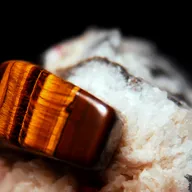 Tiger's eye
A stripe of light that slides across the stone when you tilt it.
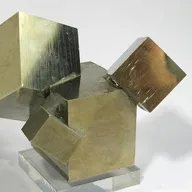 Pyrite
Fool's gold, in cubes so sharp they look machined.
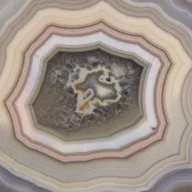 Agate
Chalcedony laid down in bands, one over the next, inside a bubble in old lava.
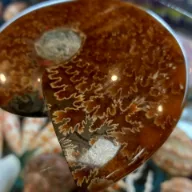 Ammonite
A shell that spiralled through the seas for three hundred million years, turned to stone.
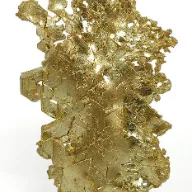 Gold
The one metal that comes out of the ground already finished.
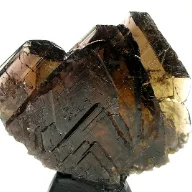 Axinite
Clove-brown wedges of a boron silicate, sharp enough to be named for an axe.
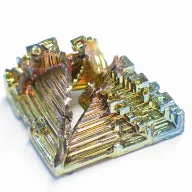 Bismuth
A metal that grows in rainbow staircases — in a saucepan, mostly.
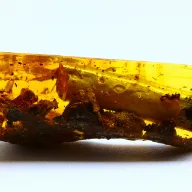 Amber
Not a stone at all: tree resin that leaked out forty million years ago and went hard.
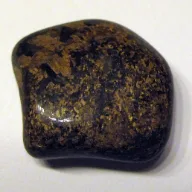 Bronzite
A dark pyroxene with a bronze sheen, from the same family the meteorites are full of.
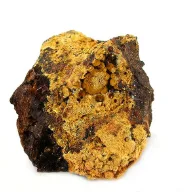 Cacoxenite
Golden needles in iron ore, named the bad guest because they ruined the smelt.
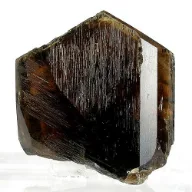 Chrysoberyl
The third hardest gem there is, no relation to beryl, and the only true cat's eye.
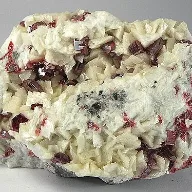 Cinnabar
Mercury ore, the red of every Chinese seal, and the most dangerous mineral in the cabinet.
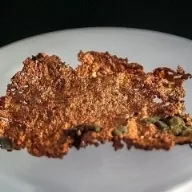 Copper
The first metal anyone ever worked, and one of the few that turns up ready to use.
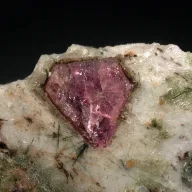 Eudialyte
Raspberry grains in grey Arctic rock, named for dissolving easily.
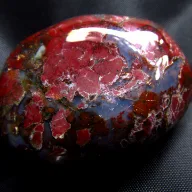 Jasper
Opaque chalcedony, stained by whatever the sediment happened to hold.
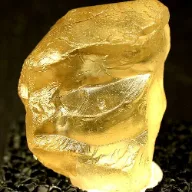 Golden labradorite
Bytownite: a calcium feldspar that cuts into clear champagne gold.
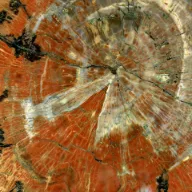 Petrified wood
A tree that became quartz cell by cell, and kept its grain.
 Lepidocrocite
The red half of rust, and the red flecks inside amethyst.
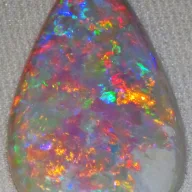 Opal
Water and silica in tiny stacked spheres, splitting light into colour.
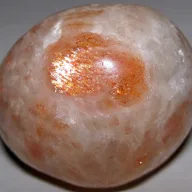 Sunstone
Feldspar full of metal flakes, throwing back the light in orange sparks.
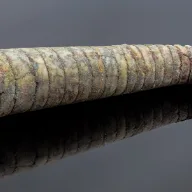 Orthoceras
A straight-shelled squid relative that died four hundred million years ago.
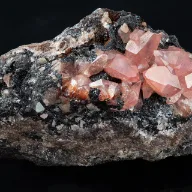 Rhodochrosite
Manganese carbonate in rose red, banded in caves and crystallised in mines.
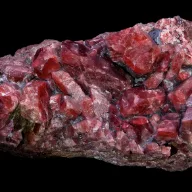 Rhodonite
Pink manganese silicate veined with the black oxide it turns into.
 Ruby
Corundum with chromium in it, and for centuries the most expensive stone on earth.
 Sardonyx
Red-brown and white in straight bands, and the Roman world's seal stone.
 Scheelite
The tungsten ore that glows electric blue under a lamp in the dark.
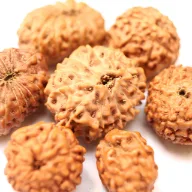 Rudraksha
The stone of a fruit, not of the ground, and the oldest prayer bead in India.
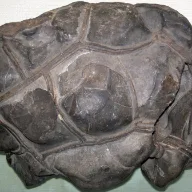 Septarian
A mud nodule that cracked from the inside and filled its own cracks with calcite.
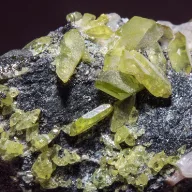 Sphene
Titanite, which throws more fire than a diamond and is far too soft to wear.
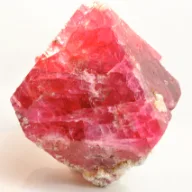 Spinel
Eight hundred years of crown jewels called it a ruby.
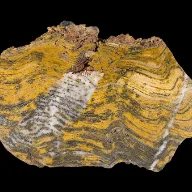 Stromatolite
Three and a half billion years of bacterial mats, turned to stone in layers.
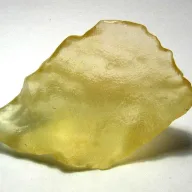 Libyan desert glass
Pale yellow glass lying loose in the Sahara, and a scarab in Tutankhamun's tomb cut from it.
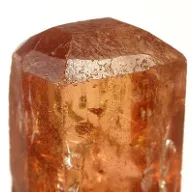 Topaz
Eight on the Mohs scale by definition, and it splits like slate if you hit it right.
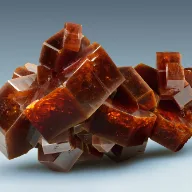 Vanadinite
Hexagonal barrels of orange-red lead vanadate, and the mineral vanadium was found in.
 Zircon
The oldest thing on earth is a grain of it, and no, it is not cubic zirconia.