 Lunarya
Eudialyte
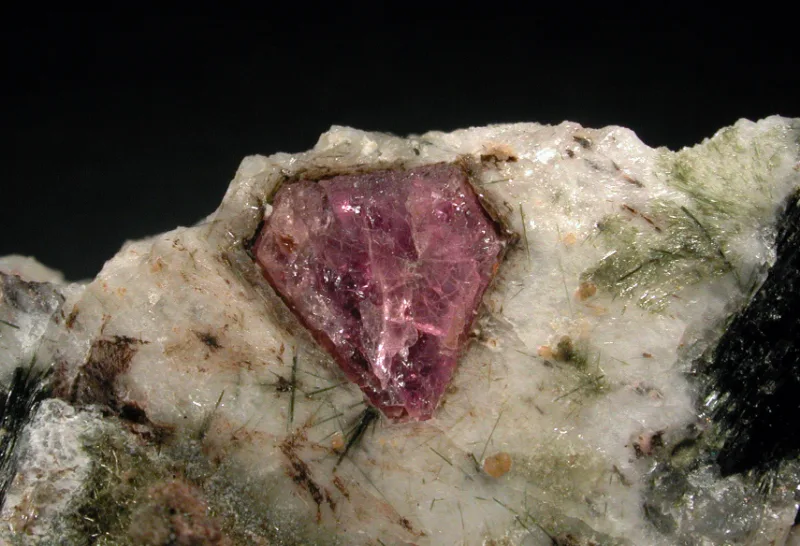
Eudialyte is a complicated sodium calcium zirconium silicate, and its name records the one thing that made it recognisable before anyone could analyse it: from the Greek eu dialytos, easily dissolved, because a weak acid attacks it where almost no other silicate will yield. It shows as raspberry, crimson and brownish-red grains scattered through pale rock, and rarely as flat tabular crystals with a glassy lustre.
The formula runs to two lines in a modern handbook, and the eudialyte group now holds thirty-odd species that differ in which metal sits where. Manganese and cerium give the red. It carries enough zirconium to be a potential ore of it, and the Kola deposits have been studied for zirconium and rare earths more than once, though the economics have never quite worked. Some specimens also carry traces of thorium and uranium and read a little above background on a counter; the amounts are small, but it is a reason to keep a large lot of raw material out of a bedroom.
In short
- Colour
- Red, orange and gold
- Mineral
- Silicate
- Formula
- Na₄(Ca,Ce)₂(Fe,Mn)ZrSi₈O₂₂(OH,Cl)₂
- Hardness
- 5–6 on the Mohs scale
- Crystal system
- Trigonal
- Found in
- The Ilímaussaq complex in Greenland is the type locality. The Kola Peninsula in Russia, at Khibiny and Lovozero, is the great source and supplies almost all the polished material. Others are Mont Saint-Hilaire in Quebec, the Langesundsfjord in Norway, Madagascar, and Magnet Cove in Arkansas.
- Element
- Fire
- Planet
- The Sun
- Chakra
- Heart
- Handling
- Water and light are both fine
How it forms
It is a mineral of nepheline syenite and of the pegmatites that cut it: alkaline magma, low in silica and rich in sodium and zirconium, crystallising slowly in the roots of ancient volcanic centres. It grows beside aegirine, arfvedsonite, nepheline and feldspar, which is why a Kola specimen is red grains in a grey-and-black rock rather than a crystal standing on its own.
In human hands
Friedrich Stromeyer named it in 1819 from Greenlandic material. The Soviet expeditions led by Alexander Fersman into the Khibiny massif in the 1920s and 1930s found it in quantity and made it familiar in Russia, where a Saami story about a battle fought on the tundra gives the polished stone its trade name, Saami blood. The crystal trade adopted it in the 1990s and has sold it steadily since, mostly as tumbles and slabs.
Varieties and trade names
- Saami blood
- The Kola material, red grains in grey syenite with black aegirine; nearly everything polished is this.
- Eucolite
- The optically negative member, once thought a separate mineral and still named on old labels.
- Greenlandic eudialyte
- From the type locality at Ilímaussaq, often in larger and cleaner crystals than the Russian.
- Gem eudialyte
- Transparent red material clean enough to facet; a few stones a year, and a collector buys them.
- Eudialyte with aegirine
- Specimens where the black needles are the point as much as the red; the two almost always grow together.
Telling it from a fake
The company it keeps settles it: red grains in a grey feldspathic rock shot through with black needles is eudialyte and not much else. Rhodonite and rhodochrosite are pink rather than raspberry, softer, and the carbonate fizzes in acid. Garnet is harder, glassier and sits in a different rock. Red feldspar has cleavage flashes, which eudialyte lacks. It will dissolve in dilute hydrochloric acid and leave a silica jelly, which is the classic test and no way to treat a good specimen.
None of this needs a laboratory, and none of it is proof. A shop that will not say whether a stone is treated has answered the question; ask, and have the answer written on the receipt.
What it is said to do
The crystal literature calls it a heart stone and reads it as being about self-worth and about wanting things openly — following what one actually cares for rather than what one has agreed to. It is given to Aries and Virgo, to the Sun, and to the heart centre. It is a modern reading, as it must be for a stone that was unknown outside Greenland until two centuries ago and unavailable in quantity until the Soviet mines opened.
Living with it
Middling hardness, 5 to 6, so it scratches in a pocket. Water is fine; acids are not, which rules out descalers, lemon juice and most bathroom cleaners. Sunlight does no harm. Keep the raw Kola material in a box rather than loose on a desk, both because it sheds grit and because of the trace radioactivity.
In magic
Known for too short a time to have a magical history, eudialyte is used in modern heart work: in workings for self-worth, for asking openly for what one wants, and for courage in love, with a red candle on a Friday or a Tuesday. Its red and black are read as the heart and the resolve together. Water does it no harm; acids, vinegar washes included, do.
- Energy
- Projective
- Day
- Sunday
- Worked for
- Love and friendship · Courage and drive
More of this colour
 Garnet
Not one mineral but a whole family, and half of it ends up as sandpaper.
 Carnelian
Orange chalcedony, and the stone hot wax will not stick to.
 Citrine
Yellow quartz, except that most of it is amethyst that has been in an oven.
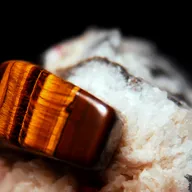 Tiger's eye
A stripe of light that slides across the stone when you tilt it.
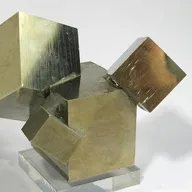 Pyrite
Fool's gold, in cubes so sharp they look machined.
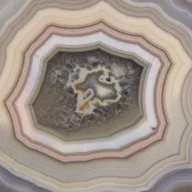 Agate
Chalcedony laid down in bands, one over the next, inside a bubble in old lava.
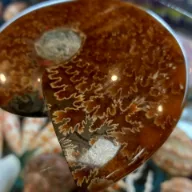 Ammonite
A shell that spiralled through the seas for three hundred million years, turned to stone.
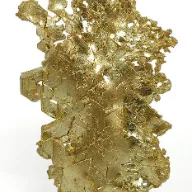 Gold
The one metal that comes out of the ground already finished.
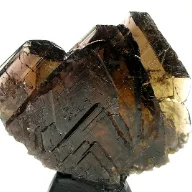 Axinite
Clove-brown wedges of a boron silicate, sharp enough to be named for an axe.
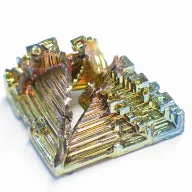 Bismuth
A metal that grows in rainbow staircases — in a saucepan, mostly.
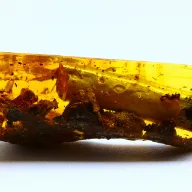 Amber
Not a stone at all: tree resin that leaked out forty million years ago and went hard.
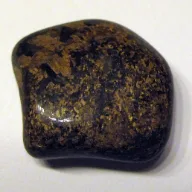 Bronzite
A dark pyroxene with a bronze sheen, from the same family the meteorites are full of.
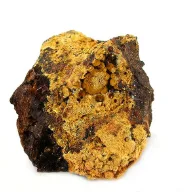 Cacoxenite
Golden needles in iron ore, named the bad guest because they ruined the smelt.
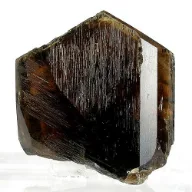 Chrysoberyl
The third hardest gem there is, no relation to beryl, and the only true cat's eye.
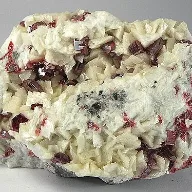 Cinnabar
Mercury ore, the red of every Chinese seal, and the most dangerous mineral in the cabinet.
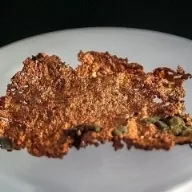 Copper
The first metal anyone ever worked, and one of the few that turns up ready to use.
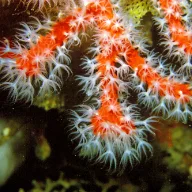 Red coral
The skeleton of a slow-growing animal, worn as a gem for five thousand years.
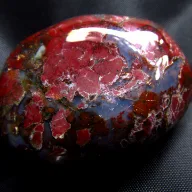 Jasper
Opaque chalcedony, stained by whatever the sediment happened to hold.
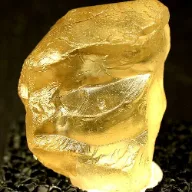 Golden labradorite
Bytownite: a calcium feldspar that cuts into clear champagne gold.
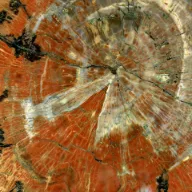 Petrified wood
A tree that became quartz cell by cell, and kept its grain.
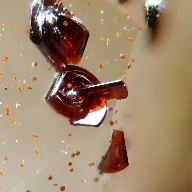 Lepidocrocite
The red half of rust, and the red flecks inside amethyst.
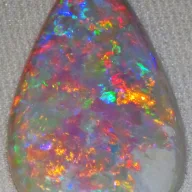 Opal
Water and silica in tiny stacked spheres, splitting light into colour.
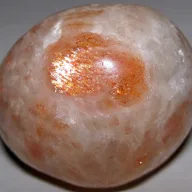 Sunstone
Feldspar full of metal flakes, throwing back the light in orange sparks.
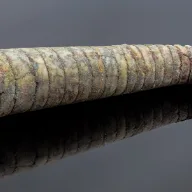 Orthoceras
A straight-shelled squid relative that died four hundred million years ago.
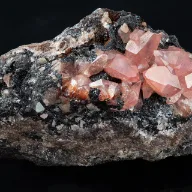 Rhodochrosite
Manganese carbonate in rose red, banded in caves and crystallised in mines.
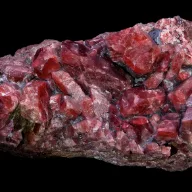 Rhodonite
Pink manganese silicate veined with the black oxide it turns into.
 Ruby
Corundum with chromium in it, and for centuries the most expensive stone on earth.
 Sardonyx
Red-brown and white in straight bands, and the Roman world's seal stone.
 Scheelite
The tungsten ore that glows electric blue under a lamp in the dark.
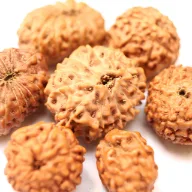 Rudraksha
The stone of a fruit, not of the ground, and the oldest prayer bead in India.
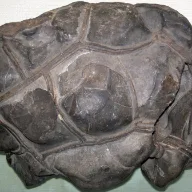 Septarian
A mud nodule that cracked from the inside and filled its own cracks with calcite.
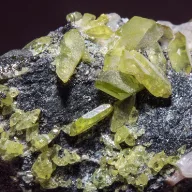 Sphene
Titanite, which throws more fire than a diamond and is far too soft to wear.
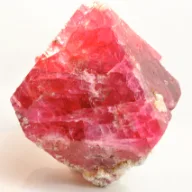 Spinel
Eight hundred years of crown jewels called it a ruby.
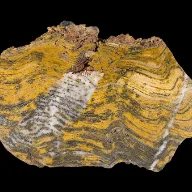 Stromatolite
Three and a half billion years of bacterial mats, turned to stone in layers.
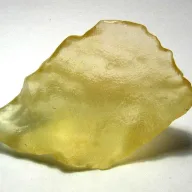 Libyan desert glass
Pale yellow glass lying loose in the Sahara, and a scarab in Tutankhamun's tomb cut from it.
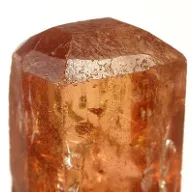 Topaz
Eight on the Mohs scale by definition, and it splits like slate if you hit it right.
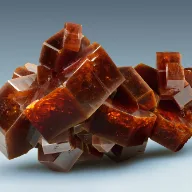 Vanadinite
Hexagonal barrels of orange-red lead vanadate, and the mineral vanadium was found in.
 Zircon
The oldest thing on earth is a grain of it, and no, it is not cubic zirconia.