 Lunarya
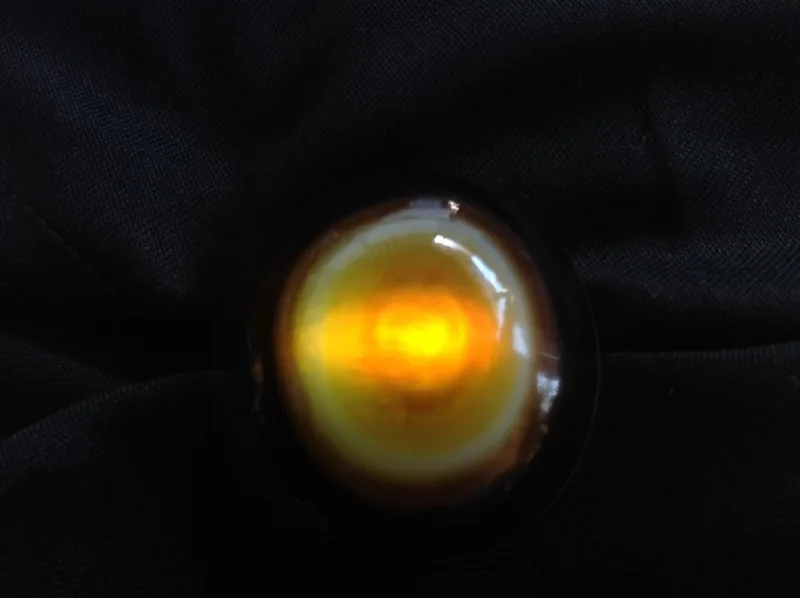
Sardonyx
Sardonyx is onyx with sard in it: straight parallel bands of chalcedony in which the dark layers are red-brown rather than black. Sard is the old name for brownish-red chalcedony, after Sardis in Lydia, and onyx is the Greek for fingernail, after the pale banding. Put them together and you have a stone that two thousand years of carvers would have chosen over almost anything else.
The reason is entirely practical. A cameo carver needs layers of contrasting colour lying flat and parallel, so that cutting down through a white layer leaves a white figure standing on a dark ground. Sardonyx does that better than any other natural material, and the bands are sharp rather than graded. It is chalcedony, so hardness 6.5 to 7, no cleavage, tough, and it takes a polish that holds detail at a fraction of a millimetre. It is one of August's birthstones, on the old list and the modern one alike, where it shares the month with peridot and spinel.
In short
- Colour
- Red, orange and gold
- Mineral
- Chalcedony
- Formula
- SiO₂
- Hardness
- 6.5–7 on the Mohs scale
- Crystal system
- Trigonal
- Found in
- India has been the main source since antiquity and still is; Brazil, Uruguay, Madagascar, Germany at Idar-Oberstein, and the United States also produce it. The sardonyx of the Roman world came largely from India and Arabia by the same trade routes as pepper.
- Birthstone of
- August
- Element
- Fire
- Planet
- Mars
- Chakra
- Root
- Handling
- Water and light are both fine
How it forms
Silica-bearing water fills a cavity in volcanic rock and deposits chalcedony in layers. Where the layers lie flat — building up on a floor, or filling a crack rather than a rounded bubble — the banding comes out straight, and that is what makes onyx and sardonyx rather than agate. Iron in the solution colours some layers brown-red while others stay white, and the alternation records changes in the water over a long time.
In human hands
This is the stone of the Roman signet ring. Sardonyx intaglios sealed letters and contracts across the empire, and the great state cameos — the Gemma Augustea, the Great Cameo of France — are cut in it. Pliny says it was prized for seals because it was almost the only stone that took none of the wax away with it. The Renaissance revived the craft, and Idar-Oberstein in Germany has cut banded chalcedony for more than five hundred years. It appears in the breastplate of Exodus and among the foundations in Revelation.
Varieties and trade names
- Classic sardonyx
- Straight bands of red-brown sard and white; the cameo and intaglio stone of the ancient world.
- Sard
- The plain brown-red chalcedony without banding; darker and browner than carnelian, and the same material.
- Onyx
- The black-and-white version of the same straight banding, which has a page of its own here.
- Roman intaglios
- Seal stones cut into the surface rather than in relief, so the impression stands out in the wax.
- Dyed banded agate
- Most modern sardonyx has had its colours deepened by iron staining or sugar-acid treatment; ancient carvers did this too.
Telling it from a fake
The bands should be straight and parallel, and they should stay straight where the stone curves — a cabochon cut from sardonyx shows the layers as clean lines across the dome. Agate's bands follow the wall of the cavity and curve. Glass imitations have bands that are too regular and often bubbles. As with onyx, assume enhancement: colour treatment of banded chalcedony is ancient practice and does not make a stone fake, though it should be mentioned by the seller.
None of this needs a laboratory, and none of it is proof. A shop that will not say whether a stone is treated has answered the question; ask, and have the answer written on the receipt.
What it is said to do
The old tradition is about steadiness and keeping one's word, which follows from the stone's use in sealing agreements: a sardonyx ring was the thing you pressed into the wax. Roman writers also gave it courage and protection in battle. The modern books keep all of that and add happiness in marriage. It is given to Mars, to Leo and Virgo, and to the root.
Living with it
Hard, tough, waterproof and lightfast; one of the least demanding stones on this site. Warm soapy water and a soft brush clean it. The only caution is for heavily dyed cheap material, which can fade and should stay out of an ultrasonic tank and away from solvents.
In magic
Sardonyx was Rome's sealing stone, cut with a device and pressed into the wax of a contract, so that a sardonyx ring was a promise kept, and Roman soldiers are said to have worn it engraved with Mars or Hercules for courage. Modern practice uses it in workings for fidelity and steadfastness, in charms for a marriage, and in protection bags. The dye in most shop pieces does not matter to the magic, only to the ultrasonic tank.
- Energy
- Projective
- Day
- Tuesday
- Worked for
- Protection · Courage and drive · Love and friendship
More of this colour
 Garnet
Not one mineral but a whole family, and half of it ends up as sandpaper.
 Carnelian
Orange chalcedony, and the stone hot wax will not stick to.
 Citrine
Yellow quartz, except that most of it is amethyst that has been in an oven.
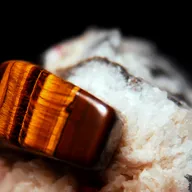 Tiger's eye
A stripe of light that slides across the stone when you tilt it.
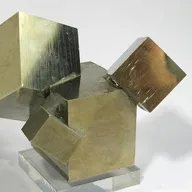 Pyrite
Fool's gold, in cubes so sharp they look machined.
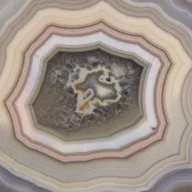 Agate
Chalcedony laid down in bands, one over the next, inside a bubble in old lava.
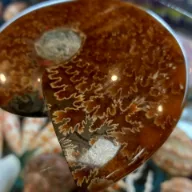 Ammonite
A shell that spiralled through the seas for three hundred million years, turned to stone.
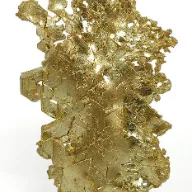 Gold
The one metal that comes out of the ground already finished.
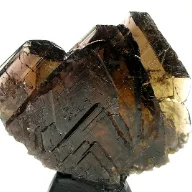 Axinite
Clove-brown wedges of a boron silicate, sharp enough to be named for an axe.
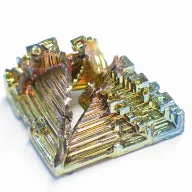 Bismuth
A metal that grows in rainbow staircases — in a saucepan, mostly.
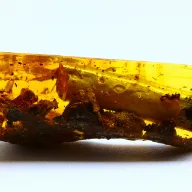 Amber
Not a stone at all: tree resin that leaked out forty million years ago and went hard.
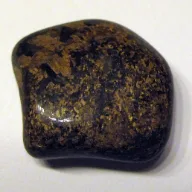 Bronzite
A dark pyroxene with a bronze sheen, from the same family the meteorites are full of.
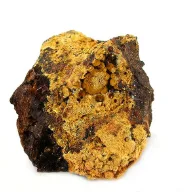 Cacoxenite
Golden needles in iron ore, named the bad guest because they ruined the smelt.
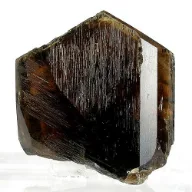 Chrysoberyl
The third hardest gem there is, no relation to beryl, and the only true cat's eye.
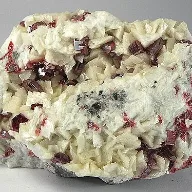 Cinnabar
Mercury ore, the red of every Chinese seal, and the most dangerous mineral in the cabinet.
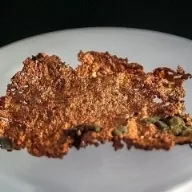 Copper
The first metal anyone ever worked, and one of the few that turns up ready to use.
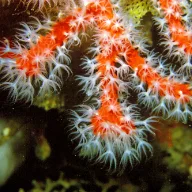 Red coral
The skeleton of a slow-growing animal, worn as a gem for five thousand years.
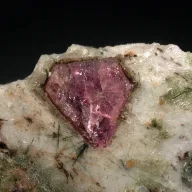 Eudialyte
Raspberry grains in grey Arctic rock, named for dissolving easily.
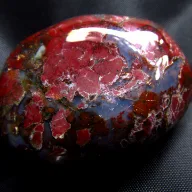 Jasper
Opaque chalcedony, stained by whatever the sediment happened to hold.
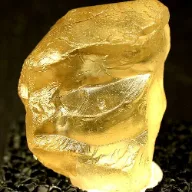 Golden labradorite
Bytownite: a calcium feldspar that cuts into clear champagne gold.
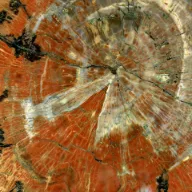 Petrified wood
A tree that became quartz cell by cell, and kept its grain.
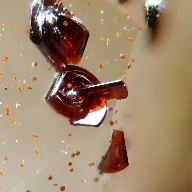 Lepidocrocite
The red half of rust, and the red flecks inside amethyst.
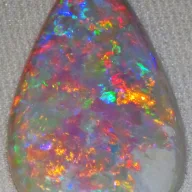 Opal
Water and silica in tiny stacked spheres, splitting light into colour.
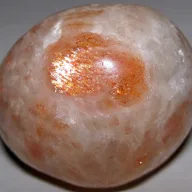 Sunstone
Feldspar full of metal flakes, throwing back the light in orange sparks.
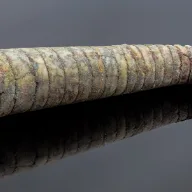 Orthoceras
A straight-shelled squid relative that died four hundred million years ago.
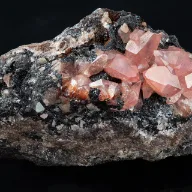 Rhodochrosite
Manganese carbonate in rose red, banded in caves and crystallised in mines.
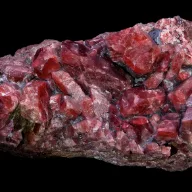 Rhodonite
Pink manganese silicate veined with the black oxide it turns into.
 Ruby
Corundum with chromium in it, and for centuries the most expensive stone on earth.
 Scheelite
The tungsten ore that glows electric blue under a lamp in the dark.
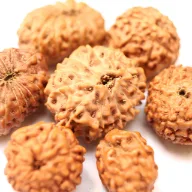 Rudraksha
The stone of a fruit, not of the ground, and the oldest prayer bead in India.
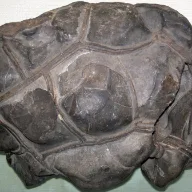 Septarian
A mud nodule that cracked from the inside and filled its own cracks with calcite.
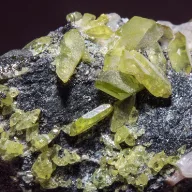 Sphene
Titanite, which throws more fire than a diamond and is far too soft to wear.
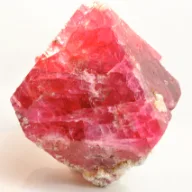 Spinel
Eight hundred years of crown jewels called it a ruby.
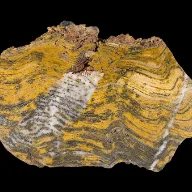 Stromatolite
Three and a half billion years of bacterial mats, turned to stone in layers.
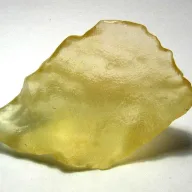 Libyan desert glass
Pale yellow glass lying loose in the Sahara, and a scarab in Tutankhamun's tomb cut from it.
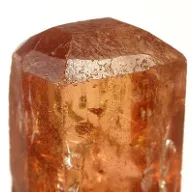 Topaz
Eight on the Mohs scale by definition, and it splits like slate if you hit it right.
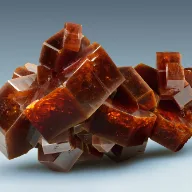 Vanadinite
Hexagonal barrels of orange-red lead vanadate, and the mineral vanadium was found in.
 Zircon
The oldest thing on earth is a grain of it, and no, it is not cubic zirconia.