 Lunarya
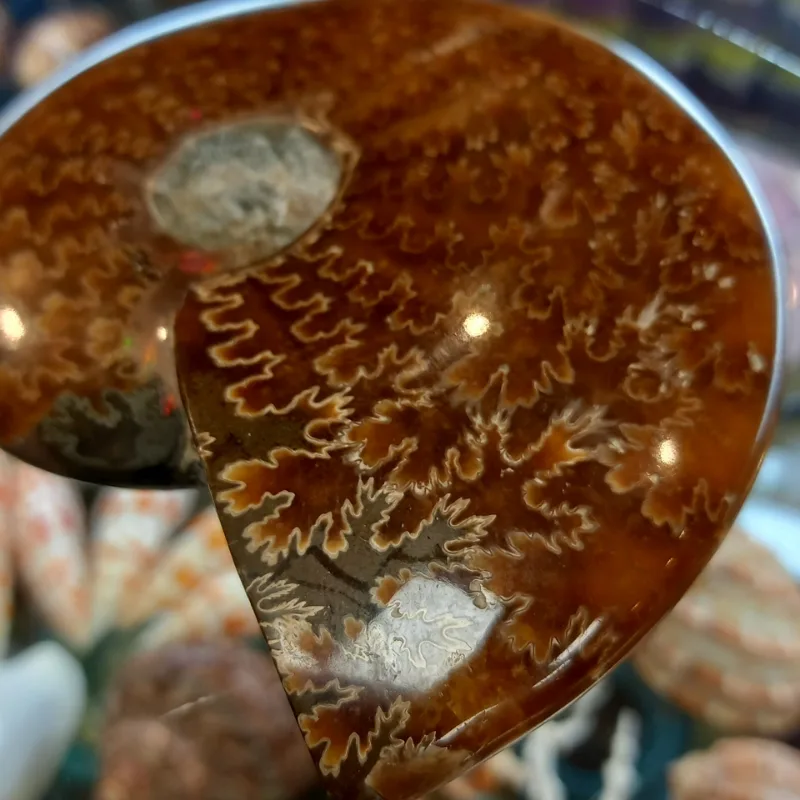
Ammonite
An ammonite is not a mineral but the shell of an animal: a coiled cephalopod, cousin to squid and octopus, that lived in the seas from the Devonian until the end of the Cretaceous and died out with the dinosaurs. What is left is the shell, replaced grain by grain with calcite, pyrite or the aragonite it was made of, and cut and polished it shows the chambers the creature grew through one after another.
The name is Pliny's: he called them the horns of Ammon, after the ram-horned Egyptian god, and the coil has been read as a horn, a snake and a wheel ever since. In Whitby in Yorkshire they were snakestones, serpents turned to stone by the abbess Hilda, and carvers added heads to them to help the story; on the Canadian plains the Blackfoot kept them as buffalo stones; and in India a black one from the Gandaki river is a shaligram, a form of Vishnu, kept in the house and never sold. The largest known was two metres across.
In short
- Colour
- Red, orange and gold
- Mineral
- A fossil, not a mineral
- Formula
- CaCO₃ (aragonite, calcite)
- Hardness
- 3.5–4 on the Mohs scale
- Crystal system
- None — it is a fossil
- Found in
- Morocco, Madagascar, the Jurassic coast of Dorset, Germany, Alberta, and the Gandaki river in Nepal.
- Element
- Earth
- Planet
- Saturn
- Chakra
- Root
- Handling
- Water and light are both fine
How it forms
The living animal built its shell in chambers, moving forward into a new one as it grew and sealing the old behind it with a wall; a tube ran back through all of them, and by pumping gas and water in and out it could rise and sink. When it died the shell settled into the mud of the sea floor and filled with sediment, and over millions of years the aragonite of the shell either survived, recrystallised as calcite, or was replaced by pyrite or silica. The frilled lines on a polished one are the sutures — the edges of the chamber walls where they met the outer shell — and they grew more complex over the ages, which is how a specialist can date a rock from one.
In human hands
Ammonites were tools of science before they were curios: because each species lasted a short time and spread wide, a rock can be dated by the ammonites in it, and the geologists of the nineteenth century built the Jurassic and Cretaceous timescales on them. Before that they were snakestones and lucky charms, sold at Whitby with carved heads, and thunderstones and dragon's teeth across Europe. The trade in polished ammonites from Morocco and Madagascar is a twentieth-century one, and the gem is later still: ammolite, the iridescent shell of ammonites from the Bearpaw shale of Alberta, was recognised as a gemstone in 1981 and is one of the few organic gems found since the Middle Ages.
Varieties and trade names
- Pyritised ammonite
- The shell replaced by brassy iron sulfide, from the Jurassic clays of Dorset, Germany and Russia; small, bright and prone to rot.
- Ammolite
- The original aragonite shell, preserved with its nacre in the Alberta shales, flashing red, green and blue; a gem in its own right.
- Cleoniceras from Madagascar
- The polished halves sold everywhere, Cretaceous, with calcite-filled chambers in honey and brown; most shop ammonites are these.
- Shaligram
- A black ammonite from the Gandaki river in Nepal, kept as a form of Vishnu in Hindu households and never bought or sold.
Telling it from a fake
A real ammonite has sutures, and the sutures are irregular: frilled, branching lines that no two specimens share, and that no mould reproduces cleanly. Cast resin ammonites are common, light for their size, warm to the touch, and show the same suture pattern on every piece in the tray; a knife scratches them, and it does not scratch calcite easily. Composite specimens are more honest and more usual — a real fossil with the missing parts filled and painted — and a good dealer will say so. Pyritised ones are the ones to worry about after purchase, since the pyrite can decay in damp air to a grey powder and sulfuric acid.
None of this needs a laboratory, and none of it is proof. A shop that will not say whether a stone is treated has answered the question; ask, and have the answer written on the receipt.
What it is said to do
The spiral has always done the talking: a stone of cycles, of the turn from one chamber of a life into the next, and of ancestors, since there is nothing older in most collections. The Blackfoot buffalo stone was for calling the herds; the Whitby snakestone was for healing and for luck; the modern lists give it for continuity, for the long view, and for grief, on the sense that this is what remains.
Living with it
Keep a polished one anywhere; wash it with water and a soft cloth. A pyritised one must be kept dry, and a Nepalese shaligram, if you are given one, is bathed and not scrubbed.
In magic
Ammonites have been charms for as long as they have been dug up: the Blackfoot carried iniskim to call the buffalo, Whitby's snakestones had heads carved on them and were sold as the serpents St Hilda turned to stone, and in Nepal a black shaligram is worshipped as Vishnu. Modern witches use the spiral for change, following it in meditation from the centre outwards, and set ammonites on ancestor altars for the dead.
- Energy
- Receptive
- Day
- Saturday
- Worked for
- Change and letting go · Comfort and recovery
More of this colour
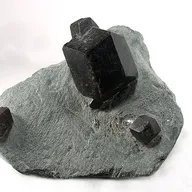 Garnet
Not one mineral but a whole family, and half of it ends up as sandpaper.
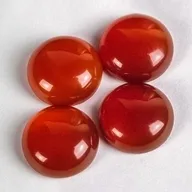 Carnelian
Orange chalcedony, and the stone hot wax will not stick to.
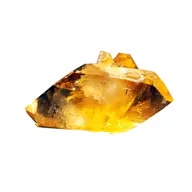 Citrine
Yellow quartz, except that most of it is amethyst that has been in an oven.
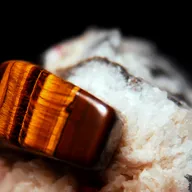 Tiger's eye
A stripe of light that slides across the stone when you tilt it.
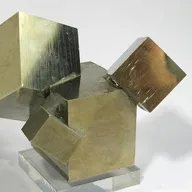 Pyrite
Fool's gold, in cubes so sharp they look machined.
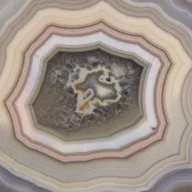 Agate
Chalcedony laid down in bands, one over the next, inside a bubble in old lava.
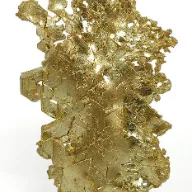 Gold
The one metal that comes out of the ground already finished.
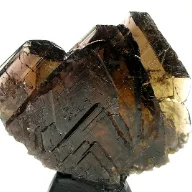 Axinite
Clove-brown wedges of a boron silicate, sharp enough to be named for an axe.
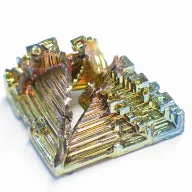 Bismuth
A metal that grows in rainbow staircases — in a saucepan, mostly.
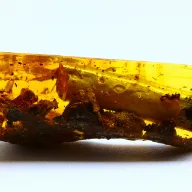 Amber
Not a stone at all: tree resin that leaked out forty million years ago and went hard.
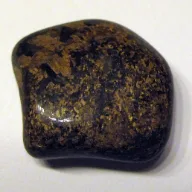 Bronzite
A dark pyroxene with a bronze sheen, from the same family the meteorites are full of.
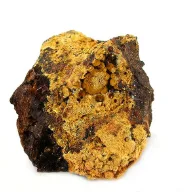 Cacoxenite
Golden needles in iron ore, named the bad guest because they ruined the smelt.
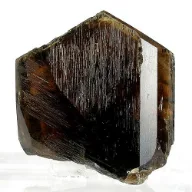 Chrysoberyl
The third hardest gem there is, no relation to beryl, and the only true cat's eye.
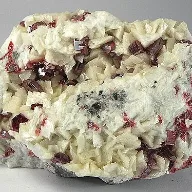 Cinnabar
Mercury ore, the red of every Chinese seal, and the most dangerous mineral in the cabinet.
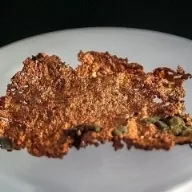 Copper
The first metal anyone ever worked, and one of the few that turns up ready to use.
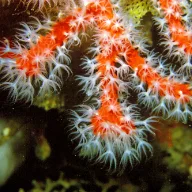 Red coral
The skeleton of a slow-growing animal, worn as a gem for five thousand years.
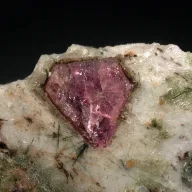 Eudialyte
Raspberry grains in grey Arctic rock, named for dissolving easily.
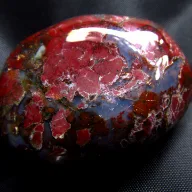 Jasper
Opaque chalcedony, stained by whatever the sediment happened to hold.
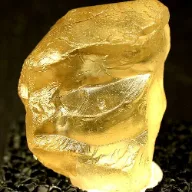 Golden labradorite
Bytownite: a calcium feldspar that cuts into clear champagne gold.
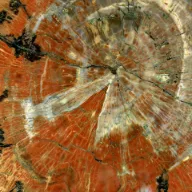 Petrified wood
A tree that became quartz cell by cell, and kept its grain.
 Lepidocrocite
The red half of rust, and the red flecks inside amethyst.
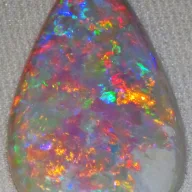 Opal
Water and silica in tiny stacked spheres, splitting light into colour.
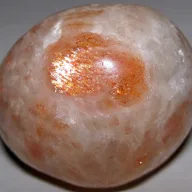 Sunstone
Feldspar full of metal flakes, throwing back the light in orange sparks.
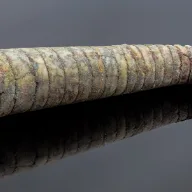 Orthoceras
A straight-shelled squid relative that died four hundred million years ago.
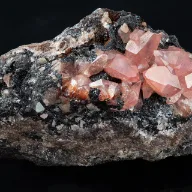 Rhodochrosite
Manganese carbonate in rose red, banded in caves and crystallised in mines.
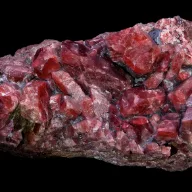 Rhodonite
Pink manganese silicate veined with the black oxide it turns into.
 Ruby
Corundum with chromium in it, and for centuries the most expensive stone on earth.
 Sardonyx
Red-brown and white in straight bands, and the Roman world's seal stone.
 Scheelite
The tungsten ore that glows electric blue under a lamp in the dark.
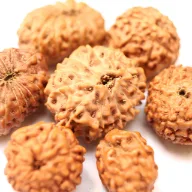 Rudraksha
The stone of a fruit, not of the ground, and the oldest prayer bead in India.
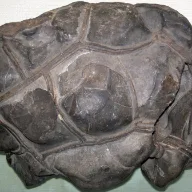 Septarian
A mud nodule that cracked from the inside and filled its own cracks with calcite.
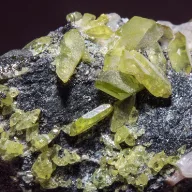 Sphene
Titanite, which throws more fire than a diamond and is far too soft to wear.
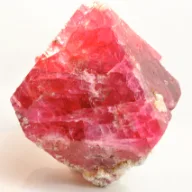 Spinel
Eight hundred years of crown jewels called it a ruby.
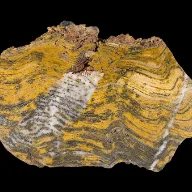 Stromatolite
Three and a half billion years of bacterial mats, turned to stone in layers.
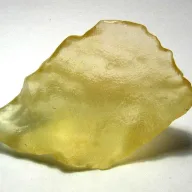 Libyan desert glass
Pale yellow glass lying loose in the Sahara, and a scarab in Tutankhamun's tomb cut from it.
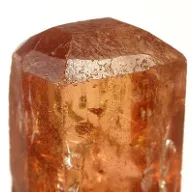 Topaz
Eight on the Mohs scale by definition, and it splits like slate if you hit it right.
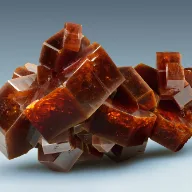 Vanadinite
Hexagonal barrels of orange-red lead vanadate, and the mineral vanadium was found in.
 Zircon
The oldest thing on earth is a grain of it, and no, it is not cubic zirconia.