 Lunarya
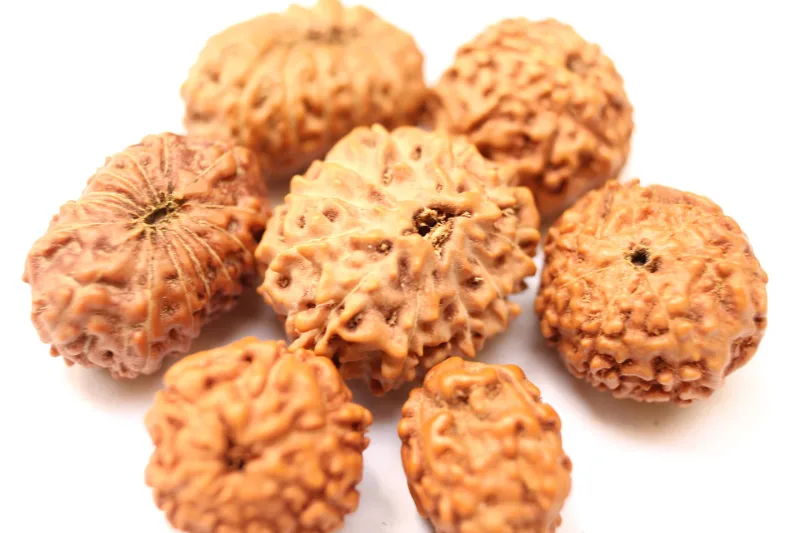
Rudraksha
Rudraksha is a seed. It is the hard stone at the centre of the fruit of Elaeocarpus ganitrus, a tall evergreen tree of the Himalayan foothills and the islands of Southeast Asia, and it is in this collection because the book has it, not because it is a mineral. The fruit is blue when ripe; the stone inside is knobbly and deeply grooved, and those grooves divide the surface into segments that the tradition calls mukhi, faces.
The number of faces decides the value. Five-faced beads are ordinary and make up the great majority of any harvest; one-, two-, three- and fourteen-faced beads are rare, expensive, and faked on an industrial scale by carving grooves into a common bead or by gluing halves together. A mala is 108 beads plus one, and they are worn against the skin, which polishes and darkens them over years. Fresh seeds are light and fibrous; old ones are dense and almost black.
In short
- Colour
- Red, orange and gold
- Mineral
- Organic, not a mineral
- Formula
- C, H, O
- Hardness
- 2–3 on the Mohs scale
- Crystal system
- None — it is organic
- Found in
- Nepal, especially the Terai and the middle hills, produces the beads most valued in the trade; Indonesia, on Java and in Kalimantan, produces the largest volume and smaller beads. Also India, Myanmar and the Pacific islands.
- Element
- Earth
- Planet
- Jupiter
- Chakra
- Crown
- Handling
- Keep out of water
How it forms
A tree flowers, fruits and drops; the flesh rots or is stripped, and the stone is cleaned and dried. That is the whole of it. What geology does for the other pages here, horticulture does for this one: soil, altitude and rainfall change the size and the hardness of the bead, and Nepalese beads from higher ground are denser and more deeply grooved than Indonesian ones.
In human hands
The name means Rudra's eyes, from the Shaivite story that Shiva wept for the world and the tears became these trees. Rudraksha malas appear in the Puranas and have been worn by ascetics, householders and kings for well over a thousand years; the bead is to Shaivism roughly what the rosary is to Catholicism. It has been an article of trade across Asia for as long, and the grading of mukhi is an old and serious business with its own literature.
Varieties and trade names
- Panchamukhi
- The five-faced bead, by far the commonest, associated with Shiva as Kalagni Rudra and used for most malas.
- Ek mukhi
- The one-faced bead, the rarest and most venerated; almost everything sold under the name is carved or assembled.
- Nepalese beads
- Larger, denser and more deeply grooved than the Indonesian, and priced several times higher.
- Indonesian beads
- Small and smooth, from Java; the great bulk of the world's supply and perfectly serviceable.
- Gauri Shankar
- Two beads naturally joined, read as Shiva and Parvati together; genuinely uncommon and much imitated.
Telling it from a fake
Look at the grooves where they meet the ends. In a natural bead the lines converge at the tip and are irregular in width; in a carved one they are cut with a tool and are too even, and the ends often show where the knife stopped. A seam of glue or a difference in colour between the halves means an assembled bead. The floating test that circulates online — that a genuine bead sinks — is unreliable; density varies with age and species, and plenty of real beads float.
None of this needs a laboratory, and none of it is proof. A shop that will not say whether a stone is treated has answered the question; ask, and have the answer written on the receipt.
What it is said to do
The tradition is devotional rather than lapidary: the bead is worn to keep a practice going, counted through in recitation, and treated as a link to Shiva rather than as a stone with a property. Modern books have added blood pressure and stress, and it is worth saying that the clinical evidence for those is thin. It is given to Jupiter, to Sagittarius and Pisces, and to the crown.
Living with it
It is organic and it dries out. Keep it off harsh soap and out of long soaking, oil it occasionally with a light oil if it looks chalky, and do not leave it in a hot car. Worn against the skin it will darken and shine, which is what it is meant to do. Traditional practice also says not to wear a mala into a bathroom, which is a matter of respect rather than of chemistry.
In magic
Rudraksha is not a stone for spells. It is a sacred object in Hindu practice, worn by devotees of Shiva and counted through in japa, the repetition of a mantra, and it is treated with the respect due to one. Western witches who keep a mala of it generally use it as Hindus do, to count a meditation and steady a mind, which is the honest use of it here too.
- Energy
- Receptive
- Day
- Thursday
- Worked for
- Calm and peace
More of this colour
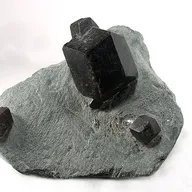 Garnet
Not one mineral but a whole family, and half of it ends up as sandpaper.
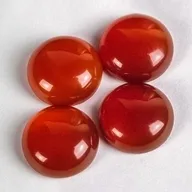 Carnelian
Orange chalcedony, and the stone hot wax will not stick to.
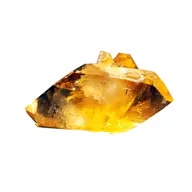 Citrine
Yellow quartz, except that most of it is amethyst that has been in an oven.
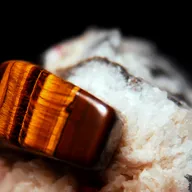 Tiger's eye
A stripe of light that slides across the stone when you tilt it.
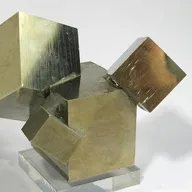 Pyrite
Fool's gold, in cubes so sharp they look machined.
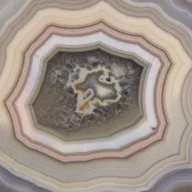 Agate
Chalcedony laid down in bands, one over the next, inside a bubble in old lava.
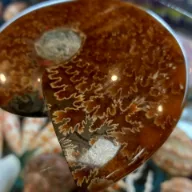 Ammonite
A shell that spiralled through the seas for three hundred million years, turned to stone.
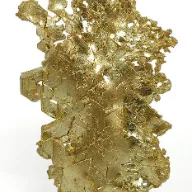 Gold
The one metal that comes out of the ground already finished.
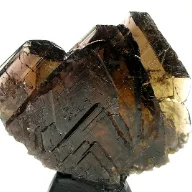 Axinite
Clove-brown wedges of a boron silicate, sharp enough to be named for an axe.
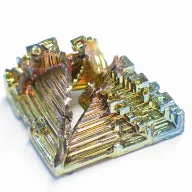 Bismuth
A metal that grows in rainbow staircases — in a saucepan, mostly.
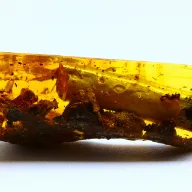 Amber
Not a stone at all: tree resin that leaked out forty million years ago and went hard.
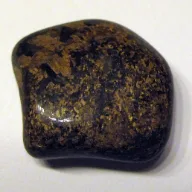 Bronzite
A dark pyroxene with a bronze sheen, from the same family the meteorites are full of.
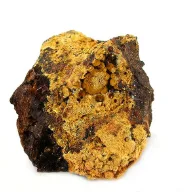 Cacoxenite
Golden needles in iron ore, named the bad guest because they ruined the smelt.
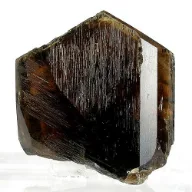 Chrysoberyl
The third hardest gem there is, no relation to beryl, and the only true cat's eye.
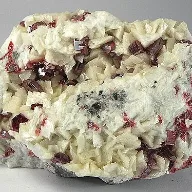 Cinnabar
Mercury ore, the red of every Chinese seal, and the most dangerous mineral in the cabinet.
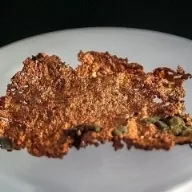 Copper
The first metal anyone ever worked, and one of the few that turns up ready to use.
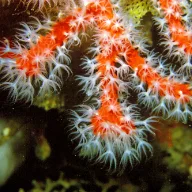 Red coral
The skeleton of a slow-growing animal, worn as a gem for five thousand years.
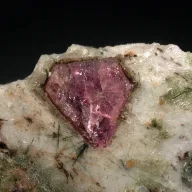 Eudialyte
Raspberry grains in grey Arctic rock, named for dissolving easily.
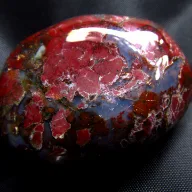 Jasper
Opaque chalcedony, stained by whatever the sediment happened to hold.
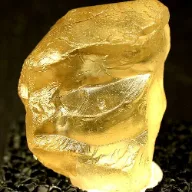 Golden labradorite
Bytownite: a calcium feldspar that cuts into clear champagne gold.
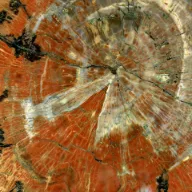 Petrified wood
A tree that became quartz cell by cell, and kept its grain.
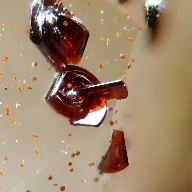 Lepidocrocite
The red half of rust, and the red flecks inside amethyst.
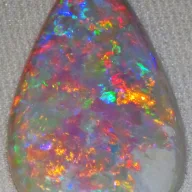 Opal
Water and silica in tiny stacked spheres, splitting light into colour.
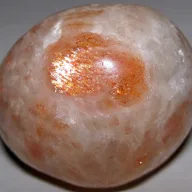 Sunstone
Feldspar full of metal flakes, throwing back the light in orange sparks.
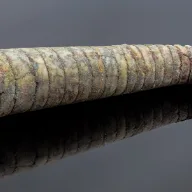 Orthoceras
A straight-shelled squid relative that died four hundred million years ago.
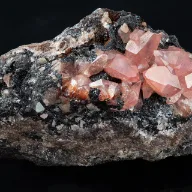 Rhodochrosite
Manganese carbonate in rose red, banded in caves and crystallised in mines.
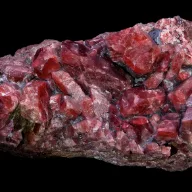 Rhodonite
Pink manganese silicate veined with the black oxide it turns into.
 Ruby
Corundum with chromium in it, and for centuries the most expensive stone on earth.
 Sardonyx
Red-brown and white in straight bands, and the Roman world's seal stone.
 Scheelite
The tungsten ore that glows electric blue under a lamp in the dark.
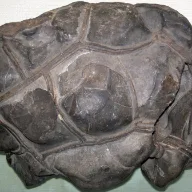 Septarian
A mud nodule that cracked from the inside and filled its own cracks with calcite.
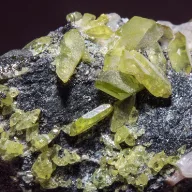 Sphene
Titanite, which throws more fire than a diamond and is far too soft to wear.
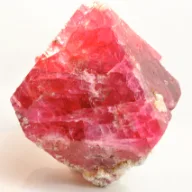 Spinel
Eight hundred years of crown jewels called it a ruby.
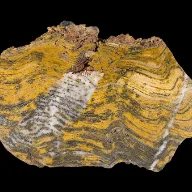 Stromatolite
Three and a half billion years of bacterial mats, turned to stone in layers.
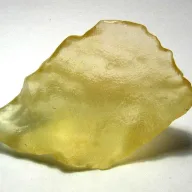 Libyan desert glass
Pale yellow glass lying loose in the Sahara, and a scarab in Tutankhamun's tomb cut from it.
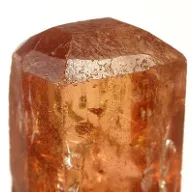 Topaz
Eight on the Mohs scale by definition, and it splits like slate if you hit it right.
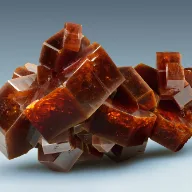 Vanadinite
Hexagonal barrels of orange-red lead vanadate, and the mineral vanadium was found in.
 Zircon
The oldest thing on earth is a grain of it, and no, it is not cubic zirconia.