 Lunarya
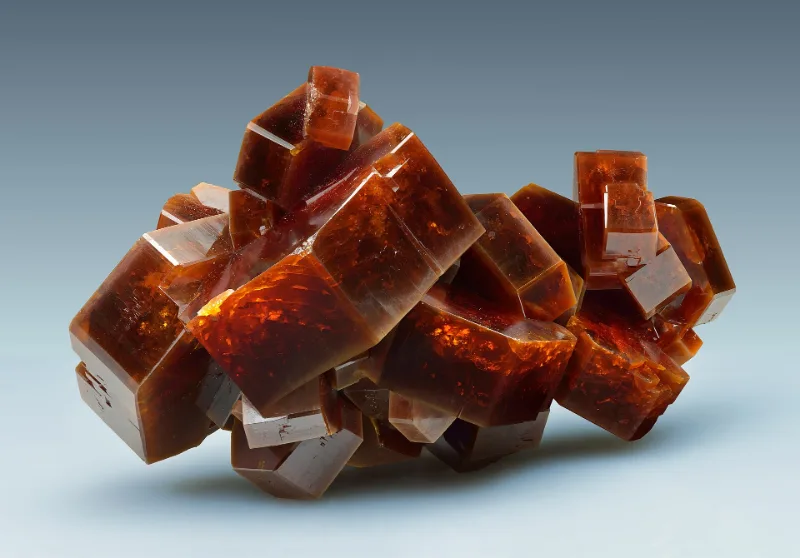
Vanadinite
Vanadinite is lead chlorovanadate, Pb₅(VO₄)₃Cl, a member of the apatite group and one of the most vivid minerals there is: orange-red to blood red to brown, in short hexagonal barrels and flat plates with a resinous shine. It is soft, 3 to 4 on the Mohs scale, and very heavy for its size, because nearly three-quarters of its weight is lead. That lead is also why the page ends with a warning.
The crystals are often hollow. Vanadinite grows fastest at the edges of a face, so a barrel can end up as a rim of crystal around an empty middle — a hopper crystal, the same habit that makes a snowflake or a halite hopper. It also grades into mimetite as arsenic replaces vanadium; the intermediate is called endlichite, and a single crystal can zone from one to the other, which is visible as colour bands from red through orange to pale yellow.
In short
- Colour
- Red, orange and gold
- Mineral
- Phosphate
- Formula
- Pb₅(VO₄)₃Cl
- Hardness
- 3–4 on the Mohs scale
- Crystal system
- Hexagonal
- Found in
- Mibladen and Touissit in Morocco, which between them supply nearly every vanadinite on a shop shelf. Also the Old Yuma and Apache mines in Arizona, Chihuahua in Mexico, Tsumeb in Namibia, and Córdoba in Argentina.
- Element
- Fire
- Planet
- Mars
- Chakra
- Sacral
- Handling
- Water and light are both fine
How it forms
Vanadinite is a secondary mineral. It forms in the oxidised upper part of a lead deposit, where groundwater has broken down the original galena and vanadium has been leached out of the surrounding rock and brought in. That needs an arid climate — enough water to move things, not enough to wash them away — which is why the great localities are in Morocco, Arizona, Mexico and Namibia and not in wet country. It sits in cavities and on barite and goethite, and the best groups took thousands of years of slow evaporation to build.
In human hands
Andrés Manuel del Río, in Mexico City in 1801, found a new element in a brown lead ore from Zimapán and called it erythronium for the red colour of its salts. A French chemist told him he had merely found chromium, and he withdrew the claim. Nils Gabriel Sefström found the same element in Swedish iron in 1830 and named it vanadium, after Vanadís, a name of the Norse goddess Freyja, for the beautiful colours of its compounds. Wöhler then showed that del Río had been right all along, and the mineral he had been looking at was named vanadinite in 1838. Vanadium today goes mostly into steel: a few tenths of a per cent makes it dramatically tougher.
Varieties and trade names
- Mibladen vanadinite
- The classic: deep orange-red barrels scattered over white barite. Most vanadinite in circulation is this, and it is still being mined.
- Hopper crystals
- Hollow barrels, grown as a rim around an empty centre. Sought by collectors and very easy to break.
- Endlichite
- Arsenic-bearing vanadinite on the way to mimetite; paler, yellower, and often colour-zoned within a single crystal.
- Brown vanadinite
- The Arizona habit is often a dark reddish brown in thicker crystals; the same mineral, less photogenic, and sometimes better formed.
- Descloizite and mottramite
- The other lead vanadates that grow with it, in brown and green; they are frequently sold as vanadinite and are not the same species.
Telling it from a fake
The colour and the shape together are close to unmistakable: hexagonal orange-red barrels, glassy to resinous, sitting loose on a matrix. Weight confirms it — the specific gravity is nearly 7, so a small piece feels wrong in the hand. Wulfenite is orange too but grows in thin square plates. Crocoite is red but in long slender needles. Realgar is red and soft but breaks down in light, which vanadinite does not.
None of this needs a laboratory, and none of it is proof. A shop that will not say whether a stone is treated has answered the question; ask, and have the answer written on the receipt.
What it is said to do
The tradition gives vanadinite to appetite and drive — the beginning of a thing rather than the finishing of it — and it is the stone recommended for people who can plan but cannot start. It goes with fire, with Mars, with Aries and Scorpio, and with the sacral centre. The colour and the association with a metal that toughens steel are doing all the work, which is worth saying, because the mineral is also two-thirds lead and much of the writing about wearing it and making water with it is advice not to follow.
Living with it
Do not make elixirs, do not tumble it, do not sand or drill it, and wash your hands after handling. Vanadinite is a lead mineral, and lead is absorbed through the gut; the risk from handling a solid specimen is small, and the risk from its dust is not. It is also soft and brittle, with crystals that shear off the matrix at a touch, so it is a display piece rather than a pocket stone. Keep it dry and dust it with a blower. Light does not affect it.
In magic
Vanadinite is used in modern practice for drive: a specimen on the desk or the altar in workings to start something put off too long, beside a red candle on a Tuesday. It is a lead mineral, so it is a stone to set down and look at, never to hold through a ritual, put in water or wear, and any spell with it ends with washing one's hands.
- Energy
- Projective
- Day
- Tuesday
- Worked for
- Courage and drive
More of this colour
 Garnet
Not one mineral but a whole family, and half of it ends up as sandpaper.
 Carnelian
Orange chalcedony, and the stone hot wax will not stick to.
 Citrine
Yellow quartz, except that most of it is amethyst that has been in an oven.
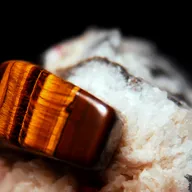 Tiger's eye
A stripe of light that slides across the stone when you tilt it.
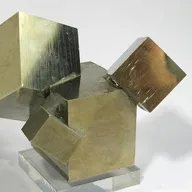 Pyrite
Fool's gold, in cubes so sharp they look machined.
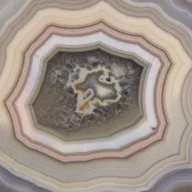 Agate
Chalcedony laid down in bands, one over the next, inside a bubble in old lava.
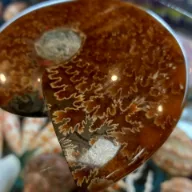 Ammonite
A shell that spiralled through the seas for three hundred million years, turned to stone.
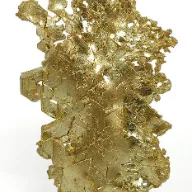 Gold
The one metal that comes out of the ground already finished.
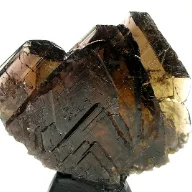 Axinite
Clove-brown wedges of a boron silicate, sharp enough to be named for an axe.
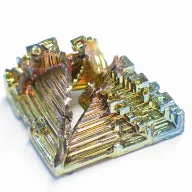 Bismuth
A metal that grows in rainbow staircases — in a saucepan, mostly.
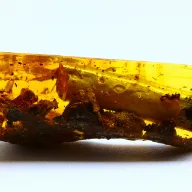 Amber
Not a stone at all: tree resin that leaked out forty million years ago and went hard.
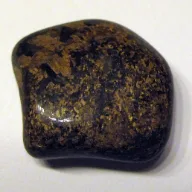 Bronzite
A dark pyroxene with a bronze sheen, from the same family the meteorites are full of.
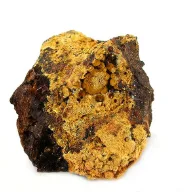 Cacoxenite
Golden needles in iron ore, named the bad guest because they ruined the smelt.
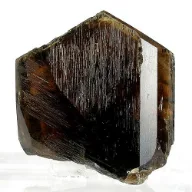 Chrysoberyl
The third hardest gem there is, no relation to beryl, and the only true cat's eye.
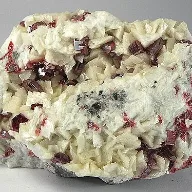 Cinnabar
Mercury ore, the red of every Chinese seal, and the most dangerous mineral in the cabinet.
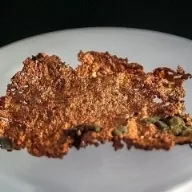 Copper
The first metal anyone ever worked, and one of the few that turns up ready to use.
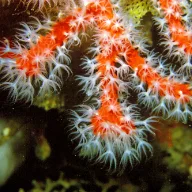 Red coral
The skeleton of a slow-growing animal, worn as a gem for five thousand years.
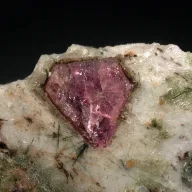 Eudialyte
Raspberry grains in grey Arctic rock, named for dissolving easily.
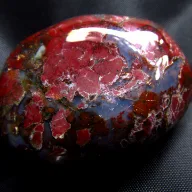 Jasper
Opaque chalcedony, stained by whatever the sediment happened to hold.
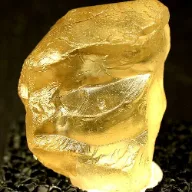 Golden labradorite
Bytownite: a calcium feldspar that cuts into clear champagne gold.
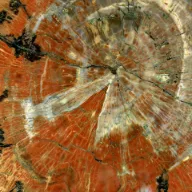 Petrified wood
A tree that became quartz cell by cell, and kept its grain.
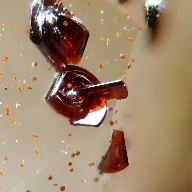 Lepidocrocite
The red half of rust, and the red flecks inside amethyst.
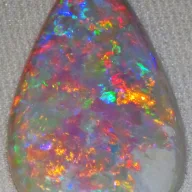 Opal
Water and silica in tiny stacked spheres, splitting light into colour.
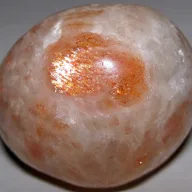 Sunstone
Feldspar full of metal flakes, throwing back the light in orange sparks.
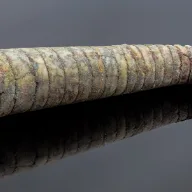 Orthoceras
A straight-shelled squid relative that died four hundred million years ago.
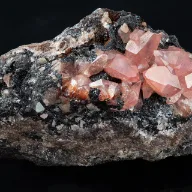 Rhodochrosite
Manganese carbonate in rose red, banded in caves and crystallised in mines.
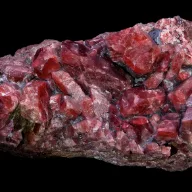 Rhodonite
Pink manganese silicate veined with the black oxide it turns into.
 Ruby
Corundum with chromium in it, and for centuries the most expensive stone on earth.
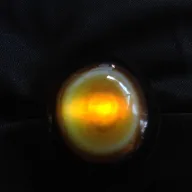 Sardonyx
Red-brown and white in straight bands, and the Roman world's seal stone.
 Scheelite
The tungsten ore that glows electric blue under a lamp in the dark.
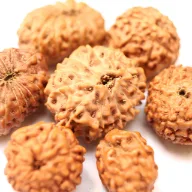 Rudraksha
The stone of a fruit, not of the ground, and the oldest prayer bead in India.
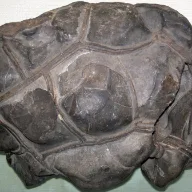 Septarian
A mud nodule that cracked from the inside and filled its own cracks with calcite.
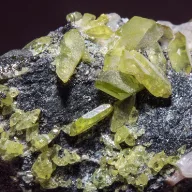 Sphene
Titanite, which throws more fire than a diamond and is far too soft to wear.
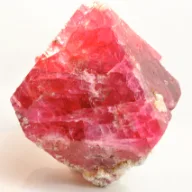 Spinel
Eight hundred years of crown jewels called it a ruby.
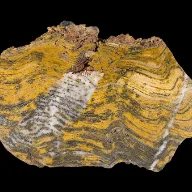 Stromatolite
Three and a half billion years of bacterial mats, turned to stone in layers.
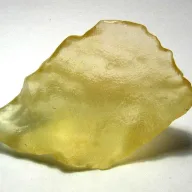 Libyan desert glass
Pale yellow glass lying loose in the Sahara, and a scarab in Tutankhamun's tomb cut from it.
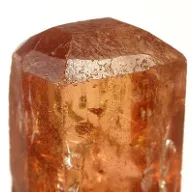 Topaz
Eight on the Mohs scale by definition, and it splits like slate if you hit it right.
 Zircon
The oldest thing on earth is a grain of it, and no, it is not cubic zirconia.