 Lunarya
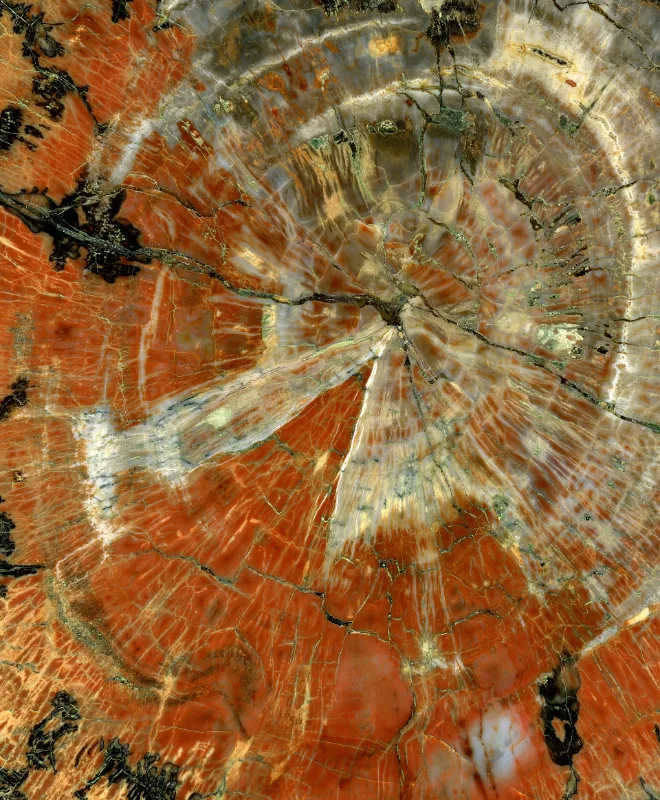
Petrified wood
Petrified wood is a fossil in the strictest sense: a tree in which the original organic material has been replaced, molecule for molecule and cell wall for cell wall, by silica. What is left is quartz in the shape of wood, keeping the growth rings, the bark texture, the knots and, under a microscope, individual cells with their walls intact. It is hard, 6.5 to 7, and takes a polish like agate, which is what it chemically is.
The process is permineralisation. Silica-rich water soaks into buried wood, deposits quartz inside the cell cavities, and then, slowly, dissolves the cellulose and lignin and fills those spaces too. If the exchange happens gently enough the structure survives at cellular scale. The colours are impurities: iron gives red, orange and yellow; manganese gives pink and purple; carbon and pyrite give black; chromium and copper occasionally give green and blue. A log that shows every colour has simply sat in changeable groundwater.
In short
- Colour
- Red, orange and gold
- Mineral
- A fossil, not a mineral
- Formula
- SiO₂
- Hardness
- 6.5–7 on the Mohs scale
- Crystal system
- None — it is a fossil
- Found in
- The Petrified Forest in Arizona is the famous one, from Triassic rock about 225 million years old. Others are Argentina, Madagascar, Indonesia, Namibia, Egypt, Australia, Greece on Lesbos, and the Yellowstone forests in Wyoming.
- Element
- Earth
- Planet
- Saturn
- Chakra
- Root
- Handling
- Water and light are both fine
How it forms
A tree falls into water or is buried by volcanic ash. Ash is the key ingredient in most great deposits, because volcanic glass weathers and floods the groundwater with dissolved silica. Buried without oxygen, the wood does not rot; instead the silica precipitates in and around it over tens of thousands of years, and the log turns to stone from the outside in. Arizona's logs floated into a river system and were buried by ash from volcanoes to the west.
In human hands
People have picked it up for as long as they have walked over it; petrified wood turns up in prehistoric tool kits where better flint was scarce, and Roman villas used slices as ornament. Its modern chapter is conservation: Arizona's deposit was being carted away by the wagonload for abrasives and souvenirs until the Petrified Forest was made a national monument in 1906, one of the first uses of the American Antiquities Act. Taking any from the park is still illegal.
Varieties and trade names
- Arizona rainbow wood
- Triassic logs from the Chinle Formation, in red, orange and yellow; legally collected only from private land outside the park.
- Madagascan wood
- Permian and Triassic conifers, often black and cream with very fine cell detail; most of the tumbled material.
- Opalised wood
- Replaced by opal instead of quartz, softer and sometimes with a play of colour; Australia produces the best.
- Peanut wood
- Australian fossil driftwood peppered with pale oval marks, which are clam borings filled with white quartz.
- Araucaria and palm wood
- The two structures most often recognisable by eye: conifer rings, and the dotted rods of fossil palm.
Telling it from a fake
Look for the grain. A polished slice should show rings, rays and a cell structure that stays consistent across the piece, and bark texture on an unpolished edge. Agate mimics banding but not the radial and concentric structure of wood together. Modern resin imitations are light and warm and smell under a hot pin. If the piece is soft enough to scratch with a knife, it is either opalised wood or not wood at all.
None of this needs a laboratory, and none of it is proof. A shop that will not say whether a stone is treated has answered the question; ask, and have the answer written on the receipt.
What it is said to do
The obvious reading, and it is the one every book gives: time, patience, a very long view, and being rooted. It is placed at the root, under Saturn, with Virgo and Capricorn, and is one of the stones handed to people who are impatient with how slowly something is going. The association is modern, but it is hard to argue with.
Living with it
Nothing to worry about. It is quartz, so water, sunlight and daily handling are all fine, and a soft brush with warm water cleans it. The only two cautions are legal rather than physical: material from protected sites is illegal to take or sell, and some cheap slices are dyed to brighten the colours, which then fade.
In magic
Petrified wood is used in modern practice for workings that take a long time: patience spells, ancestor altars, rituals for staying with a slow job. Its best-documented magic is a curse. Petrified Forest National Park in Arizona keeps a pile of pieces posted back by visitors who took them home and then had a run of bad luck, with their letters of apology. Leaving it where it lies is part of the ritual.
- Energy
- Receptive
- Day
- Saturday
- Worked for
- Grounding and endurance
More of this colour
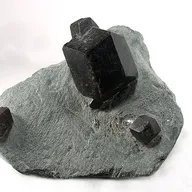 Garnet
Not one mineral but a whole family, and half of it ends up as sandpaper.
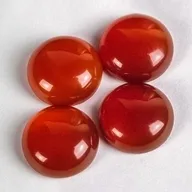 Carnelian
Orange chalcedony, and the stone hot wax will not stick to.
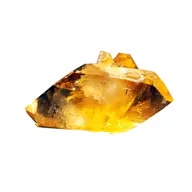 Citrine
Yellow quartz, except that most of it is amethyst that has been in an oven.
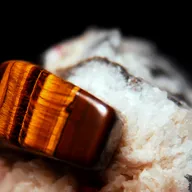 Tiger's eye
A stripe of light that slides across the stone when you tilt it.
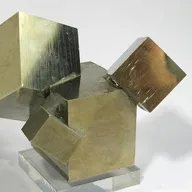 Pyrite
Fool's gold, in cubes so sharp they look machined.
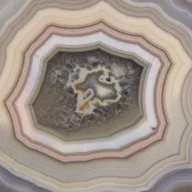 Agate
Chalcedony laid down in bands, one over the next, inside a bubble in old lava.
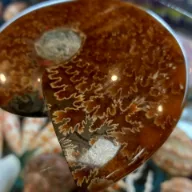 Ammonite
A shell that spiralled through the seas for three hundred million years, turned to stone.
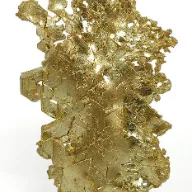 Gold
The one metal that comes out of the ground already finished.
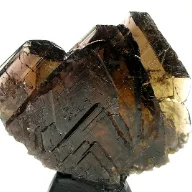 Axinite
Clove-brown wedges of a boron silicate, sharp enough to be named for an axe.
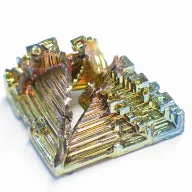 Bismuth
A metal that grows in rainbow staircases — in a saucepan, mostly.
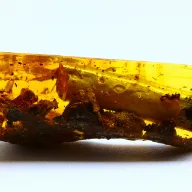 Amber
Not a stone at all: tree resin that leaked out forty million years ago and went hard.
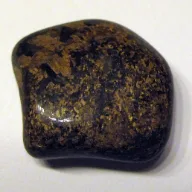 Bronzite
A dark pyroxene with a bronze sheen, from the same family the meteorites are full of.
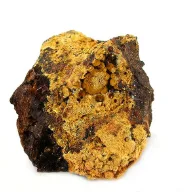 Cacoxenite
Golden needles in iron ore, named the bad guest because they ruined the smelt.
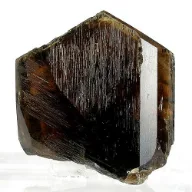 Chrysoberyl
The third hardest gem there is, no relation to beryl, and the only true cat's eye.
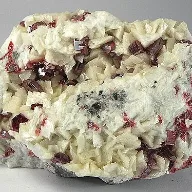 Cinnabar
Mercury ore, the red of every Chinese seal, and the most dangerous mineral in the cabinet.
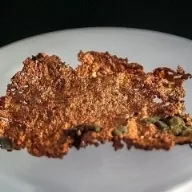 Copper
The first metal anyone ever worked, and one of the few that turns up ready to use.
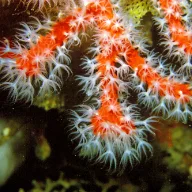 Red coral
The skeleton of a slow-growing animal, worn as a gem for five thousand years.
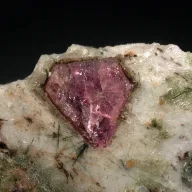 Eudialyte
Raspberry grains in grey Arctic rock, named for dissolving easily.
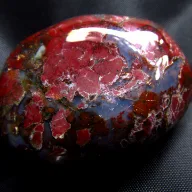 Jasper
Opaque chalcedony, stained by whatever the sediment happened to hold.
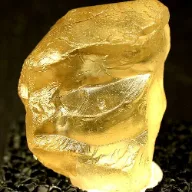 Golden labradorite
Bytownite: a calcium feldspar that cuts into clear champagne gold.
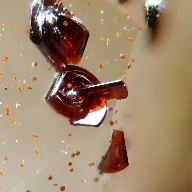 Lepidocrocite
The red half of rust, and the red flecks inside amethyst.
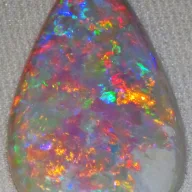 Opal
Water and silica in tiny stacked spheres, splitting light into colour.
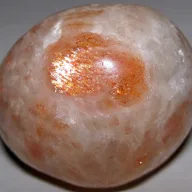 Sunstone
Feldspar full of metal flakes, throwing back the light in orange sparks.
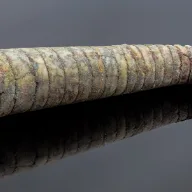 Orthoceras
A straight-shelled squid relative that died four hundred million years ago.
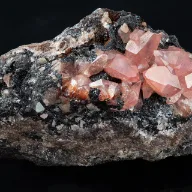 Rhodochrosite
Manganese carbonate in rose red, banded in caves and crystallised in mines.
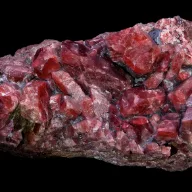 Rhodonite
Pink manganese silicate veined with the black oxide it turns into.
 Ruby
Corundum with chromium in it, and for centuries the most expensive stone on earth.
 Sardonyx
Red-brown and white in straight bands, and the Roman world's seal stone.
 Scheelite
The tungsten ore that glows electric blue under a lamp in the dark.
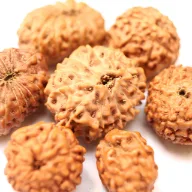 Rudraksha
The stone of a fruit, not of the ground, and the oldest prayer bead in India.
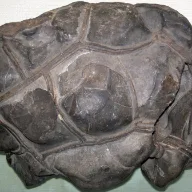 Septarian
A mud nodule that cracked from the inside and filled its own cracks with calcite.
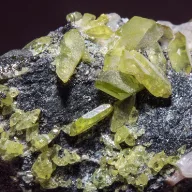 Sphene
Titanite, which throws more fire than a diamond and is far too soft to wear.
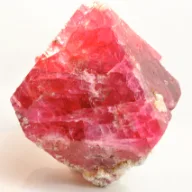 Spinel
Eight hundred years of crown jewels called it a ruby.
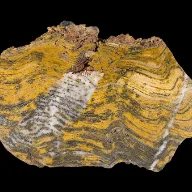 Stromatolite
Three and a half billion years of bacterial mats, turned to stone in layers.
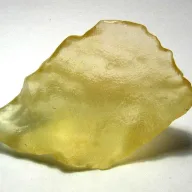 Libyan desert glass
Pale yellow glass lying loose in the Sahara, and a scarab in Tutankhamun's tomb cut from it.
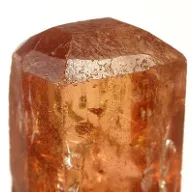 Topaz
Eight on the Mohs scale by definition, and it splits like slate if you hit it right.
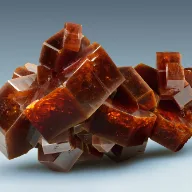 Vanadinite
Hexagonal barrels of orange-red lead vanadate, and the mineral vanadium was found in.
 Zircon
The oldest thing on earth is a grain of it, and no, it is not cubic zirconia.