 Lunarya
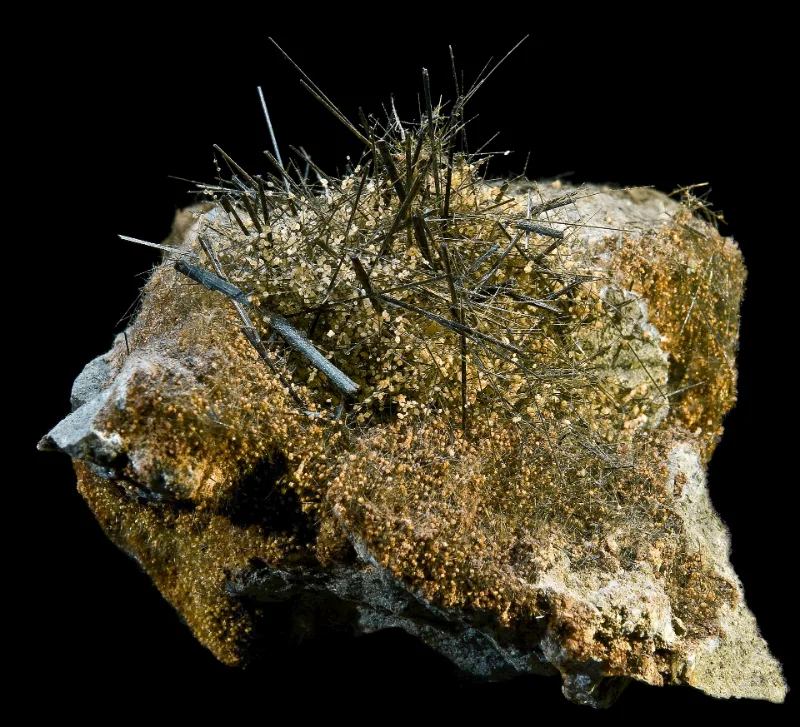
Actinolite
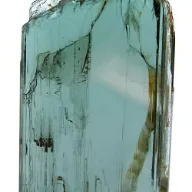
Actinolite is an amphibole: a calcium, magnesium and iron silicate that grows in long thin blades and needles, green because of the iron, and darker the more of it there is. It is common in rocks that have been squeezed and heated, and it comes in every habit from glassy prisms to felted masses of fibre.
It is the mineral nephrite is made of. When the needles grow so fine and so tangled that no single one can be seen, the result is the tougher of the two jades, the one China has carved for thousands of years — so a great deal of actinolite has passed through human hands under another name. In its loosest form it is one of the six minerals classed as asbestos, and a handful of old mines, in Australia and elsewhere, were worked for it. The name is Greek, aktis, a ray, for the way the needles fan out from a point.
In short
- Colour
- Green
- Mineral
- Amphibole
- Formula
- Ca₂(Mg,Fe)₅Si₈O₂₂(OH)₂
- Hardness
- 5–6 on the Mohs scale
- Crystal system
- Monoclinic
- Found in
- Taiwan and British Columbia for nephrite; Austria, Italy, Portugal, the Urals and the USA for crystals.
- Element
- Earth
- Planet
- Saturn
- Chakra
- Heart
- Handling
- Water and light are both fine
How it forms
Actinolite is a mineral of metamorphism. It grows where basalt, dolomite or serpentine is heated and pressed, in the greenschist belts of old mountain roots and in the aureoles around cooling granite, taking its calcium from the limestone and its iron and magnesium from the dark rock. In an open crack it grows as separate blades; in a rock under strain it grows as a felt of needles pointing every way, which is how nephrite gets a toughness no single crystal has. The pale end of the series, with the iron replaced by magnesium, is tremolite; the two grade into each other without a line.
In human hands
The needles were named by Kirwan in 1794 for the way they radiate, and the stone had been in use for most of human history before that as nephrite, which nobody knew was the same mineral until the microscope. As asbestos it had a shorter and worse career: the fibrous form was mined at Gundagai in New South Wales and used in insulation and cement, and it is one of the six regulated asbestos minerals now, because the fibres are fine enough to lodge in a lung. The crystals sold to collectors are the harmless kind, single needles too large to breathe, from alpine veins in the Tyrol and Piedmont and the phlogopite quarries of Ontario.
Varieties and trade names
- Nephrite
- Actinolite grown as a dense felt of microscopic fibres: one of the two jades, and the tougher of them.
- Byssolite
- Hair-fine green needles in loose sprays, from alpine veins; pretty, fragile and best kept under glass.
- Actinolite in quartz
- Green needles frozen inside clear quartz, sold as a stone in its own right and cut for cabochons.
- Cat's-eye actinolite
- Parallel fibres cut into a dome, so that a single line of light slides across the top; mostly from Taiwan.
Telling it from a fake
Loose actinolite looks like a small green explosion — needles fanning from a point — and nothing much imitates it, because there is no money in it. The confusion is with other green needles: tourmaline is harder and its needles are triangular in section, epidote is yellower and grows in stubbier blades, and tremolite is simply the paler end of the same series. The thing to check is the fibre: felted, fine, splintery actinolite is asbestos, and should not be sanded, crushed or kept where it will shed. A whole crystal is safe; dust is not.
None of this needs a laboratory, and none of it is proof. A shop that will not say whether a stone is treated has answered the question; ask, and have the answer written on the receipt.
What it is said to do
Traditionally a shield: the stone given for keeping other people's weather out, and for being able to stand in a crowd without taking any of it home. Because it is the stuff of nephrite it borrows some of jade's reputation for steadiness, and the modern lists file it under the outdoors, for walking and for being on the ground rather than in one's head.
Living with it
A pocket or desk stone. Rinse it and keep it from knocks, which snap the needles; and never handle the fibrous kind as anything but a specimen behind glass.
In magic
Actinolite has no older magic of its own, though as the stuff of nephrite it borrows a little of jade's. Modern practice uses it as a shield for sensitive people in crowded places, carried in a pocket, and as a grounding stone for walks and outdoor rites. The fibrous kind is asbestos and has no place in any working; only solid crystals and nephrite should be handled.
- Energy
- Receptive
- Day
- Saturday
- Worked for
- Protection · Grounding and endurance
More of this colour
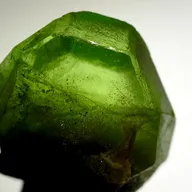 Peridot
Green olivine from the mantle, and occasionally from space.
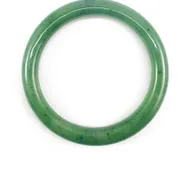 Jade
Two different minerals under one name, and the toughest stone on this page.
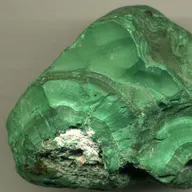 Malachite
Copper gone green, in bands you can read like tree rings.
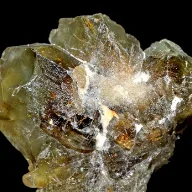 Alexandrite
Green by day and red by lamplight, and named for a tsar who was not yet one.
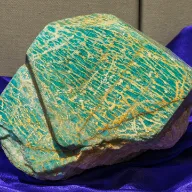 Amazonite
Green feldspar from a river it was never found in.
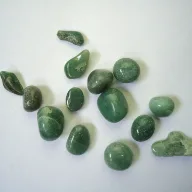 Aventurine
Quartz with a glitter of green mica through it, named by accident.
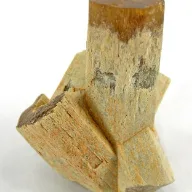 Beryl
One mineral, six famous names: emerald, aquamarine, morganite and the rest are all this.
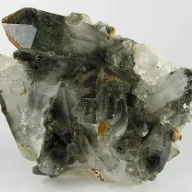 Chlorite
The green that gets into everything: a whole family of soft micaceous minerals, and the ghost inside phantom quartz.
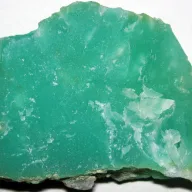 Chrysoprase
Apple-green chalcedony coloured by nickel, and the most valuable of all the quartzes.
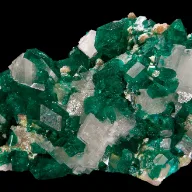 Dioptase
Copper green so convincing that the first crystals sent to Moscow were reported as emeralds.
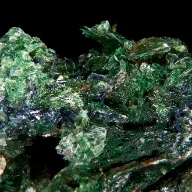 Fuchsite
Muscovite that took up chromium and turned green and glittering.
 Bloodstone
Dark green chalcedony spotted with red, and one of the two birthstones of March.
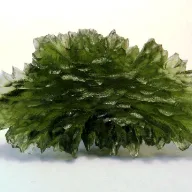 Moldavite
Bohemian glass made by an asteroid hitting Germany fifteen million years ago.
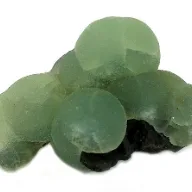 Prehnite
Green botryoidal crusts, usually with black epidote needles through them.
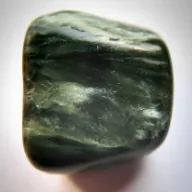 Seraphinite
Dark green chlorite with silver feathers running through it.
Saussurite
What a feldspar becomes when hot water gets at it for long enough.
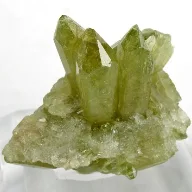 Vesuvianite
Named for the volcano that threw it out, and for looking like several other minerals at once.
 Zoisite
A grey-green rock mineral that produced two of the century's fashionable gems.