 Lunarya
Chlorite
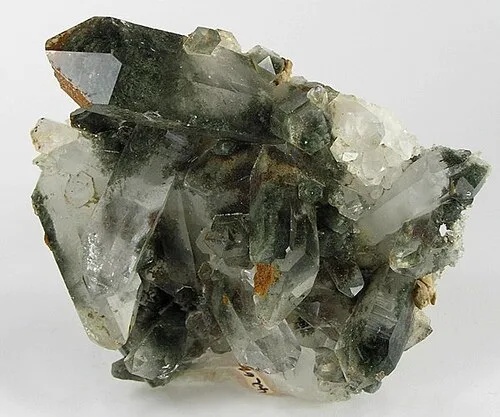
Chlorite is not one mineral but a family of them — clinochlore, chamosite, pennantite and a dozen more — layered silicates that grow as soft green flakes and earthy coatings. They are the reason so much metamorphic rock is green, and the reason a quartz crystal sometimes has a green ghost inside it. The name is from the Greek for green and has nothing to do with chlorine.
Chlorite looks like mica and peels like mica, but the flakes are brittle in a particular way: bend one and it stays bent, where a mica flake springs back. It is soft enough to mark with a fingernail and often feels slightly greasy. Geologists use it as a thermometer — the proportions of iron, magnesium and aluminium in a chlorite record the temperature at which it grew — and a whole metamorphic grade, the greenschist facies, is named after the colour it gives the rock.
In short
- Colour
- Green
- Mineral
- Silicate
- Formula
- (Mg,Fe)₅Al(Si₃Al)O₁₀(OH)₈
- Hardness
- 2–2.5 on the Mohs scale
- Crystal system
- Monoclinic
- Found in
- The Alps, the Zillertal in Austria, Ganesh Himal in Nepal, the Urals and Siberia, Brazil, and the copper belts of Arizona and Chile.
- Element
- Earth
- Planet
- Venus
- Chakra
- Heart
- Handling
- Water and light are both fine
How it forms
Chlorite grows when other minerals give up water and heat: biotite, amphibole, pyroxene and garnet all break down to it at low metamorphic grade, and the halo of pale green rock around a hydrothermal ore body is largely chlorite. In an Alpine cleft it grows as tiny green flakes on the walls of the cavity, and when a quartz crystal there pauses in its growth, a dusting of chlorite settles on its faces; when the quartz starts again it seals the green layer inside, leaving a perfect smaller crystal outlined within the larger one. That is a phantom, and chlorite is the commonest thing to make one.
In human hands
Chlorite has been known as long as anyone has broken open green rock, and named since 1789. It has no use as an ore, but it has mattered to geologists out of all proportion to its glamour: the first metamorphic zones ever mapped, by George Barrow in the Scottish Highlands in the 1890s, begin with the chlorite zone, and the sequence he worked out is still how metamorphic grade is taught. In the crystal trade it arrived by the back door, inside quartz, and stayed because a phantom is a striking thing to own.
Varieties and trade names
- Clinochlore
- The magnesium member and the commonest; most green chlorite in quartz is this.
- Chamosite
- The iron member, darker and nearly black, common in sedimentary iron ores.
- Seraphinite
- Silvery-feathered clinochlore from Siberia, cut as a gemstone and named for its wings.
- Kämmererite
- Chromium-bearing clinochlore, an improbable raspberry violet, from Turkey and the Urals.
- Chlorite phantom quartz
- A quartz crystal with one or more green outlines of its former selves sealed inside it.
- Chlorite included quartz
- Green flakes and clouds suspended through the crystal, from Nepal and the Alps; sold as green lodolite or garden quartz.
Telling it from a fake
Soft, green, and flaky, with flakes that stay bent when you bend them: that is chlorite rather than mica or serpentine. In quartz it is unmistakable, since no dye reaches the inside of a crystal — the green is in defined layers or clouds, not in cracks. Serpentine is massive and waxy rather than flaky, and epidote is harder and yellower. What is sold as "chlorite quartz" but shows an even green wash all over the outside is usually a coating.
None of this needs a laboratory, and none of it is proof. A shop that will not say whether a stone is treated has answered the question; ask, and have the answer written on the receipt.
What it is said to do
Read as a cleanser: the books give it for clearing out what has built up, physically and otherwise, and pair it with the heart. The phantom crystals carry a second reading, of growth in stages and of what an old self is still doing inside the present one — a tidy piece of symbolism that the geology, for once, actually supports.
Living with it
Chlorite on its own is too soft to wear or wash; brush it dry. Inside quartz it is protected, and the crystal can be washed in lukewarm water like any other. Nothing here fades.
In magic
Chlorite comes into practice through quartz. A chlorite phantom, the ghost of an earlier crystal inside a later one, is used in workings for growth in stages and for clearing out what has built up, and modern books treat green chlorite quartz as a cleanser for the other stones on the altar. The bare mineral is too soft for a ritual of any kind.
- Energy
- Receptive
- Day
- Friday
- Worked for
- Cleansing · Change and letting go
More of this colour
 Peridot
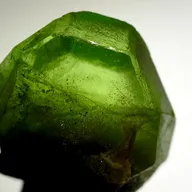
Green olivine from the mantle, and occasionally from space.
 Jade
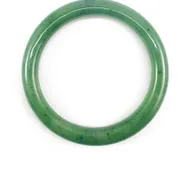
Two different minerals under one name, and the toughest stone on this page.
 Malachite
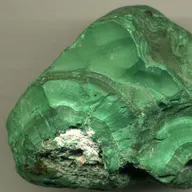
Copper gone green, in bands you can read like tree rings.
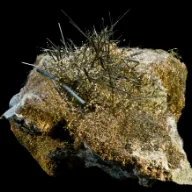 Actinolite
Green needles of amphibole, and the mineral half of all jade is made of.
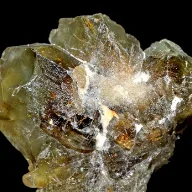 Alexandrite
Green by day and red by lamplight, and named for a tsar who was not yet one.
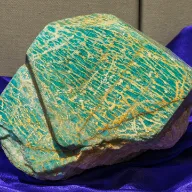 Amazonite
Green feldspar from a river it was never found in.
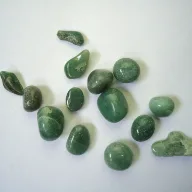 Aventurine
Quartz with a glitter of green mica through it, named by accident.
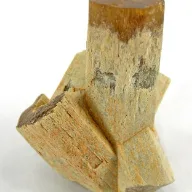 Beryl
One mineral, six famous names: emerald, aquamarine, morganite and the rest are all this.
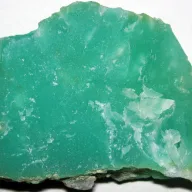 Chrysoprase
Apple-green chalcedony coloured by nickel, and the most valuable of all the quartzes.
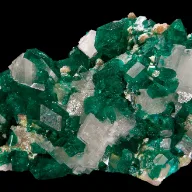 Dioptase
Copper green so convincing that the first crystals sent to Moscow were reported as emeralds.
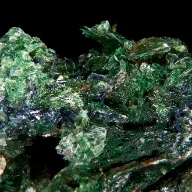 Fuchsite
Muscovite that took up chromium and turned green and glittering.
 Bloodstone
Dark green chalcedony spotted with red, and one of the two birthstones of March.
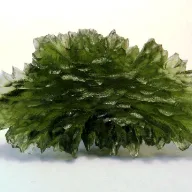 Moldavite
Bohemian glass made by an asteroid hitting Germany fifteen million years ago.
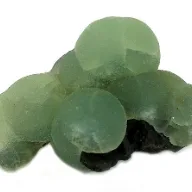 Prehnite
Green botryoidal crusts, usually with black epidote needles through them.
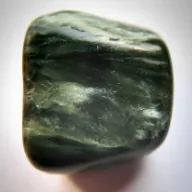 Seraphinite
Dark green chlorite with silver feathers running through it.
Saussurite
What a feldspar becomes when hot water gets at it for long enough.
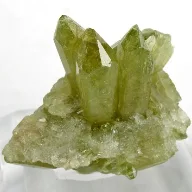 Vesuvianite
Named for the volcano that threw it out, and for looking like several other minerals at once.
 Zoisite
A grey-green rock mineral that produced two of the century's fashionable gems.