 Lunarya
Prehnite
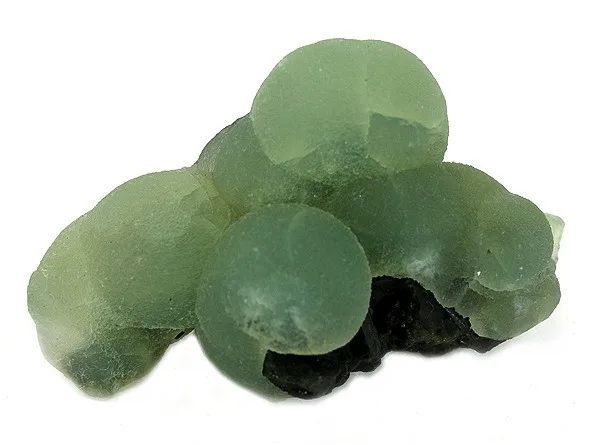
Prehnite is a calcium aluminium silicate, Ca₂Al₂Si₃O₁₀(OH)₂, and it almost always grows the same way: as rounded, grape-like crusts of a pale apple to olive green, with a faint waxy sheen and a radiating fibrous structure inside. It is hard enough to handle at 6 to 6.5. The book's entry pairs it with epidote, and that pairing is the usual one — slender black-green epidote needles standing up through the green.
It has a small place in the history of mineralogy: described in 1788 from material Colonel Hendrik von Prehn brought back from the Cape of Good Hope, it was the first mineral ever named after a person, and the first named from southern Africa. Geologists also use it as a thermometer — prehnite-pumpellyite facies is a named stage of very low-grade metamorphism, the point where a buried volcanic rock has been warmed but not much more. The trade calls the massive material grape jade, which it is not.
In short
- Colour
- Green
- Mineral
- Silicate
- Formula
- Ca₂Al₂Si₃O₁₀(OH)₂
- Hardness
- 6–6.5 on the Mohs scale
- Crystal system
- Orthorhombic
- Found in
- South Africa at the Cape, the type area; Australia at Wave Hill and Prospect Hill; Mali, which produces the best epidote combinations; China, Scotland, France, and New Jersey and Virginia in the United States.
- Element
- Earth
- Planet
- Venus
- Chakra
- Heart
- Handling
- Water and light are both fine
How it forms
Prehnite is a mineral of cavities and cracks in basalt and dolerite, and of the veins that cut altered igneous rock. Warm water carrying calcium, aluminium and silica moves through the rock at somewhere between 200 and 400 degrees, and prehnite crystallises on the cavity walls in rounded masses; epidote, calcite, quartz, zeolites and copper minerals come with it. The grape shape is what a radiating fibrous mineral does when it grows outward from many points at once.
In human hands
Named in 1788, and for its first two centuries a mineralogist's stone rather than a lapidary's. The cutting trade arrived with the Australian and Malian material in the late twentieth century, and prehnite with epidote became a standard specimen and cabochon stone in the 1990s. It is still not a jeweller's gem in the way that jade or peridot are, largely because clean transparent material is scarce.
Varieties and trade names
- Prehnite with epidote
- Green crusts pierced by black-green epidote needles, from Mali above all; the combination the book lists.
- Botryoidal prehnite
- Plain grape-like masses in apple green, from the basalt cavities of Australia, Scotland and New Jersey.
- Gem prehnite
- Translucent material cut into cabochons and, rarely, faceted; the best is a clean yellow-green.
- Cat's-eye prehnite
- Cut across the fibres so a single band of light lies along the dome; uncommon and rather fine.
- Grape jade
- A trade name for massive prehnite, especially the Chinese material; it is not jade and does not behave like it.
Telling it from a fake
The habit gives it away: rounded green knobs with a fibrous, radiating interior visible on a broken edge. Jade is tougher, harder to break and has a felted rather than radiating structure. Serpentine is much softer and waxier. Green fluorite is softer and cleaves into octahedra. Grossular garnet is harder and glassy. Prehnite is also faintly translucent with a slightly greasy lustre that most green stones lack.
None of this needs a laboratory, and none of it is proof. A shop that will not say whether a stone is treated has answered the question; ask, and have the answer written on the receipt.
What it is said to do
The modern reading is orderly: calm, seeing what is coming, and the particular satisfaction of clearing a backlog — several books describe it as the stone for tidying, which is unusually specific and rather endearing. It is placed at the heart, under Venus, with Libra and Virgo. The tradition is twentieth-century and follows the colour and the soft, rounded shapes.
Living with it
Reasonably tough and quite safe in water and sunlight. Two cautions: it has a distinct cleavage, so a sharp knock can chip a cabochon, and specimens with delicate epidote needles should be handled by the base, since the needles snap. Avoid ultrasonic cleaners on combination specimens.
In magic
Prehnite is used in modern practice for calm and for foresight: held in meditation before a decision, kept on a desk for clearing a backlog, set beside a green candle on a Friday for peace at home. It has no older tradition, and the books are honest that its reputation follows its soft colour and rounded habit. It takes water and light without harm.
- Energy
- Receptive
- Day
- Friday
- Worked for
- Calm and peace · Study and clear thinking
More of this colour
 Peridot
Green olivine from the mantle, and occasionally from space.
 Jade
Two different minerals under one name, and the toughest stone on this page.
 Malachite
Copper gone green, in bands you can read like tree rings.
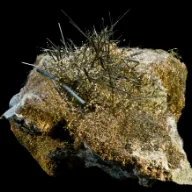 Actinolite
Green needles of amphibole, and the mineral half of all jade is made of.
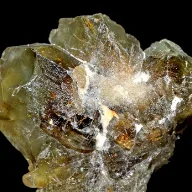 Alexandrite
Green by day and red by lamplight, and named for a tsar who was not yet one.
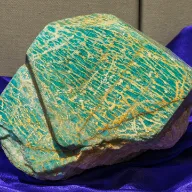 Amazonite
Green feldspar from a river it was never found in.
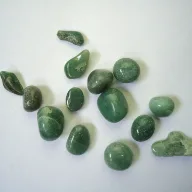 Aventurine
Quartz with a glitter of green mica through it, named by accident.
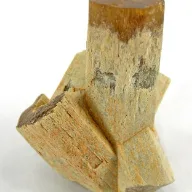 Beryl
One mineral, six famous names: emerald, aquamarine, morganite and the rest are all this.
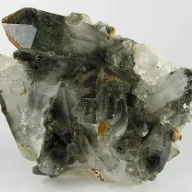 Chlorite
The green that gets into everything: a whole family of soft micaceous minerals, and the ghost inside phantom quartz.
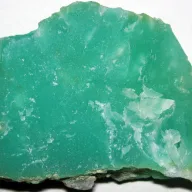 Chrysoprase
Apple-green chalcedony coloured by nickel, and the most valuable of all the quartzes.
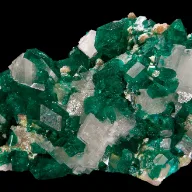 Dioptase
Copper green so convincing that the first crystals sent to Moscow were reported as emeralds.
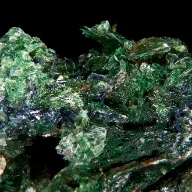 Fuchsite
Muscovite that took up chromium and turned green and glittering.
 Bloodstone
Dark green chalcedony spotted with red, and one of the two birthstones of March.
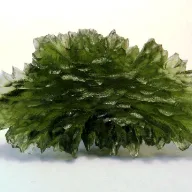 Moldavite
Bohemian glass made by an asteroid hitting Germany fifteen million years ago.
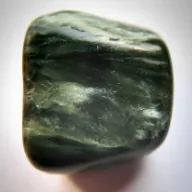 Seraphinite
Dark green chlorite with silver feathers running through it.
Saussurite
What a feldspar becomes when hot water gets at it for long enough.
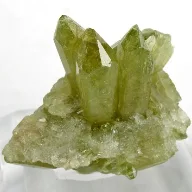 Vesuvianite
Named for the volcano that threw it out, and for looking like several other minerals at once.
 Zoisite
A grey-green rock mineral that produced two of the century's fashionable gems.