 Lunarya
Amazonite
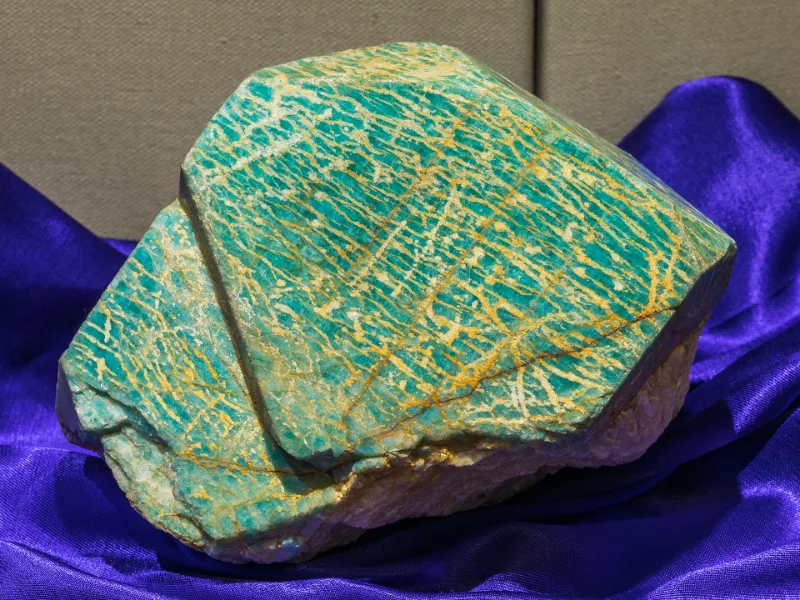
Amazonite is microcline, the commonest feldspar in granite, in a blue-green that no other feldspar has. The colour comes from a little lead and water caught in the lattice, not from copper as was long assumed, and it is usually crossed by thin white streaks of albite that grew through it, which is the surest sign that a green stone is this one.
The name comes from the Amazon, where green stones were reported by early travellers, but no amazonite has ever been found there; the stones were probably nephrite. It is old in human hands regardless — there are beads of it from Mesopotamia and Egypt, and a ring and a scarab of it were among the things in Tutankhamun's tomb. The classic crystals, blue-green blocks sitting in a nest of smoky quartz, come out of the granite of Pikes Peak in Colorado, and are among the best-known mineral specimens in the world.
In short
- Colour
- Green
- Mineral
- Feldspar
- Formula
- KAlSi₃O₈
- Hardness
- 6–6.5 on the Mohs scale
- Crystal system
- Triclinic
- Found in
- Colorado (Pikes Peak), Russia (the Ilmen mountains), Madagascar, Brazil, Ethiopia, Norway.
- Element
- Water
- Planet
- Uranus
- Chakra
- Throat
- Handling
- Water and light are both fine
How it forms
Microcline crystallises last in a cooling granite, in the coarse veins and pockets called pegmatites where the leftover melt, rich in potassium and water, finally sets. Where that melt carried a trace of lead, and the rock was mildly radioactive, the feldspar grew green: the colour is a defect in the lattice, made by radiation acting on lead and water, and heating it drives it off. The white streaks are albite, the sodium feldspar, which separates out of the potassium one as the crystal cools and grows through it in lines. At Pikes Peak the pockets are lined with amazonite and black smoky quartz together, which is why the two are so often seen in one piece.
In human hands
The Egyptians of the Middle Kingdom cut it into beads and amulets and it turns up in the jewellery of Tutankhamun, three thousand years before anyone knew what it was; the chapter of the Book of the Dead sometimes carved into it may be why it later got a reputation for courage. It was named in the eighteenth century, from the Amazon stones that were not it, and first found in quantity in the Ilmen mountains of the southern Urals, where Russian pegmatites gave the palest, most turquoise-coloured pieces. The Colorado finds began in the 1870s and have never stopped; the Crystal Peak district is still worked by hand every summer.
Varieties and trade names
- Pikes Peak amazonite
- The Colorado crystals, blue-green with white albite lines, often grown with black smoky quartz; the specimen everyone wants.
- Russian amazonite
- From the Ilmen mountains, paler and more turquoise, and the material of the vases and tabletops of the Tsars.
- Madagascan amazonite
- Massive rather than crystalline, in an even green with little white, cut into most of the beads and tumbled stones sold.
- Amazonite with smoky quartz
- The two grown together, as they are in the Colorado pockets, and sold as a pairing of green and black.
Telling it from a fake
The white streaks are the test: a green stone with thin white albite lines running through it, and two flat cleavage faces at nearly right angles that flash in the light, is amazonite. Dyed howlite and magnesite copy the colour but show dark veining rather than white lines and are softer than a knife. Jade is denser and has no cleavage; chrysoprase is glassy and translucent; turquoise is opaque and softer. Nothing synthetic is sold as amazonite, because there is no money in it — the fraud runs the other way, with amazonite sold as jade.
None of this needs a laboratory, and none of it is proof. A shop that will not say whether a stone is treated has answered the question; ask, and have the answer written on the receipt.
What it is said to do
Traditionally the stone of the throat, given for saying the thing that needs saying — the old Egyptian association with courage, filtered through the Amazon warriors the name suggests, has made it a stone of speaking up and of fair dealing. The modern lists also read it as soothing, on the strength of the colour, which is roughly what everyone says about everything blue-green.
Living with it
A worry stone or a bead. Wash it in water; keep it from knocks, since the cleavage means a dropped one splits cleanly, and from heat, which fades the green.
In magic
Amazonite's craft is speech: modern practice gives it to the throat, to workings for saying something true and dealing fairly, and to calm before a hard conversation, and some books call it the stone of hope and hand it to gamblers. The Book of the Dead asks for an amulet in the shape of a papyrus column, made of green feldspar, which may well have been amazonite — about as far back as the craft can follow it.
- Energy
- Receptive
- Day
- Saturday
- Worked for
- Speaking and being heard · Calm and peace
More of this colour
 Peridot
Green olivine from the mantle, and occasionally from space.
 Jade
Two different minerals under one name, and the toughest stone on this page.
 Malachite
Copper gone green, in bands you can read like tree rings.
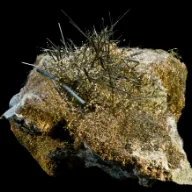 Actinolite
Green needles of amphibole, and the mineral half of all jade is made of.
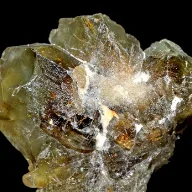 Alexandrite
Green by day and red by lamplight, and named for a tsar who was not yet one.
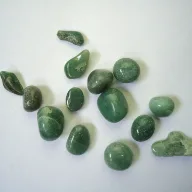 Aventurine
Quartz with a glitter of green mica through it, named by accident.
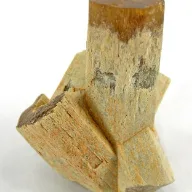 Beryl
One mineral, six famous names: emerald, aquamarine, morganite and the rest are all this.
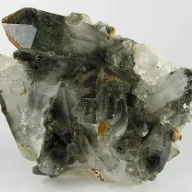 Chlorite
The green that gets into everything: a whole family of soft micaceous minerals, and the ghost inside phantom quartz.
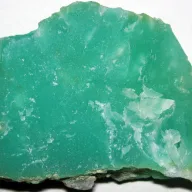 Chrysoprase
Apple-green chalcedony coloured by nickel, and the most valuable of all the quartzes.
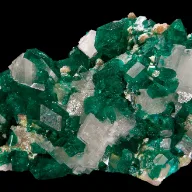 Dioptase
Copper green so convincing that the first crystals sent to Moscow were reported as emeralds.
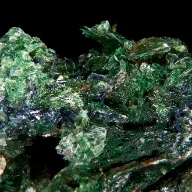 Fuchsite
Muscovite that took up chromium and turned green and glittering.
 Bloodstone
Dark green chalcedony spotted with red, and one of the two birthstones of March.
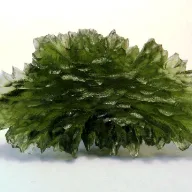 Moldavite
Bohemian glass made by an asteroid hitting Germany fifteen million years ago.
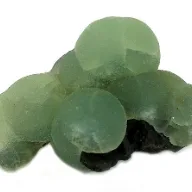 Prehnite
Green botryoidal crusts, usually with black epidote needles through them.
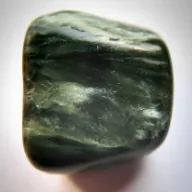 Seraphinite
Dark green chlorite with silver feathers running through it.
Saussurite
What a feldspar becomes when hot water gets at it for long enough.
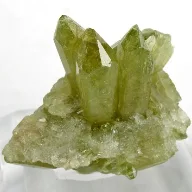 Vesuvianite
Named for the volcano that threw it out, and for looking like several other minerals at once.
 Zoisite
A grey-green rock mineral that produced two of the century's fashionable gems.