 Lunarya
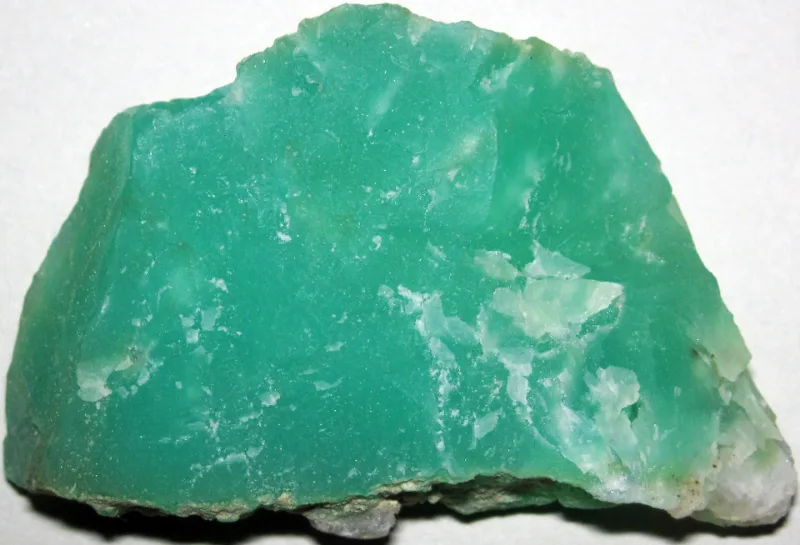
Chrysoprase
Chrysoprase is chalcedony — microcrystalline quartz — coloured a vivid apple green by nickel. It is the most valuable member of the quartz family, above amethyst and citrine, and the only one whose colour comes from nickel at all: the green is due to tiny inclusions of a hydrated nickel silicate scattered through the silica, not to anything in the quartz structure itself.
The colour is the whole point, and the colour is fragile in a way that no other quartz's is. Left in strong sunlight or heated, chrysoprase pales, sometimes to grey-green, and dealers have known for two centuries that a bleached piece will often recover if it is kept damp and dark for a few months. Good material is translucent and evenly coloured with no banding, which is what separates it from the green agates it is sold alongside.
In short
- Colour
- Green
- Mineral
- Chalcedony
- Formula
- SiO₂
- Hardness
- 7 on the Mohs scale
- Crystal system
- Trigonal
- Found in
- Marlborough in Queensland, Australia — the main source today — with Szklary in Poland, Tanzania, Brazil, Kazakhstan and California.
- Element
- Earth
- Planet
- Venus
- Chakra
- Heart
- Handling
- Fades in sunlight
How it forms
It is a weathering product of nickel-rich ultramafic rock. Where serpentinite lies in a hot wet climate, water strips it of magnesium and nickel and leaves a laterite; silica dissolved in the same water fills the cracks and cavities of the weathered rock with chalcedony, and the nickel goes along with it, precipitating as minute green particles inside the growing silica. The result is a network of green veins and nodules in a soft brown clay, which is why chrysoprase is dug rather than mined.
In human hands
Szklary in Silesia supplied Europe through the Middle Ages: the stone is in the Chapel of Saint Wenceslas in Prague, panelled by Charles IV in the 1370s, and Frederick the Great had it cut for Sanssouci and for snuff boxes. It is very likely the chrysoprasus of Revelation, one of the twelve foundation stones. The Silesian deposit faded in the nineteenth century, and Queensland took over after 1965, when the Marlborough find gave the trade its "Australian jade" — a name that has misled buyers ever since, since it is not jade of any kind.
Varieties and trade names
- Marlborough chrysoprase
- The Australian material: deep, even apple green, the standard by which the rest is judged.
- Szklary chrysoprase
- The historic Polish stone, paler and often veined, in European royal collections.
- Lemon chrysoprase
- Not chrysoprase at all but nickel-bearing magnesite, pale citron and opaque, from the same Australian deposits.
- Prase
- A leek-green quartz coloured by actinolite inclusions; an old name that keeps being borrowed for this stone.
- Chrome chalcedony
- Green chalcedony coloured by chromium, from Zimbabwe, sold as mtorolite; closer in look than anything else.
Telling it from a fake
Even green, translucent, no bands, and hard enough to scratch glass. Dyed green agate is banded when you look into it and the dye sits in the porous layers; jade is tougher, with a fibrous felted texture and a different, greasier lustre; "lemon chrysoprase" is opaque, pale and soft enough to scratch. A stone with pale washed-out patches has been left in a window, and that is worth checking before buying.
None of this needs a laboratory, and none of it is proof. A shop that will not say whether a stone is treated has answered the question; ask, and have the answer written on the receipt.
What it is said to do
The medieval books give chrysoprase to thieves: held in the mouth it was said to make one invisible, which is the sort of claim that tells you how highly the stone was valued. Modern readings are gentler — gladness, the lifting of low spirits, an open heart — and it is one of the stones given for making a fresh start after something has ended. Venus, in both the old lists and the new ones.
Living with it
Wash it in lukewarm water; it is hard and takes handling well. Keep it out of the sun and away from heat, which is the one thing that damages it, and store it somewhere dark rather than on a bright shelf. A faded piece is sometimes brought back by months in a damp, dark drawer.
In magic
Chrysoprase had an old following among thieves; the modern craft uses it more kindly, as a stone of gladness and fresh starts, carried out of a grief or a heartbreak, and in Friday workings for affection between friends. It is the green of new leaves, which is most of the reasoning. Keep it out of the sun and away from candle heat, both of which pale it.
- Energy
- Receptive
- Day
- Friday
- Worked for
- Comfort and recovery · Love and friendship
More of this colour
 Peridot
Green olivine from the mantle, and occasionally from space.
 Jade
Two different minerals under one name, and the toughest stone on this page.
 Malachite
Copper gone green, in bands you can read like tree rings.
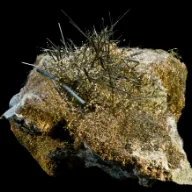 Actinolite
Green needles of amphibole, and the mineral half of all jade is made of.
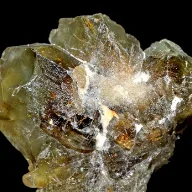 Alexandrite
Green by day and red by lamplight, and named for a tsar who was not yet one.
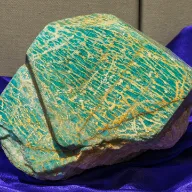 Amazonite
Green feldspar from a river it was never found in.
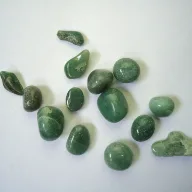 Aventurine
Quartz with a glitter of green mica through it, named by accident.
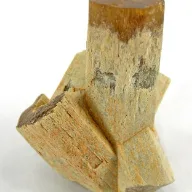 Beryl
One mineral, six famous names: emerald, aquamarine, morganite and the rest are all this.
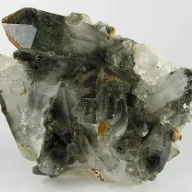 Chlorite
The green that gets into everything: a whole family of soft micaceous minerals, and the ghost inside phantom quartz.
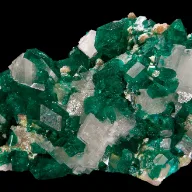 Dioptase
Copper green so convincing that the first crystals sent to Moscow were reported as emeralds.
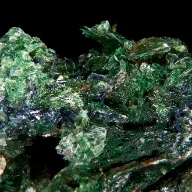 Fuchsite
Muscovite that took up chromium and turned green and glittering.
 Bloodstone
Dark green chalcedony spotted with red, and one of the two birthstones of March.
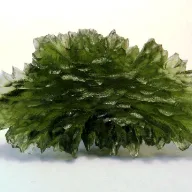 Moldavite
Bohemian glass made by an asteroid hitting Germany fifteen million years ago.
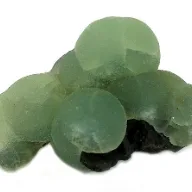 Prehnite
Green botryoidal crusts, usually with black epidote needles through them.
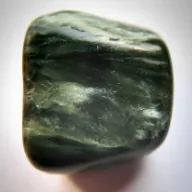 Seraphinite
Dark green chlorite with silver feathers running through it.
Saussurite
What a feldspar becomes when hot water gets at it for long enough.
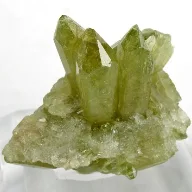 Vesuvianite
Named for the volcano that threw it out, and for looking like several other minerals at once.
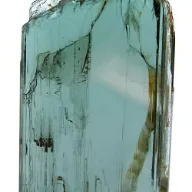 Zoisite
A grey-green rock mineral that produced two of the century's fashionable gems.