 Lunarya
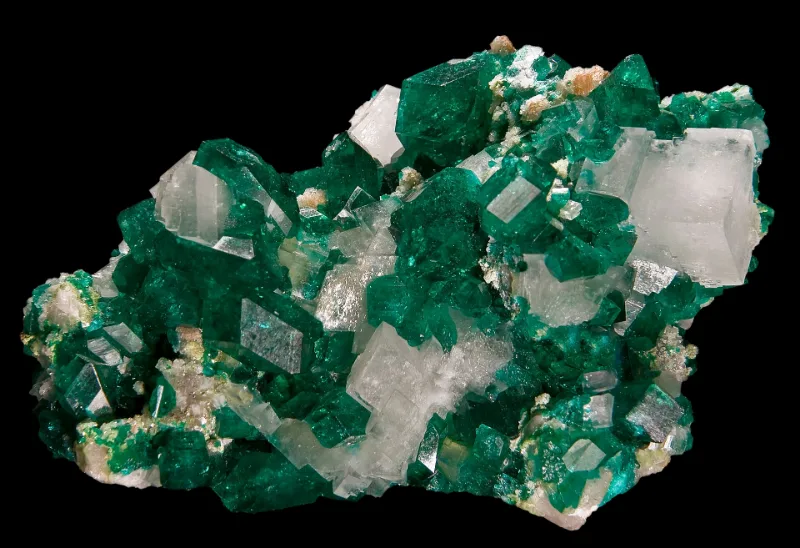
Dioptase
Dioptase is a hydrated copper silicate that grows as short, glassy, emerald-green crystals, and it is the most intensely coloured green mineral there is. It is also soft, at five on the Mohs scale, and splits along perfect cleavages at the smallest provocation, which is why it has never become a gemstone despite looking like one. It is nearly always a small crystal on a rock, and it is nearly always beautiful.
The colour is copper, the same element that makes malachite and azurite, and here it sits in a ring silicate structure with water in the channels. The name is Haüy's, from the Greek for seeing through, because you can see the internal cleavage planes inside a transparent crystal — an odd thing to name a mineral for, and a reminder that the cleavages were the first thing anybody noticed. Warm it and it loses its water and its colour; the crystals are for cabinets, not for kilns.
In short
- Colour
- Green
- Mineral
- Silicate
- Formula
- CuSiO₃·H₂O
- Hardness
- 5 on the Mohs scale
- Crystal system
- Trigonal
- Found in
- Tsumeb in Namibia, Renéville and Mindouli in the Republic of the Congo, Altyn-Tyube in Kazakhstan, the Christmas mine in Arizona, Chile and Peru.
- Element
- Water
- Planet
- Venus
- Chakra
- Heart
- Handling
- Keep out of water
How it forms
Dioptase belongs to the oxidised zone of a copper deposit in a dry climate. Copper sulfides weather, the copper travels in solution, and where that solution meets silica released from the weathering of the surrounding rock — and a limestone or dolomite to keep the acidity in check — dioptase crystallises in cavities at ordinary temperatures. The conditions are fussy, which is why it is rare, and the best of it lines cracks in dolomite: Tsumeb's crystals grew in one of the strangest ore bodies ever mined, a pipe that has produced over two hundred and fifty mineral species, some found nowhere else.
In human hands
In the 1780s a merchant at Altyn-Tyube in what is now Kazakhstan sent green crystals to Moscow believing he had found emerald; the stones were hard enough to excite everybody and soft enough to disappoint the jewellers, and the mineral was called achirite after him for a while. Haüy renamed it dioptase in 1797 after establishing it was a copper mineral. Tsumeb and the Congo have supplied collectors since the early twentieth century, and good Congolese plates of crystals on white dolomite remain among the most reproduced mineral photographs there are.
Varieties and trade names
- Tsumeb dioptase
- Dark, glassy crystals from Namibia, often with cerussite and calcite; the connoisseur's material.
- Congo dioptase
- Bright green crystals strewn over white dolomite from Renéville; the picture most people have in mind.
- Achirite
- The original Kazakh material and its old trade name, from the merchant who took it for emerald.
- Plancheite and shattuckite
- Blue copper silicates that grow with it and are often on the same specimen.
- Chrysocolla
- The soft blue-green copper silicate that coats the same cavities; dioptase crystals sometimes sit on it.
Telling it from a fake
Emerald colour, glassy lustre, small crystals on rock, and soft enough to scratch with a steel point: that combination is dioptase. Emerald is much harder and grows as hexagonal prisms; malachite is banded and fibrous and fizzes in acid; green fluorite is cubic and softer still. Nobody fakes dioptase — it is worth less than the emerald it resembles — but it is sometimes sold as "copper emerald", which is a trade name and not a claim to be believed.
None of this needs a laboratory, and none of it is proof. A shop that will not say whether a stone is treated has answered the question; ask, and have the answer written on the receipt.
What it is said to do
A heart stone in the modern lists, given for forgiveness and for the sort of grief that has gone quiet and stayed. Some books make it a stone of abundance on the strength of its colour. The tradition is recent; the mineral was unknown outside central Asia until the eighteenth century and rare everywhere until the twentieth.
Living with it
Fragile in three directions at once. Do not tumble it, do not put it in an ultrasonic cleaner, and do not leave it in the sun or near a radiator, since heat drives off the water it is built around. Dust it with a soft brush; if it must be washed, cool water briefly and no soap.
In magic
Dioptase has no place in older magic. Modern practice sets it on the heart altar for forgiveness and for the quiet grief that stays, and, because of the colour, in money workings beside green candles. It is a copper mineral that holds water in its structure, so it is set down rather than handled and never goes into water, an elixir or the sun.
- Energy
- Receptive
- Day
- Friday
- Worked for
- Comfort and recovery · Money and luck
More of this colour
 Peridot
Green olivine from the mantle, and occasionally from space.
 Jade
Two different minerals under one name, and the toughest stone on this page.
 Malachite
Copper gone green, in bands you can read like tree rings.
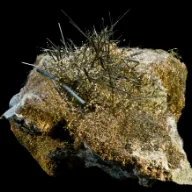 Actinolite
Green needles of amphibole, and the mineral half of all jade is made of.
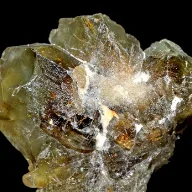 Alexandrite
Green by day and red by lamplight, and named for a tsar who was not yet one.
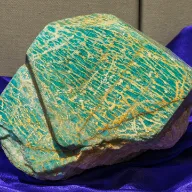 Amazonite
Green feldspar from a river it was never found in.
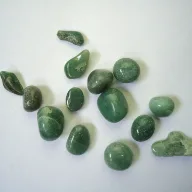 Aventurine
Quartz with a glitter of green mica through it, named by accident.
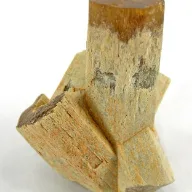 Beryl
One mineral, six famous names: emerald, aquamarine, morganite and the rest are all this.
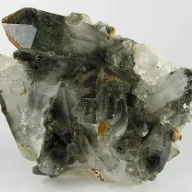 Chlorite
The green that gets into everything: a whole family of soft micaceous minerals, and the ghost inside phantom quartz.
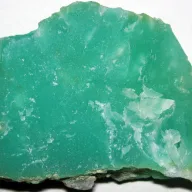 Chrysoprase
Apple-green chalcedony coloured by nickel, and the most valuable of all the quartzes.
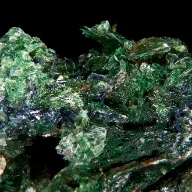 Fuchsite
Muscovite that took up chromium and turned green and glittering.
 Bloodstone
Dark green chalcedony spotted with red, and one of the two birthstones of March.
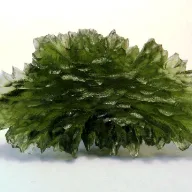 Moldavite
Bohemian glass made by an asteroid hitting Germany fifteen million years ago.
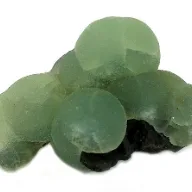 Prehnite
Green botryoidal crusts, usually with black epidote needles through them.
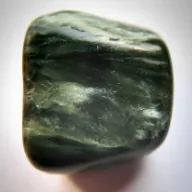 Seraphinite
Dark green chlorite with silver feathers running through it.
Saussurite
What a feldspar becomes when hot water gets at it for long enough.
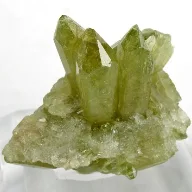 Vesuvianite
Named for the volcano that threw it out, and for looking like several other minerals at once.
 Zoisite
A grey-green rock mineral that produced two of the century's fashionable gems.