 Lunarya
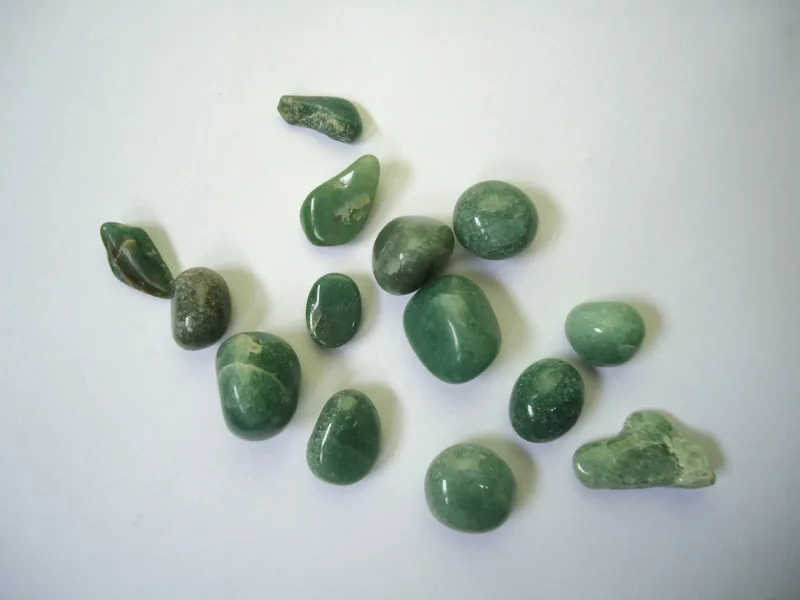
Aventurine
Aventurine is quartzite — quartz grains grown together — with flakes of another mineral scattered through it, which catch the light and give the stone a sparkle called aventurescence. In the common green kind the flakes are fuchsite, a chromium mica; in the orange and brown they are hematite or goethite; and the stone is mostly cut into beads, spheres and the tumbled pebbles it is best known as.
The name is a mistake that stuck: in the 1700s a glassmaker in Murano dropped copper filings into a batch by chance — a ventura — and the sparkling brown glass was called aventurine; when a natural stone with the same glitter turned up, it took the glass's name. So goldstone, the glass, came first, and the mineral is named after an imitation of itself. Most green aventurine comes from India, from around Mysore and Chennai, and the trade has long sold it as Indian jade, which it is not.
In short
- Colour
- Green
- Mineral
- Quartz
- Formula
- SiO₂
- Hardness
- 6.5–7 on the Mohs scale
- Crystal system
- Trigonal
- Found in
- India (Karnataka and Tamil Nadu) for green; Brazil, Russia, Spain, Chile and Tanzania for the other colours.
- Element
- Earth
- Planet
- Mercury
- Chakra
- Heart
- Handling
- Water and light are both fine
How it forms
Aventurine is a metamorphic rock rather than a single crystal: a sandstone that was buried and heated until its quartz grains recrystallised into an interlocking mass, with the mica that had been in the sediment recrystallising at the same time into flakes lying roughly in one plane. Where the sediment carried chromium the mica grew as green fuchsite and the whole stone is green; where it carried iron the flakes are hematite and the stone is brown to orange. The plane of the flakes is why a polished piece sparkles more from one direction than another, and why the sparkle is finer than goldstone's, which was stirred rather than pressed.
In human hands
The stone was in use long before the name: Tibet set it into statues for eyes, and the Chinese carved it beside true jade. Europe met it in the eighteenth century through the Murano glass and gave the mineral the glass's name, and the Russian imperial workshops cut big vases from the Ural material, one of which the Tsar gave to the Geological Society of London and which stands in the Natural History Museum. The Indian deposits, worked since the nineteenth century, made it cheap, and it became the green pebble in every tumbled-stone bag and, in the 1980s, the stone of the gamblers' charm.
Varieties and trade names
- Green aventurine
- Quartzite with fuchsite, from India: the common one, in every shade from pale mint to dark forest depending on the mica.
- Orange aventurine
- With hematite flakes instead, from India and Brazil, in a rusty peach; sometimes sold as peach or red aventurine.
- Yellow aventurine
- Paler, with a faint sparkle from muscovite, and the one most often confused with plain yellow quartzite.
- Blue aventurine
- Quartzite with blue dumortierite, from India; a different inclusion, the same glitter, and a much rarer stone.
Telling it from a fake
Aventurine sparkles from flakes, and the flakes are uneven — different sizes, lying roughly one way, catching the light in patches. Goldstone, the glass, sparkles evenly from perfect copper triangles and is warm and bubbled. Dyed quartzite without mica is sold as aventurine and has no glitter at all; look for it. Jade, which aventurine is sold as, has no sparkle and no grain, and is much tougher. A knife will not scratch aventurine, which rules out the dyed howlite and calcite that share its colour; the sparkle rules in the real thing.
None of this needs a laboratory, and none of it is proof. A shop that will not say whether a stone is treated has answered the question; ask, and have the answer written on the receipt.
What it is said to do
The stone of luck, by way of the name — the accident that made it — and of the green that means growth and money in most of the old lists. It is the gambler's stone and the stone for a new job, given for opportunity and for the optimism that lets a person notice one. The Tibetan use for eyes gives the older reading, of seeing more clearly and wider.
Living with it
The sturdiest thing in the bag. Wash it, wear it and leave it in the sun; only a dyed one changes, and dyed aventurine is a fraud rather than a variety.
In magic
The gambler's stone. Modern practice carries aventurine in a pocket at cards, keeps it in a green bag with a coin for a new job, and plants it with seeds for a garden that should thrive, as the moon waxes. The name comes from the Venetian glassmakers' a ventura, by chance, which suits a stone of luck better than any legend could. Water and sun do it no harm.
- Energy
- Receptive
- Day
- Wednesday
- Worked for
- Money and luck
More of this colour
 Peridot
Green olivine from the mantle, and occasionally from space.
 Jade
Two different minerals under one name, and the toughest stone on this page.
 Malachite
Copper gone green, in bands you can read like tree rings.
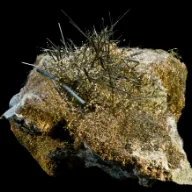 Actinolite
Green needles of amphibole, and the mineral half of all jade is made of.
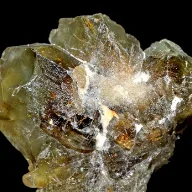 Alexandrite
Green by day and red by lamplight, and named for a tsar who was not yet one.
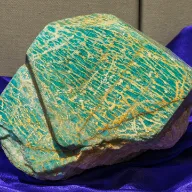 Amazonite
Green feldspar from a river it was never found in.
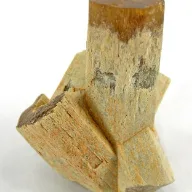 Beryl
One mineral, six famous names: emerald, aquamarine, morganite and the rest are all this.
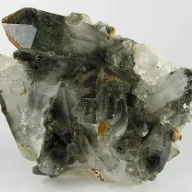 Chlorite
The green that gets into everything: a whole family of soft micaceous minerals, and the ghost inside phantom quartz.
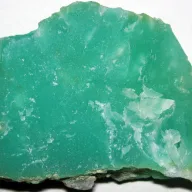 Chrysoprase
Apple-green chalcedony coloured by nickel, and the most valuable of all the quartzes.
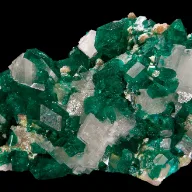 Dioptase
Copper green so convincing that the first crystals sent to Moscow were reported as emeralds.
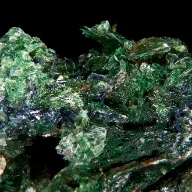 Fuchsite
Muscovite that took up chromium and turned green and glittering.
 Bloodstone
Dark green chalcedony spotted with red, and one of the two birthstones of March.
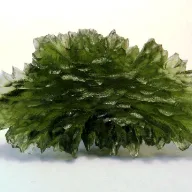 Moldavite
Bohemian glass made by an asteroid hitting Germany fifteen million years ago.
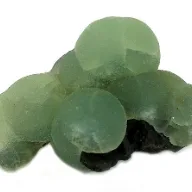 Prehnite
Green botryoidal crusts, usually with black epidote needles through them.
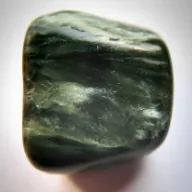 Seraphinite
Dark green chlorite with silver feathers running through it.
Saussurite
What a feldspar becomes when hot water gets at it for long enough.
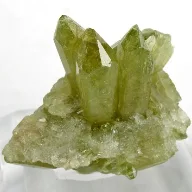 Vesuvianite
Named for the volcano that threw it out, and for looking like several other minerals at once.
 Zoisite
A grey-green rock mineral that produced two of the century's fashionable gems.