 Lunarya
Saussurite
Saussurite is not a mineral but a texture with a name: the tough, dull green mass that calcium-rich plagioclase feldspar turns into when hot water alters it. Under a microscope it is a felt of several minerals at once — zoisite or epidote, albite, calcite, sericite mica, sometimes a little garnet — grown so finely intergrown that the original crystal keeps its outline while its insides are entirely replaced.
Because it is a mixture, it has no formula and no crystal system of its own, and its hardness depends on what it is made of, generally 6 to 7. What it does have is toughness: the interlocking felt resists breaking in the way nephrite jade does, which is why saussuritised gabbro has been carved and sold as a jade substitute for two centuries. Some of what the trade has called jade over the years is this. It is named after Horace-Bénédict de Saussure, the Genevan naturalist who climbed Mont Blanc.
In short
- Colour
- Green
- Mineral
- A rock, not one mineral
- Formula
- Ca₂Al₃(SiO₄)₃(OH) + NaAlSi₃O₈
- Hardness
- 6–7 on the Mohs scale
- Crystal system
- None — it is a rock
- Found in
- Wherever gabbro and basalt have been mildly metamorphosed, which is a great many places: the Alps, where it was first described; Liguria in Italy; the Urals; China; the Appalachians; and the ophiolite belts of the Mediterranean and the Middle East.
- Element
- Earth
- Planet
- Venus
- Chakra
- Heart
- Handling
- Water and light are both fine
How it forms
Saussuritisation happens at low to moderate temperature, in the greenschist range, when water moves through a gabbro. Calcium-rich plagioclase is unstable under those conditions: its calcium goes into epidote and zoisite, its sodium into albite, and a fine intergrowth of the two replaces the original crystal grain for grain. The rock ends up greener, tougher and heavier, and the process is one of the standard signs that a basic igneous rock has been through the low-grade mill.
In human hands
Named early in the nineteenth century in honour of de Saussure, and for most of its life a word in a petrology textbook rather than a stone anyone bought. Neolithic Europe knew the material, though not the name: some of the tough green stone worked into polished axe heads across the Alps is saussuritised gabbro rather than jadeite. The crystal trade sells it occasionally, usually mislabelled as jade or as an unnamed green rock, and there is no Creative Commons photograph of it, which is why this page has none.
Varieties and trade names
- Saussurite jade
- The trade name for tough green massive material cut as a jade substitute; not jade by any definition.
- Saussuritised gabbro
- The rock itself, green and mottled, with the outlines of the original feldspar crystals still visible.
- Smaragdite gabbro
- A related green rock in which the pyroxene has become bright green amphibole; often carved in Italy.
- Zoisite
- One of the minerals saussurite is largely made of, and the parent of tanzanite and thulite; it has a page of its own here.
- Epidote
- The other, in pistachio green; the mineral that makes unakite green and that grows with prehnite.
Telling it from a fake
There is no clean test, because there is no single mineral to test for. Saussurite is green, tough, dull to slightly waxy, mottled rather than banded, and usually shows ghost outlines of the crystals it replaced. Against jadeite it is less translucent and less vivid; against nephrite it is coarser and less silky; against serpentine it is much harder. If a green stone is being sold as jade at a low price and has that flat, cloudy green, this is a good candidate.
None of this needs a laboratory, and none of it is proof. A shop that will not say whether a stone is treated has answered the question; ask, and have the answer written on the receipt.
What it is said to do
The trade readings, where they exist at all, are about transformation: something that has become another thing entirely under pressure and time, and is stronger for it. It is given to Venus, to Taurus and Virgo, and to the heart. Practically nothing has been written about it, because almost nobody sells it under its own name — which makes it one of the few stones here with less lore than geology.
Living with it
Tough and unproblematic. Water, sunlight and handling do nothing to it, and it wears better than most green stones because of the interlocking texture. The softer components — calcite and mica — will polish unevenly, so an old piece develops a slightly matt surface, which is honest wear rather than damage.
In magic
Saussurite has almost no place in practice, since it is rarely sold under its own name. The few who use it treat it as a stone of transformation under pressure — something altered into something stronger — and keep it on the altar through a working for a long change. It is tough and safe in water and light.
- Energy
- Receptive
- Day
- Friday
- Worked for
- Change and letting go
More of this colour
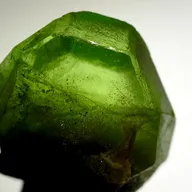 Peridot
Green olivine from the mantle, and occasionally from space.
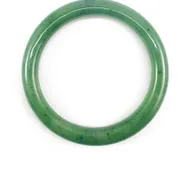 Jade
Two different minerals under one name, and the toughest stone on this page.
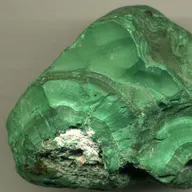 Malachite
Copper gone green, in bands you can read like tree rings.
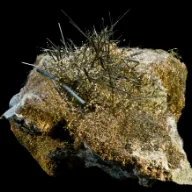 Actinolite
Green needles of amphibole, and the mineral half of all jade is made of.
 Alexandrite
Green by day and red by lamplight, and named for a tsar who was not yet one.
 Amazonite
Green feldspar from a river it was never found in.
 Aventurine
Quartz with a glitter of green mica through it, named by accident.
 Beryl
One mineral, six famous names: emerald, aquamarine, morganite and the rest are all this.
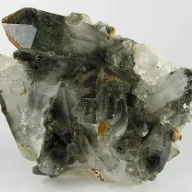 Chlorite
The green that gets into everything: a whole family of soft micaceous minerals, and the ghost inside phantom quartz.
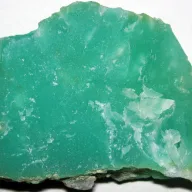 Chrysoprase
Apple-green chalcedony coloured by nickel, and the most valuable of all the quartzes.
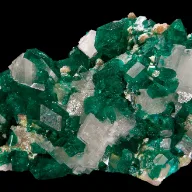 Dioptase
Copper green so convincing that the first crystals sent to Moscow were reported as emeralds.
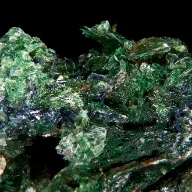 Fuchsite
Muscovite that took up chromium and turned green and glittering.
 Bloodstone
Dark green chalcedony spotted with red, and one of the two birthstones of March.
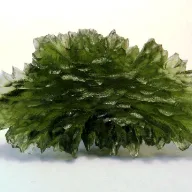 Moldavite
Bohemian glass made by an asteroid hitting Germany fifteen million years ago.
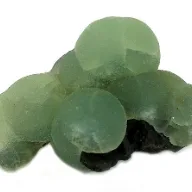 Prehnite
Green botryoidal crusts, usually with black epidote needles through them.
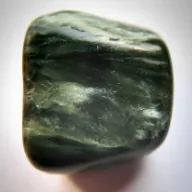 Seraphinite
Dark green chlorite with silver feathers running through it.
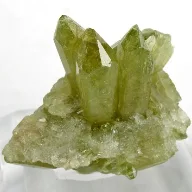 Vesuvianite
Named for the volcano that threw it out, and for looking like several other minerals at once.
 Zoisite
A grey-green rock mineral that produced two of the century's fashionable gems.