 Lunarya
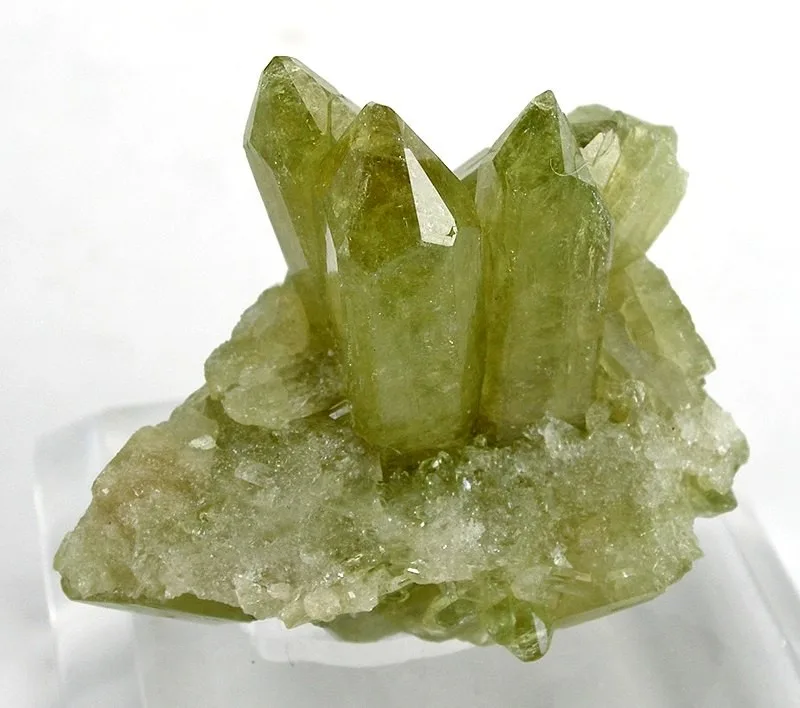
Vesuvianite
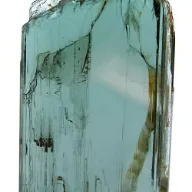
Vesuvianite is a complicated calcium aluminium silicate, tetragonal, 6 to 7 on the Mohs scale, usually some shade of green — olive, bottle, yellow-green, brown — and occasionally blue or purple. It grows in stubby square prisms with pyramidal ends and in dense massive lumps. It has a second name, idocrase, which is still used by gemmologists and which means, roughly, mixed form: its crystals look like a committee decision between garnet, zircon and epidote.
The chemistry is genuinely baroque — ten calcium, a handful of aluminium and magnesium, five separate silicate groups arranged in two different ways, and a variable set of hydroxyl and fluorine at the end. That flexibility means vesuvianite will take almost any spare element going, and the varieties are named after whichever one got in: copper for the blue, manganese for the red-purple, boron for the Siberian material. It is one of the standard minerals of a skarn, and finding it tells a geologist that a limestone has been cooked by an intrusion.
In short
- Colour
- Green
- Mineral
- Silicate
- Formula
- Ca₁₀(Mg,Fe)₂Al₄(SiO₄)₅(Si₂O₇)₂(OH)₄
- Hardness
- 6–7 on the Mohs scale
- Crystal system
- Tetragonal
- Found in
- Monte Somma on Vesuvius, the type locality, where the crystals come out of blocks thrown up by the volcano. Ala and the Val d'Aosta in the Italian Alps; the asbestos mines of Quebec; the Wilui river in Siberia; Pakistan; the Jeffrey mine's famous green crystals; Kenya and Tanzania; and Siskiyou and Tulare counties in California for the massive green material.
- Element
- Earth
- Planet
- Jupiter
- Chakra
- Heart
- Handling
- Water and light are both fine
How it forms
Vesuvianite forms in contact metamorphism, where a hot intrusion has baked a limestone or dolomite and fluids have carried silica and aluminium into it. The resulting rock, a skarn, is a jumble of calc-silicates — grossular garnet, diopside, wollastonite, calcite — and vesuvianite grows in it wherever the chemistry is right, sometimes in cavities as good crystals and more often as massive green rock. Vesuvius makes it differently: blocks of old limestone are torn from the walls of the conduit, cooked in the magma and thrown out, with the crystals lining their cavities.
In human hands
Abraham Gottlob Werner named it in 1795 from the Vesuvius material. René Just Haüy, who did not like the habit of naming minerals after places, proposed idocrase instead, and both names have survived — vesuvianite in mineralogy, idocrase in the gem trade. Its commercial life has mostly been as a substitute for something else: californite, the massive green kind from California, was marketed from about 1900 as California jade and American jade, and a certain amount of what is sold as jade in antique shops is this. The blue cyprine from Telemark in Norway has become a collector's stone in the last twenty years.
Varieties and trade names
- Californite
- Massive, translucent, apple to olive green. Sold as California jade for over a century; it is not jade, it is softer, and it is often very good-looking.
- Cyprine
- Blue to violet-blue, coloured by copper, from Telemark in Norway and a few other places. Rare and expensive.
- Gem idocrase
- Transparent green or yellow-brown faceted stones, mostly from Quebec, Kenya and Pakistan; handsome, unusual, and almost never seen in a shop.
- Manganvesuvianite
- Deep red to purple, from the Kalahari manganese field — the same orebody that produces sugilite.
- Wiluite
- The boron-rich Siberian material, split off as a separate species in 1998. Older specimens are still labelled vesuvianite, and the label is not wrong for its time.
Telling it from a fake
Look at the crystal ends: vesuvianite makes a squared prism with a low pyramid on top, which grossular garnet — its constant companion — never does, since garnet grows in rounded twelve- and twenty-four-sided balls. Massive californite is separated from jade by hardness and by its lower toughness: nephrite will not chip at an edge and californite will. Epidote is a similar green but grows in slender striated crystals and is strongly two-coloured when turned.
None of this needs a laboratory, and none of it is proof. A shop that will not say whether a stone is treated has answered the question; ask, and have the answer written on the receipt.
What it is said to do
The tradition gives vesuvianite release — specifically the letting go of anger and of old fear — and courage of the undramatic sort, which is a fair reading for a mineral that turns up as the plain, sturdy rock-forming green in a metamorphic mess. It goes with earth, with Jupiter, with Sagittarius and Capricorn, and with the heart centre. Californite carries the jade attributions in the shops, which is a case of the trade name doing the work rather than the stone.
Living with it
Hard enough for everyday wear, with no cleavage worth worrying about, and unaffected by water or light. Ordinary soap and water, a soft brush, no special precautions. Avoid strong heat, which can dull the colour of the gem material, and avoid ultrasonic cleaning if the piece is included or has been assembled from a massive block with fractures in it. If you are buying green massive material described as jade, ask what it is: the answer is quite often this.
In magic
Vesuvianite, named for the volcano where it was first described, is used in modern practice for letting go of anger and old fear, and for the quiet courage that comes after. Californite, its jade-like form, sometimes stands in for jade. It is hard and stable and safe in water and light; only sudden heat should be kept from it.
- Energy
- Receptive
- Day
- Thursday
- Worked for
- Change and letting go · Courage and drive
More of this colour
 Peridot
Green olivine from the mantle, and occasionally from space.
 Jade
Two different minerals under one name, and the toughest stone on this page.
 Malachite
Copper gone green, in bands you can read like tree rings.
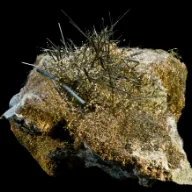 Actinolite
Green needles of amphibole, and the mineral half of all jade is made of.
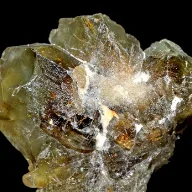 Alexandrite
Green by day and red by lamplight, and named for a tsar who was not yet one.
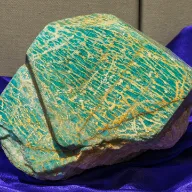 Amazonite
Green feldspar from a river it was never found in.
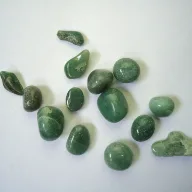 Aventurine
Quartz with a glitter of green mica through it, named by accident.
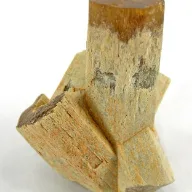 Beryl
One mineral, six famous names: emerald, aquamarine, morganite and the rest are all this.
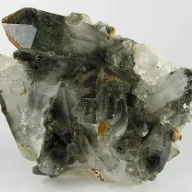 Chlorite
The green that gets into everything: a whole family of soft micaceous minerals, and the ghost inside phantom quartz.
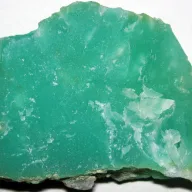 Chrysoprase
Apple-green chalcedony coloured by nickel, and the most valuable of all the quartzes.
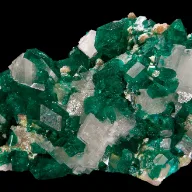 Dioptase
Copper green so convincing that the first crystals sent to Moscow were reported as emeralds.
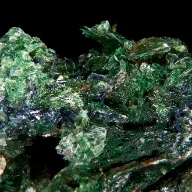 Fuchsite
Muscovite that took up chromium and turned green and glittering.
 Bloodstone
Dark green chalcedony spotted with red, and one of the two birthstones of March.
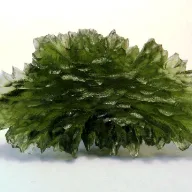 Moldavite
Bohemian glass made by an asteroid hitting Germany fifteen million years ago.
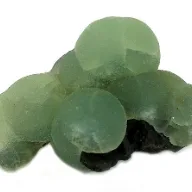 Prehnite
Green botryoidal crusts, usually with black epidote needles through them.
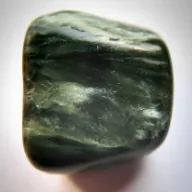 Seraphinite
Dark green chlorite with silver feathers running through it.
Saussurite
What a feldspar becomes when hot water gets at it for long enough.
 Zoisite
A grey-green rock mineral that produced two of the century's fashionable gems.