 Lunarya
Jade
Jade is two minerals that were not told apart until 1863: nephrite, a felted mass of amphibole fibres, and jadeite, a pyroxene that takes a brighter, more translucent colour. Jadeite is the harder of the two; nephrite is the tougher, and its interlocking fibres make it one of the toughest natural materials known: a nephrite axe will outlast almost any other stone at the same job.
That toughness is why jade is the world's great axe stone: neolithic workshops in China, New Zealand, the Alps and Central America all found the same thing independently. In China it has been the paramount precious material for eight thousand years, cut into ritual discs and plaques long before gold meant anything there, and in Mesoamerica the Olmec and Maya valued it above everything. The intense green of imperial jadeite comes from chromium, and almost all of it comes from a single region in Myanmar.
In short
- Colour
- Green
- Mineral
- Pyroxene
- Formula
- NaAlSi₂O₆
- Hardness
- 6–7 on the Mohs scale
- Crystal system
- Monoclinic
- Found in
- Nephrite from China, Siberia, New Zealand and British Columbia; jadeite chiefly from Myanmar and Guatemala.
- Element
- Earth
- Planet
- Venus
- Chakra
- Heart
- Handling
- Water and light are both fine
How it forms
Both jades are made where one plate of the Earth's crust slides under another, at high pressure and unusually low temperature, which is why there is so little of either. Nephrite forms where serpentinised rock meets marble, as a felt of amphibole fibres; jadeite forms in the deeper, rarer rocks of that setting, as interlocking grains, in the Kachin hills of Myanmar, the Motagua valley of Guatemala, Japan, California and Kazakhstan. Chromium gives jadeite its imperial green, iron the greys and spinach greens of nephrite, manganese the lavender. Jadeite comes out of the rivers as boulders with a weathered rind, and the trade cuts a window in the rind and gambles on the rest.
In human hands
The oldest worked jade is Chinese: the Liangzhu culture was carving discs and tubes of nephrite five thousand years ago, Confucius listed its virtues, and the Han princes were buried in suits of jade plaques sewn with gold wire. Jadeite reached China from Burma only in the eighteenth century and took over. The Māori cut their pounamu into clubs and pendants and hold title to it by treaty today; the Olmec and Maya cut jadeite into masks; and Neolithic Europe traded axe heads of Alpine jadeitite from Mont Viso to Scotland. The two minerals were told apart in 1863, and the name is the Spanish for a stone that cured the loins.
Varieties and trade names
- Jadeite
- One of the two minerals the word jade covers: a pyroxene, harder, denser and brighter than nephrite, and the source of every expensive jade. Almost all of it comes from Myanmar.
- Nephrite
- The other: a felted mass of tremolite and actinolite fibres, both of which have pages of their own here. Slightly softer than jadeite and far tougher — the toughest natural stone known — and the jade of ancient China, New Zealand and Siberia.
- Imperial jade
- Jadeite in a clear, even chromium green with real translucency, from Myanmar, and by weight one of the most expensive materials on earth.
- Lavender jade
- Jadeite coloured lilac by manganese, second only to green in price, and usually paler in the hand than in the photograph.
- Mutton-fat jade
- The creamy white nephrite of Khotan, in China's far west, carried east along the Silk Road for two thousand years.
- Pounamu and Siberian nephrite
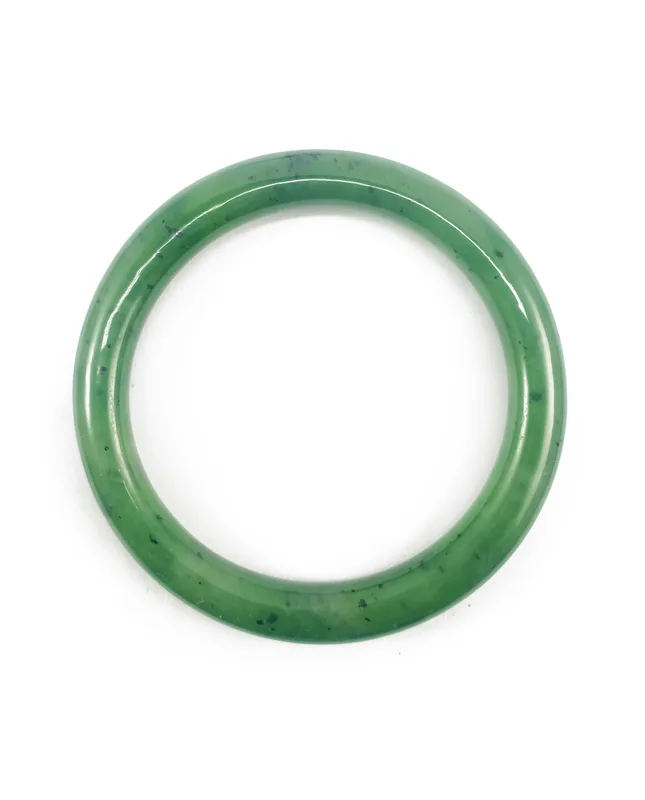
- Two dark greens: New Zealand's, protected by treaty, and Siberia's spinach-green from the Vitim river, which the bangle above is.
- Dianite
- Sold as blue jade or Siberian jade and it is neither: a blue-grey rock made largely of the amphibole potassic-richterite, from the Murun massif in Yakutia, named after Diana, Princess of Wales.
Telling it from a fake
The trade grades jadeite itself: A is untreated, B has been bleached in acid to remove the brown and refilled with resin, which yellows in a few years, C is dyed. Tap a bangle with a coin — untreated jadeite rings like a bell, resin-filled jade goes dull — and look with a loupe at where the colour sits: natural colour is in the grains, dye is in the cracks between them. What is sold as jade at a low price is mostly something else: serpentine as new jade, aventurine as Indian jade, dyed quartzite as Malaysian jade, and glass. Jade is heavy, and serpentine and glass are not.
None of this needs a laboratory, and none of it is proof. A shop that will not say whether a stone is treated has answered the question; ask, and have the answer written on the receipt.
What it is said to do
The stone of the measured life: in the Chinese tradition it stands for five virtues, among them integrity and restraint, and it is worn as a protector that takes a blow on your behalf — a jade bangle that cracks is read as having done its job.
Living with it
Washes in warm soapy water and wears indefinitely. Much of what is sold as jade is dyed serpentine, quartzite or glass; real jadeite has a slightly granular, dimpled polish and a surprising density in the hand.
In magic
Jade carries the deepest tradition in this section. In China it was carved into the bi discs and cong tubes buried with the dead, and into the cicadas laid on their tongues, and a jade bangle is still worn as protection that breaks in your place. Modern Western practice uses it for prosperity and long life, a piece kept in a purse or on a desk, and for protection. Nothing in a ritual can hurt it.
- Energy
- Receptive
- Day
- Friday
- Worked for
- Protection · Money and luck
More of this colour
 Peridot
Green olivine from the mantle, and occasionally from space.
 Malachite
Copper gone green, in bands you can read like tree rings.
 Actinolite
Green needles of amphibole, and the mineral half of all jade is made of.
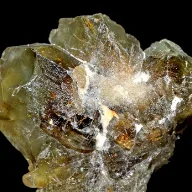 Alexandrite
Green by day and red by lamplight, and named for a tsar who was not yet one.
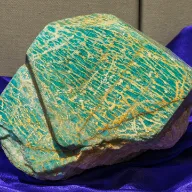 Amazonite
Green feldspar from a river it was never found in.
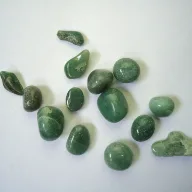 Aventurine
Quartz with a glitter of green mica through it, named by accident.
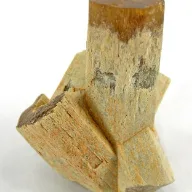 Beryl
One mineral, six famous names: emerald, aquamarine, morganite and the rest are all this.
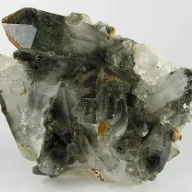 Chlorite
The green that gets into everything: a whole family of soft micaceous minerals, and the ghost inside phantom quartz.
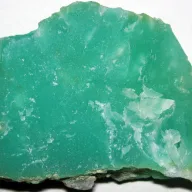 Chrysoprase
Apple-green chalcedony coloured by nickel, and the most valuable of all the quartzes.
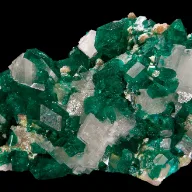 Dioptase
Copper green so convincing that the first crystals sent to Moscow were reported as emeralds.
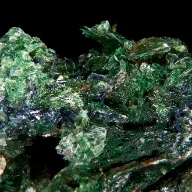 Fuchsite
Muscovite that took up chromium and turned green and glittering.
 Bloodstone
Dark green chalcedony spotted with red, and one of the two birthstones of March.
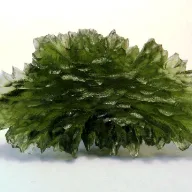 Moldavite
Bohemian glass made by an asteroid hitting Germany fifteen million years ago.
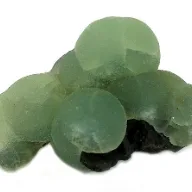 Prehnite
Green botryoidal crusts, usually with black epidote needles through them.
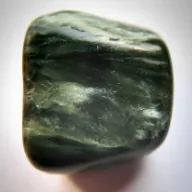 Seraphinite
Dark green chlorite with silver feathers running through it.
Saussurite
What a feldspar becomes when hot water gets at it for long enough.
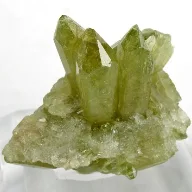 Vesuvianite
Named for the volcano that threw it out, and for looking like several other minerals at once.
 Zoisite
A grey-green rock mineral that produced two of the century's fashionable gems.