 Lunarya
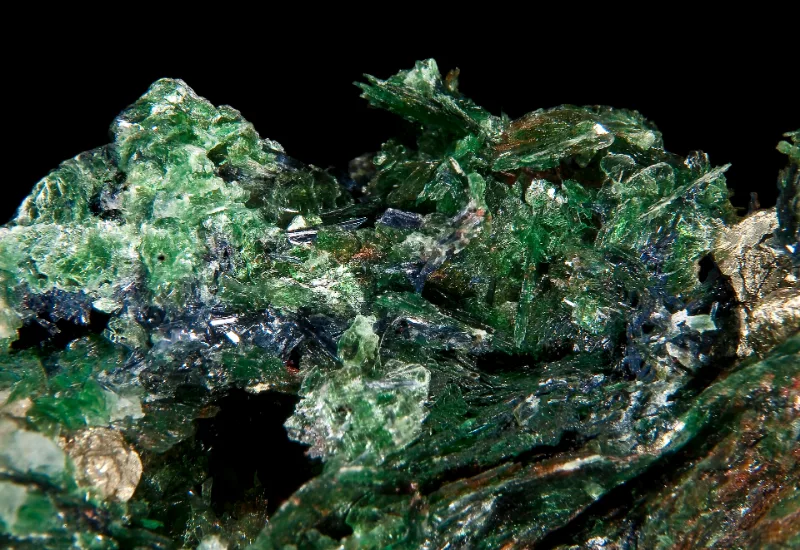
Fuchsite
Fuchsite is muscovite mica with chromium in it: K(Al,Cr)₂(AlSi₃O₁₀)(OH)₂. The chromium does all the work, taking the colourless mica to pistachio, apple green and, in the richest material, a deep emerald. The glitter is not an inclusion but the mica itself, which splits along one perfect cleavage into elastic sheets thin enough to see through, and a rock full of them catches the light from every angle at once.
It is not a species in its own right. The International Mineralogical Association treats fuchsite as a variety name for chromian muscovite, which is worth knowing when a label calls it a mineral. It is soft, 2 to 3, and the sheets bend and spring back — elastic, where chlorite flakes bend and stay bent, which is the standard way to separate the two. Verdite, the South African carving stone, is mostly microcrystalline fuchsite; the sparkle in a great deal of green aventurine is fuchsite flakes inside the quartz.
In short
- Colour
- Green
- Mineral
- Mica
- Formula
- K(Al,Cr)₂(AlSi₃O₁₀)(OH)₂
- Hardness
- 2–3 on the Mohs scale
- Crystal system
- Monoclinic
- Found in
- Brazil and India are the main suppliers of lapidary material, India especially for ruby in fuchsite from Karnataka. Others are the Urals, the Austrian Tyrol, Zimbabwe, South Africa for verdite, Scotland, Finland and Greenland.
- Element
- Earth
- Planet
- Venus
- Chakra
- Heart
- Handling
- Keep out of water
How it forms
Where chromium-bearing rock is metamorphosed in the presence of potassium, the mica that grows takes chromium into the aluminium sites. That means serpentinites, altered ultramafic rocks and the sediments shed from them, and it means the quartz-mica schists of greenstone belts. Prospectors treat fuchsite as an indicator: in the Archaean belts of Canada, Australia and West Africa, green mica in a quartz vein is a reason to look harder for gold.
In human hands
Named in 1842 for Johann Nepomuk von Fuchs, the Bavarian chemist and mineralogist. Verdite has been carved in southern Africa for a long time and commercially since the nineteenth century. Indian ruby in fuchsite arrived in the crystal trade in the 1980s and is now one of the most recognisable combination stones on a market stall, usually described as a heart opener on the strength of the red-in-green.
Varieties and trade names
- Ruby in fuchsite
- Red corundum crystals in green mica, from Karnataka; often with blue kyanite as well.
- Verdite
- A South African rock of massive fuchsite, dense enough to carve; deep green, sometimes mottled.
- Green aventurine
- Quartzite glittering with fuchsite flakes, which has a page of its own here.
- Greenlandite
- A fuchsite-quartz gneiss from Greenland, grass green and banded.
- Fuchsite schist
- The plain rock, flaky and bright, sold as specimens and used as an indicator for gold.
Telling it from a fake
It flakes. A needle will lift a sheet from the edge of a specimen, and the sheet is springy. Malachite is banded, much heavier, and fizzes in acid; serpentine is waxy and smooth with no flakes; green aventurine is quartz and will not mark with a knife. For ruby in fuchsite, check that the red is a hard hexagonal crystal with flat faces rather than a dyed patch, and be aware that some of the cheaper material has had the red enhanced.
None of this needs a laboratory, and none of it is proof. A shop that will not say whether a stone is treated has answered the question; ask, and have the answer written on the receipt.
What it is said to do
Called the healer stone in the modern literature, and given particularly to people who look after others: the reading is about recovering from doing too much rather than about doing more. It sits at the heart, under Venus, with Taurus and Aquarius. Ruby in fuchsite is read as the pair of that, courage set in recovery, which is a neat idea invented in the last forty years and none the worse for it.
Living with it
Soft and flaky, and the sheets lift if it is soaked, so wipe it rather than wash it and never leave it in water. Light does no harm. Do not tumble it with anything, do not carry it in a pocket, and handle a schist specimen by the matrix rather than the glittering face, which sheds onto fingers and clothes.
In magic
Fuchsite is used in modern practice for people who look after others: a piece on the altar in workings for rest after caring, or in a bag with lavender for recovery from burnout, with ruby in fuchsite adding courage to the rest. The glitter sheds, so it is a stone for a dish rather than a pocket, and never for water.
- Energy
- Receptive
- Day
- Friday
- Worked for
- Comfort and recovery
More of this colour
 Peridot
Green olivine from the mantle, and occasionally from space.
 Jade
Two different minerals under one name, and the toughest stone on this page.
 Malachite
Copper gone green, in bands you can read like tree rings.
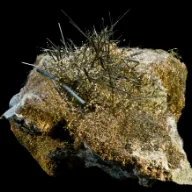 Actinolite
Green needles of amphibole, and the mineral half of all jade is made of.
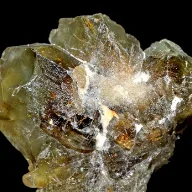 Alexandrite
Green by day and red by lamplight, and named for a tsar who was not yet one.
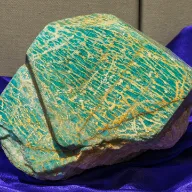 Amazonite
Green feldspar from a river it was never found in.
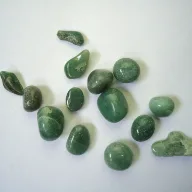 Aventurine
Quartz with a glitter of green mica through it, named by accident.
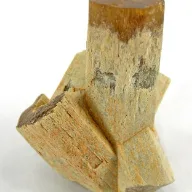 Beryl
One mineral, six famous names: emerald, aquamarine, morganite and the rest are all this.
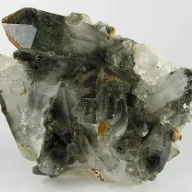 Chlorite
The green that gets into everything: a whole family of soft micaceous minerals, and the ghost inside phantom quartz.
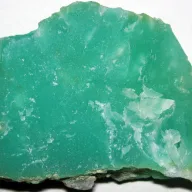 Chrysoprase
Apple-green chalcedony coloured by nickel, and the most valuable of all the quartzes.
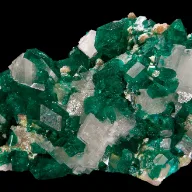 Dioptase
Copper green so convincing that the first crystals sent to Moscow were reported as emeralds.
 Bloodstone
Dark green chalcedony spotted with red, and one of the two birthstones of March.
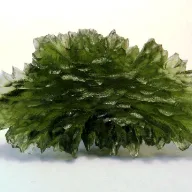 Moldavite
Bohemian glass made by an asteroid hitting Germany fifteen million years ago.
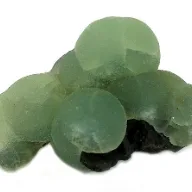 Prehnite
Green botryoidal crusts, usually with black epidote needles through them.
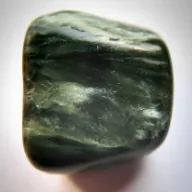 Seraphinite
Dark green chlorite with silver feathers running through it.
Saussurite
What a feldspar becomes when hot water gets at it for long enough.
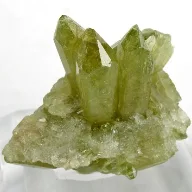 Vesuvianite
Named for the volcano that threw it out, and for looking like several other minerals at once.
 Zoisite
A grey-green rock mineral that produced two of the century's fashionable gems.