 Lunarya
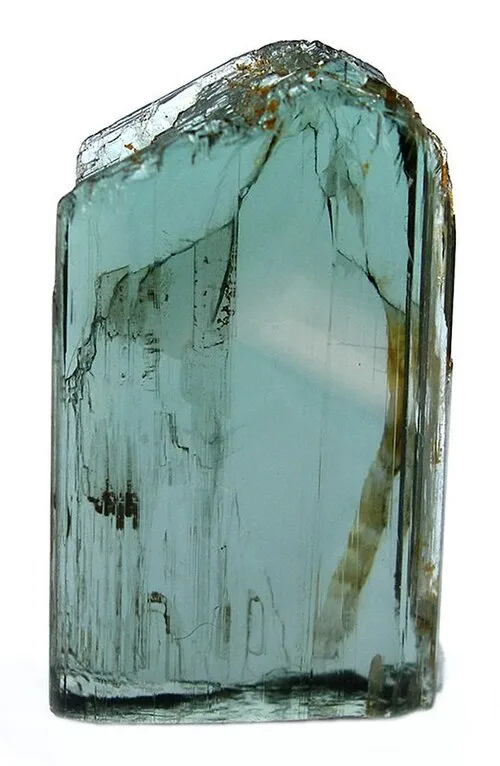
Zoisite
Zoisite is a calcium aluminium silicate, Ca₂Al₃(SiO₄)₃(OH), 6 to 7 on the Mohs scale, orthorhombic, and a member of the epidote group. In its ordinary form it is a grey, greenish or brownish mineral that makes up part of a metamorphic rock and attracts no attention at all. Trace elements change that completely: vanadium gives tanzanite, manganese gives the pink thulite, and chromium gives the green of anyolite.
It is a metamorphic mineral, and where it occurs tells a geologist what happened to the rock. Zoisite forms when calcium-rich feldspar breaks down under pressure with water present, so it turns up in amphibolite, in eclogite, in altered gabbro and in the saussurite that replaces feldspar in old basalt. The crystals are prisms, deeply striated along their length, with one perfect cleavage — a property they pass on to tanzanite and the reason both need careful setting.
In short
- Colour
- Green
- Mineral
- Silicate
- Formula
- Ca₂Al₃(SiO₄)₃(OH)
- Hardness
- 6–7 on the Mohs scale
- Crystal system
- Orthorhombic
- Found in
- The Saualpe in Carinthia, Austria, is the type locality. Merelani in Tanzania for tanzanite, and Longido, also in Tanzania, for ruby-bearing anyolite. Leksvik and Telemark in Norway for thulite, which is Norway's national stone; also North Carolina, Western Australia, Pakistan, Kenya and the Alps.
- Element
- Earth
- Planet
- Venus
- Chakra
- Heart
- Handling
- Water and light are both fine
How it forms
Zoisite needs calcium, aluminium and water, and moderate to high pressure. In a subducting slab, plagioclase feldspar becomes unstable and reacts to give zoisite plus other calc-silicates, which is why it is common in eclogites brought up from real depth. At Merelani the rock is a graphitic gneiss squeezed and pulled apart around 600 million years ago, with hot fluid filling the gaps. At Longido, chromium-rich fluids worked on an ultramafic rock and grew green zoisite, red corundum and black amphibole together in one mass.
In human hands
Baron Sigmund Zois von Edelstein, a Slovenian industrialist and collector, bought the first specimens from a dealer who had found them in the Saualpe; Abraham Gottlob Werner described the mineral in 1805 and named it after the man who paid for it. For a century and a half it stayed a rock-forming curiosity. Then Longido produced anyolite in 1954, and Merelani produced tanzanite in 1967 — and because Tiffany's marketing of tanzanite was so successful, zoisite is now known mainly as the parent of a gem named after a country.
Varieties and trade names
- Tanzanite
- Blue-violet zoisite coloured by vanadium, from one deposit in Tanzania, almost always heated. It has a page of its own here.
- Anyolite
- Green chromium zoisite with red ruby crystals and black amphibole through it, from Longido. The name is from the Maasai word for green. Carved and polished rather than faceted.
- Thulite
- Pink to rose-red zoisite coloured by manganese, from Norway, where it is the national stone; carved and cut as cabochons, and named after Thule, the ancient name for the far north.
- Green and yellow zoisite
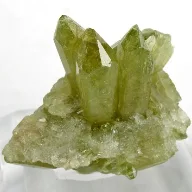
- Transparent crystals from Merelani in colours that have not been given a trade name. Faceted for collectors, and much cheaper than the same rough would be if it were blue.
- Ordinary zoisite
- Grey to greenish, massive, part of the rock. This is nearly all of it, and no one sells it.
Telling it from a fake
The striations are useful: zoisite prisms are grooved hard along their length, and the mineral is strongly pleochroic, so a transparent crystal shows different colours down different directions. Epidote, its close relative, is a more yellowish green and commonly better-formed. Anyolite is difficult to confuse with anything: opaque green with red patches and black flecks is that rock and no other. Thulite is separated from pink quartzite and from rhodonite by hardness and by its pearly cleavage surfaces.
None of this needs a laboratory, and none of it is proof. A shop that will not say whether a stone is treated has answered the question; ask, and have the answer written on the receipt.
What it is said to do
The tradition gives zoisite recovery and slow growth — the stone handed to someone getting over an illness or a long stretch of difficulty — and anyolite, with its red in green, is given to the heart specifically. It goes with earth, with Venus, with Taurus and Cancer, and with the heart centre. The writing on it is post-war and mostly follows the two gem varieties rather than the mineral itself, which is worth remembering when a description of zoisite sounds exactly like a description of tanzanite.
Living with it
Reasonably hard, but with one perfect cleavage and a real sensitivity to heat, which it shares with tanzanite. Avoid ultrasonic cleaners and steam entirely; sudden temperature change is how these stones break. Warm water, mild soap, a soft brush. Water and light do no damage. Anyolite is a rock rather than a crystal, so it takes knocks better, but polished pieces can lose their shine on a rough surface and the ruby and the zoisite in them wear at different rates.
In magic
Zoisite, and above all anyolite, ruby set in green zoisite, is used in modern practice for recovery: a stone kept near someone getting over an illness, and in workings for slow growth and patience with a body that is mending. The tradition dates from after the war, and none of it is medicine. Sudden heat cracks zoisite, so it stays away from candle flames.
- Energy
- Receptive
- Day
- Friday
- Worked for
- Comfort and recovery
More of this colour
 Peridot
Green olivine from the mantle, and occasionally from space.
 Jade
Two different minerals under one name, and the toughest stone on this page.
 Malachite
Copper gone green, in bands you can read like tree rings.
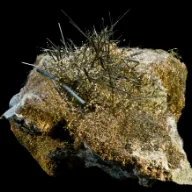 Actinolite
Green needles of amphibole, and the mineral half of all jade is made of.
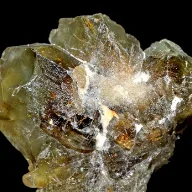 Alexandrite
Green by day and red by lamplight, and named for a tsar who was not yet one.
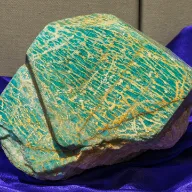 Amazonite
Green feldspar from a river it was never found in.
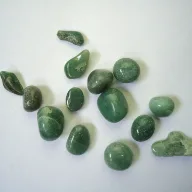 Aventurine
Quartz with a glitter of green mica through it, named by accident.
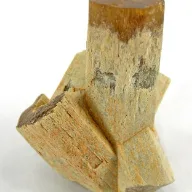 Beryl
One mineral, six famous names: emerald, aquamarine, morganite and the rest are all this.
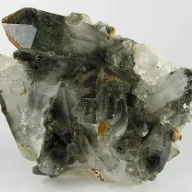 Chlorite
The green that gets into everything: a whole family of soft micaceous minerals, and the ghost inside phantom quartz.
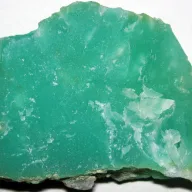 Chrysoprase
Apple-green chalcedony coloured by nickel, and the most valuable of all the quartzes.
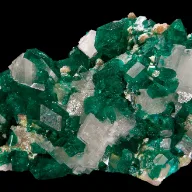 Dioptase
Copper green so convincing that the first crystals sent to Moscow were reported as emeralds.
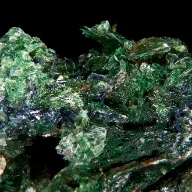 Fuchsite
Muscovite that took up chromium and turned green and glittering.
 Bloodstone
Dark green chalcedony spotted with red, and one of the two birthstones of March.
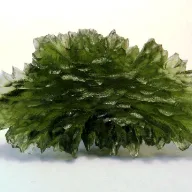 Moldavite
Bohemian glass made by an asteroid hitting Germany fifteen million years ago.
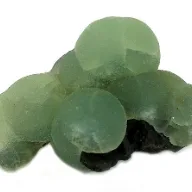 Prehnite
Green botryoidal crusts, usually with black epidote needles through them.
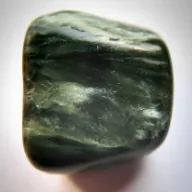 Seraphinite
Dark green chlorite with silver feathers running through it.
Saussurite
What a feldspar becomes when hot water gets at it for long enough.
 Vesuvianite
Named for the volcano that threw it out, and for looking like several other minerals at once.