 Lunarya
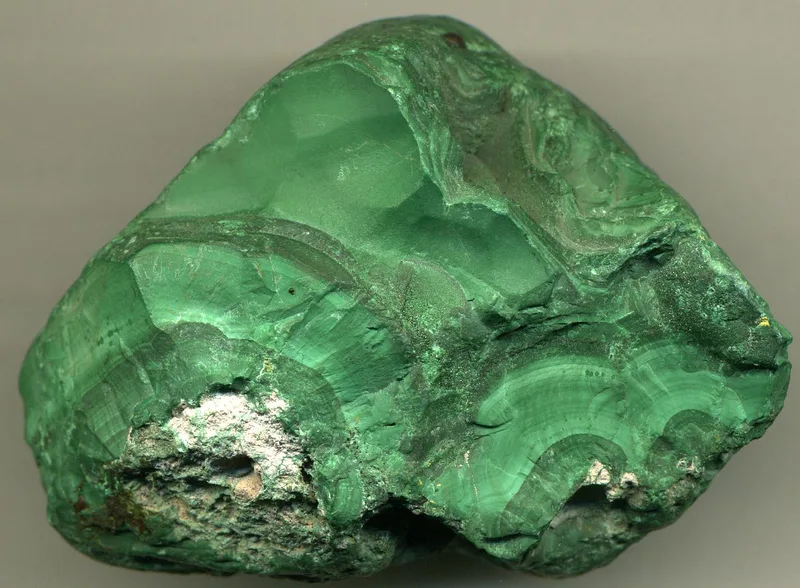
Malachite
A copper carbonate that forms where copper ore weathers near the surface, laid down in rounded layers that cut into those unmistakable bands of light and dark green. It is soft — around 4 on the Mohs scale — and fizzes in acid, which is the quickest way to tell a real piece from a plastic one.
Malachite was ground into the first green pigment, used in Egyptian tomb painting and on European panels until synthetic greens replaced it, and smelted for copper long before that. The Russian deposits at Nizhny Tagil produced blocks big enough to veneer entire rooms, and the malachite hall of the Winter Palace is the showpiece. Because the stone is a copper salt, its dust is toxic: it should never be cut or sanded dry, and it should not be left in water.
In short
- Colour
- Green
- Mineral
- Carbonate
- Formula
- Cu₂CO₃(OH)₂
- Hardness
- 3.5–4 on the Mohs scale
- Crystal system
- Monoclinic
- Found in
- The Democratic Republic of the Congo, Zambia, Russia, Australia and Arizona.
- Element
- Earth
- Planet
- Venus
- Chakra
- Heart
- Handling
- Keep out of water
How it forms
Malachite is what copper turns into near the surface: groundwater carrying dissolved copper from a sulfide ore body meets limestone, and the copper comes out of solution as a carbonate, laid down in rounded layers as the water's chemistry pulses. Cut across, the layers are the bands; the green skin on a bronze statue or a copper roof is the same chemistry on a smaller scale. Azurite, its blue twin, forms beside it and slowly turns into it, so that some malachite keeps azurite's shape. The great deposits are the copper belt of Katanga in the Congo, the Urals, Arizona and Namibia.
In human hands
Copper was first smelted from malachite, in Anatolia and the Balkans, around seven thousand years ago, and the Egyptians ground it into the green eye paint they wore before kohl and made their paradise a field of it. Ground finer it was the green of European painting until the eighteenth century and of Chinese painting for longer. The Demidov mines in the Urals produced blocks big enough to face rooms in the technique called Russian mosaic: the Malachite Room of the Winter Palace and the columns of St Isaac's are veneered in it, and Bazhov's Ural tales made the stone a character. Most of it now comes from the Congo.
Varieties and trade names
- Banded malachite
- The cut and polished kind, with its rings of light and dark; the pattern is the stone's growth, and no two slabs repeat.
- Velvet malachite
- Uncut crusts of silky needle-like crystals, dull to touch and glittering under a lamp, sold as specimens.
- Azurmalachite
- Malachite and azurite in one piece, green and deep blue, mostly from Arizona and the Congo.
- Eilat stone
- Malachite, chrysocolla and turquoise mixed, from the old copper workings at Timna in Israel, and Israel's national stone.
Telling it from a fake
Malachite is expensive per gram and heavily faked. Reconstituted malachite is powder in resin, with bands too regular and the same motif repeating; plastic is light, warm to the touch and has bands that look printed, often with black outlines; glass is glass. Real malachite is heavy and cold, its bands wander and never repeat, and a drop of vinegar on an unpolished spot on the back fizzes, because it is a carbonate — which also settles the plastic question. A knife scratches it, since it is soft. Grass-green beads with no banding are dyed howlite.
None of this needs a laboratory, and none of it is proof. A shop that will not say whether a stone is treated has answered the question; ask, and have the answer written on the receipt.
What it is said to do
Traditionally the stone of transformation and of saying no — it is given for setting a boundary and for going through a change you did not choose. In Egypt and in Russia alike it was hung over cradles as a guard against the evil eye.
Living with it
Dry cloth only. No water, no salt, no vinegar, no sanding, and wash your hands after handling raw or freshly cut pieces. A polished, sealed cabochon is perfectly safe to wear.
In magic
Malachite was a cradle charm from Egypt to Russia, hung where a child slept against the evil eye, and Egyptians ground it into green eye paint that was protection as much as make-up. Modern practice uses it for protection, for breaking a pattern and in business spells. It is a copper mineral: never grind it, never make an elixir with it, and keep a raw piece out of water and away from a child's mouth.
- Energy
- Receptive
- Day
- Friday
- Worked for
- Protection · Change and letting go
More of this colour
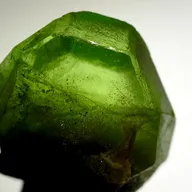 Peridot
Green olivine from the mantle, and occasionally from space.
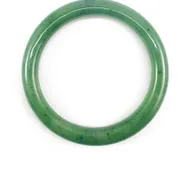 Jade
Two different minerals under one name, and the toughest stone on this page.
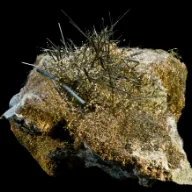 Actinolite
Green needles of amphibole, and the mineral half of all jade is made of.
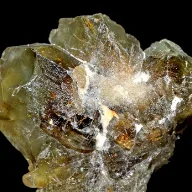 Alexandrite
Green by day and red by lamplight, and named for a tsar who was not yet one.
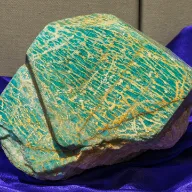 Amazonite
Green feldspar from a river it was never found in.
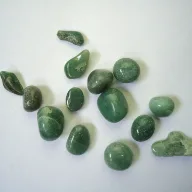 Aventurine
Quartz with a glitter of green mica through it, named by accident.
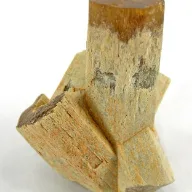 Beryl
One mineral, six famous names: emerald, aquamarine, morganite and the rest are all this.
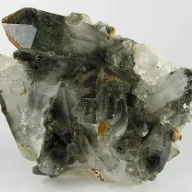 Chlorite
The green that gets into everything: a whole family of soft micaceous minerals, and the ghost inside phantom quartz.
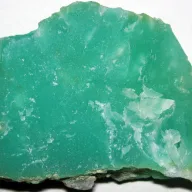 Chrysoprase
Apple-green chalcedony coloured by nickel, and the most valuable of all the quartzes.
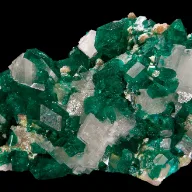 Dioptase
Copper green so convincing that the first crystals sent to Moscow were reported as emeralds.
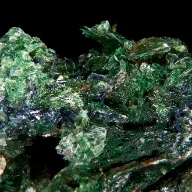 Fuchsite
Muscovite that took up chromium and turned green and glittering.
 Bloodstone
Dark green chalcedony spotted with red, and one of the two birthstones of March.
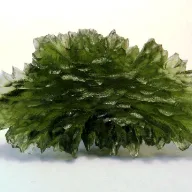 Moldavite
Bohemian glass made by an asteroid hitting Germany fifteen million years ago.
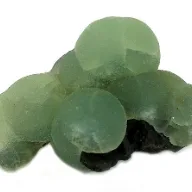 Prehnite
Green botryoidal crusts, usually with black epidote needles through them.
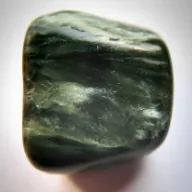 Seraphinite
Dark green chlorite with silver feathers running through it.
Saussurite
What a feldspar becomes when hot water gets at it for long enough.
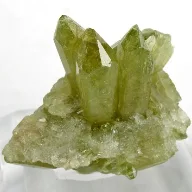 Vesuvianite
Named for the volcano that threw it out, and for looking like several other minerals at once.
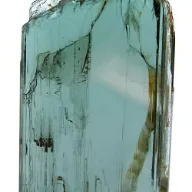 Zoisite
A grey-green rock mineral that produced two of the century's fashionable gems.