 Lunarya
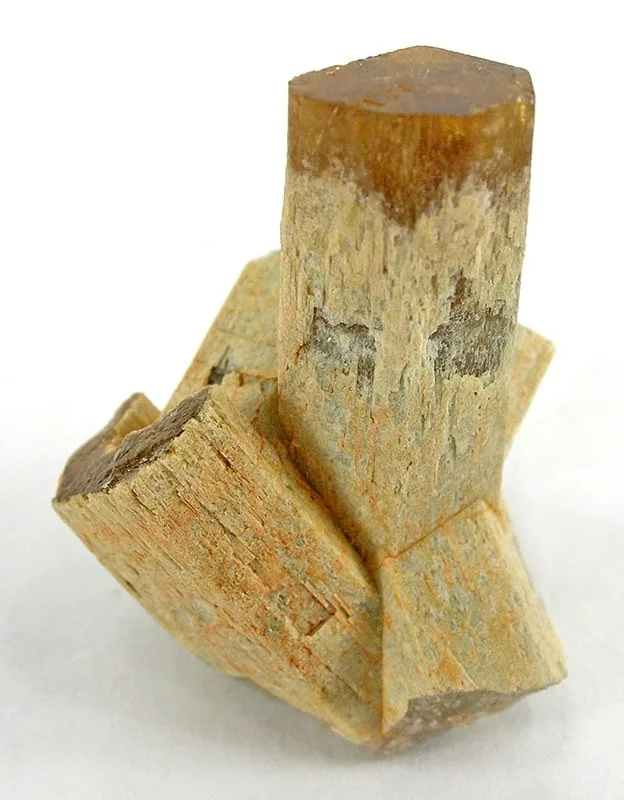
Beryl
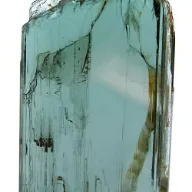
Beryl is a beryllium aluminium silicate, hard, hexagonal and colourless when it is pure — which it rarely is. A trace of chromium makes it emerald, of iron aquamarine or heliodor, of manganese morganite or red beryl, and each of those has a name and a price of its own, so the mineral itself is known mostly to the people who dig it and to the industry that gets beryllium out of it.
The Greeks called every pale green-blue stone beryllos, and when the first spectacles were ground in the thirteenth century the lenses were beryl, because glass could not be made clear enough; the German for glasses, Brille, is still the word. The crystals can be enormous — one from the Bumpus quarry in Maine was five and a half metres long and weighed eighteen tonnes — and the mineral is dangerous in a way the gems are not: beryllium dust is a carcinogen, and grinding the ore was a fatal trade until the 1950s.
In short
- Colour
- Green
- Mineral
- Beryl
- Formula
- Be₃Al₂Si₆O₁₈
- Hardness
- 7.5–8 on the Mohs scale
- Crystal system
- Hexagonal
- Found in
- Brazil (Minas Gerais), Colombia (Muzo, Chivor), Namibia, Madagascar, Pakistan, Utah (Wah Wah mountains), Russia (the Urals), Maine.
- Element
- Water
- Planet
- Venus
- Chakra
- Heart
- Handling
- Water and light are both fine
How it forms
Beryllium is scarce and awkward, and it gathers only in the last melt of a granite, the pegmatite, where beryl grows as six-sided prisms sometimes the size of a tree trunk, clear at best where the fluid was quiet, and blue where it carried iron. Emerald is the exception: it needs chromium, which pegmatites do not have, and it forms where a beryllium fluid has crossed a dark, chromium-rich rock, in schists and, at Muzo, in black shale — which is why emerald is so rare and so full of cracks. The colours are all impurities in the same lattice; heat a green-yellow beryl and the iron shifts and it turns aquamarine blue, which is what happens to most aquamarine before it is sold.
In human hands
Emerald was mined in Egypt from the Ptolemies on, at Cleopatra's mines by the Red Sea, and beryl was a gem of Rome; Pliny says Nero watched the games through one, though that may have been the green rather than a lens. The spectacle-makers of Italy and Germany used it for lenses from about 1280. The Spanish conquest brought the Colombian emeralds and the Mughals cut them into cups; Brazil's pegmatites, opened in the eighteenth century, made aquamarine and heliodor common. Morganite was named by Kunz for J. P. Morgan in 1910, red beryl was found in Utah in 1904, and beryl became an ore in the 1930s when beryllium went into the alloys of aircraft and, later, the triggers of bombs.
Varieties and trade names
- Emerald
- Beryl coloured by chromium or vanadium, the rarest and the most cracked; Colombia's is the standard, and has been since 1540.
- Aquamarine
- Blue from iron, clean and large, mostly Brazilian; it has a page of its own here.
- Morganite
- Pink to peach from manganese, from Madagascar, Brazil and California, and named for the banker who collected it.
- Heliodor
- Golden-yellow from iron in its other state, from Namibia and Ukraine; the name is Greek for gift of the sun.
- Goshenite
- Beryl with nothing in it, colourless, from Goshen in Massachusetts; the spectacle stone, and the base the others are built on.
- Bixbite
- Red beryl from one mountain range in Utah, coloured by manganese, and rarer than diamond by a long way.
Telling it from a fake
Beryl is a hexagonal prism, harder than a knife and than quartz, with flat ends and faint lines running down its length; that shape and that hardness rule out apatite, which is softer, and tourmaline, which is triangular. The problems are at the gem end. Emerald is imitated by green glass, by garnet-and-glass doublets and by synthetic emerald, which has been grown since 1935 and is the same mineral; nearly all natural emerald is filled with oil or resin to hide the cracks, and a jeweller should say so. Aquamarine is imitated by blue topaz, which is heavier and shows a different cleavage, and by glass. Heliodor and morganite are rarely faked, since they are cheap enough not to bother.
None of this needs a laboratory, and none of it is proof. A shop that will not say whether a stone is treated has answered the question; ask, and have the answer written on the receipt.
What it is said to do
The old lapidaries gave beryl to the sea and to sight — the stone of sailors, and of the lens — and the modern lists split the tradition among its colours: emerald for the heart and for renewal, aquamarine for calm and courage on the water, morganite for love, heliodor for the sun. The plain mineral is read for clear seeing, patience and the long growth of a crystal that can take a million years to reach the size of a hand.
Living with it
Hard and easy: wash it, wear it, forget it. Only an emerald wants care, because of the oil in its cracks, which hot water and ultrasonic cleaners strip out; and the dust of the ore is the one dangerous thing about the family.
In magic
Beryl gave scrying one of its old names: in early modern England a 'beryl' was the crystal a seer gazed into for visions, whatever it was actually made of. Modern practice keeps it for divination and clear sight, and gives each colour its own work — emerald for love, aquamarine for calm, heliodor for the sun. It is hard and safe in any rite; only an oiled emerald should stay out of hot water.
- Energy
- Receptive
- Day
- Friday
- Worked for
- Divination and intuition · Study and clear thinking
More of this colour
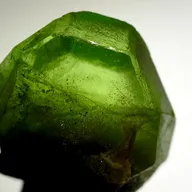 Peridot
Green olivine from the mantle, and occasionally from space.
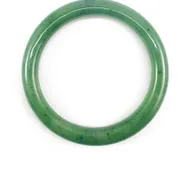 Jade
Two different minerals under one name, and the toughest stone on this page.
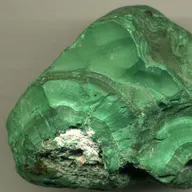 Malachite
Copper gone green, in bands you can read like tree rings.
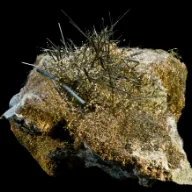 Actinolite
Green needles of amphibole, and the mineral half of all jade is made of.
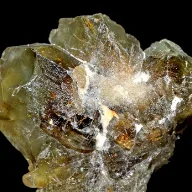 Alexandrite
Green by day and red by lamplight, and named for a tsar who was not yet one.
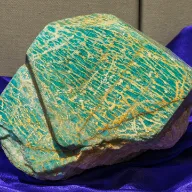 Amazonite
Green feldspar from a river it was never found in.
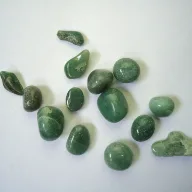 Aventurine
Quartz with a glitter of green mica through it, named by accident.
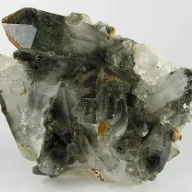 Chlorite
The green that gets into everything: a whole family of soft micaceous minerals, and the ghost inside phantom quartz.
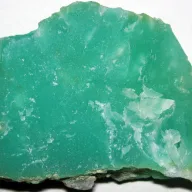 Chrysoprase
Apple-green chalcedony coloured by nickel, and the most valuable of all the quartzes.
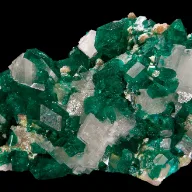 Dioptase
Copper green so convincing that the first crystals sent to Moscow were reported as emeralds.
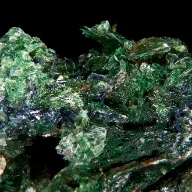 Fuchsite
Muscovite that took up chromium and turned green and glittering.
 Bloodstone
Dark green chalcedony spotted with red, and one of the two birthstones of March.
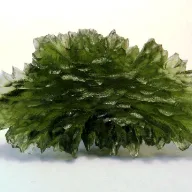 Moldavite
Bohemian glass made by an asteroid hitting Germany fifteen million years ago.
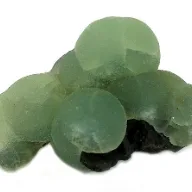 Prehnite
Green botryoidal crusts, usually with black epidote needles through them.
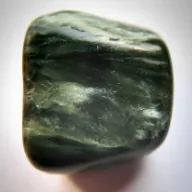 Seraphinite
Dark green chlorite with silver feathers running through it.
Saussurite
What a feldspar becomes when hot water gets at it for long enough.
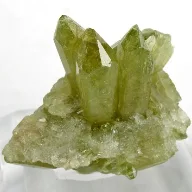 Vesuvianite
Named for the volcano that threw it out, and for looking like several other minerals at once.
 Zoisite
A grey-green rock mineral that produced two of the century's fashionable gems.