 Lunarya
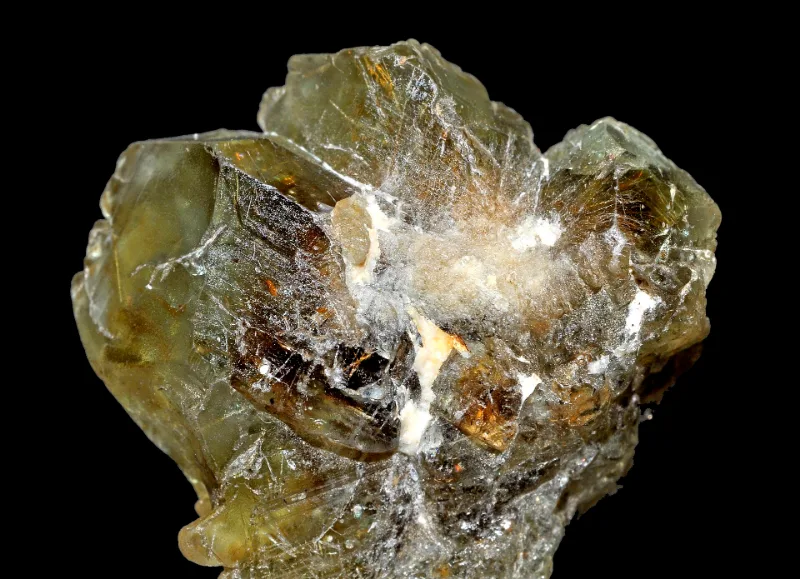
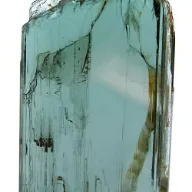
Alexandrite
Alexandrite is chrysoberyl — a beryllium aluminium oxide, one of the hardest things in the ground after diamond and corundum — with a trace of chromium in place of some of the aluminium. The chromium absorbs a band of yellow light, so the stone is green under daylight, which is rich in blue, and red under a candle or a filament bulb, which is rich in red. It is the same stone; only the light changes.
It was found in the emerald mines of the Urals in the 1830s and named by the Finnish mineralogist Nordenskiöld for the heir to the Russian throne, the future Alexander II — though the story that it was discovered on the boy's birthday is a later gloss, and the man who actually dug it up seems to have been the Ekaterinburg lapidary Yakov Kokovin. Red and green were the colours of the imperial army, which made it a patriotic stone in Russia for a generation. The Urals are worked out; nearly all of it now comes from a single district in Brazil and from Sri Lanka and East Africa.
In short
- Colour
- Green
- Mineral
- Oxide
- Formula
- BeAl₂O₄
- Hardness
- 8.5 on the Mohs scale
- Crystal system
- Orthorhombic
- Found in
- Brazil (Hematita, Minas Gerais), Sri Lanka, Tanzania, Madagascar, India; the Urals historically.
- Birthstone of
- June
- Element
- Air
- Planet
- Mercury
- Chakra
- Heart
- Handling
- Water and light are both fine
How it forms
Chrysoberyl needs beryllium, which is rare, and it grows in the pegmatites and mica schists where beryllium collects — the same rocks that give emerald and aquamarine. For alexandrite it also needs chromium, which lives in the dark rocks beryllium avoids, so the two elements meet only where a beryllium-bearing fluid has soaked into a chromium-bearing rock: the phlogopite schists of the Urals, the metamorphosed belts of Minas Gerais and Tanzania. That coincidence is why the stone is rare, and why a clean one over three carats is rarer still. The crystals grow as flat tablets and as the twinned, six-pointed stars the mineral is famous for.
In human hands
The Ural finds of the 1830s went to the court, and the best of them were set beside emeralds in the Russian crown jewels; Tiffany's George Kunz bought up much of the rest at the end of the century and made it a stone Americans knew. When the Ural mines were exhausted, alexandrite went nearly extinct as a gem until the Hematita deposit was found in Brazil in 1987 and reopened the market. It has been grown in laboratories since the 1970s, by flux and by pulling from the melt, and the synthetic is chemically the real thing; it was added to the American birthstone list for June in 1952.
Varieties and trade names
- Russian alexandrite
- The Ural stones, with the strongest green-to-red change ever found; a grade now as much as a place, and worth the most.
- Brazilian alexandrite
- From Hematita in Minas Gerais since 1987: cleaner and larger than the Russian, with a bluer green and a purpler red.
- Cat's-eye alexandrite
- Chrysoberyl fibres cut into a dome, so that the stone shows a moving line of light as well as the change of colour.
- Synthetic alexandrite
- Grown in the laboratory since the 1970s and identical in chemistry; sold honestly as lab-grown, and dishonestly as Russian.
Telling it from a fake
Take it from the window to a lamp: real alexandrite goes from green to red, and a stone that does not change is chrysoberyl or something else. Most of what is sold cheaply as alexandrite is colour-change corundum, a synthetic sapphire doped with vanadium, which shifts from a greyish blue to a purple rather than from green to red and has been made in bulk since about 1910; colour-change glass and spinel are the same trick. Real stones are rarely clean and rarely large. Lab-grown alexandrite is the harder case, since it is the same mineral; it tends to be too clean and too big, and only a laboratory can be sure.
None of this needs a laboratory, and none of it is proof. A shop that will not say whether a stone is treated has answered the question; ask, and have the answer written on the receipt.
What it is said to do
The stone of two natures, traditionally: given to people who have to be one thing by day and another by night, and read as luck in the Russian manner, where a stone that changes was thought to warn of change. The modern lists make it a stone of adaptability and of joy, and, because of its birthday, of June.
Living with it
Hard enough to wear daily, in a ring or anywhere else. Wash it in soapy water and forget about it; the only care it needs is not to be swapped for a fake.
In magic
Alexandrite was found in the Urals in the 1830s and named for the heir who became Tsar Alexander II, and Russian lore made it a stone of fortune and of warning, since a stone that changes might foretell a change. Modern practice uses it for luck, for adaptability, and in workings for a life that has to be two things at once, one by day and one by night. It is tough enough for anything.
- Energy
- Projective
- Day
- Wednesday
- Worked for
- Money and luck · Change and letting go
More of this colour
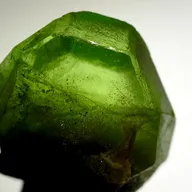 Peridot
Green olivine from the mantle, and occasionally from space.
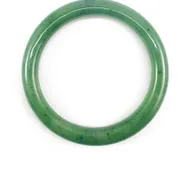 Jade
Two different minerals under one name, and the toughest stone on this page.
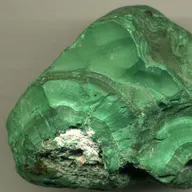 Malachite
Copper gone green, in bands you can read like tree rings.
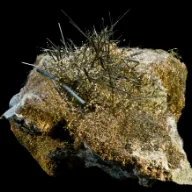 Actinolite
Green needles of amphibole, and the mineral half of all jade is made of.
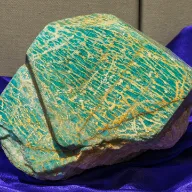 Amazonite
Green feldspar from a river it was never found in.
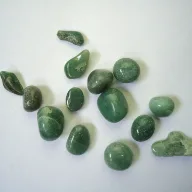 Aventurine
Quartz with a glitter of green mica through it, named by accident.
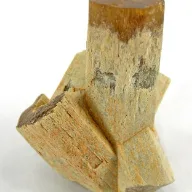 Beryl
One mineral, six famous names: emerald, aquamarine, morganite and the rest are all this.
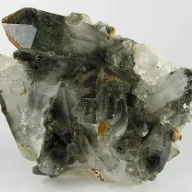 Chlorite
The green that gets into everything: a whole family of soft micaceous minerals, and the ghost inside phantom quartz.
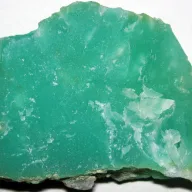 Chrysoprase
Apple-green chalcedony coloured by nickel, and the most valuable of all the quartzes.
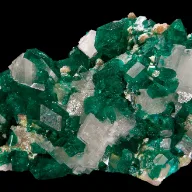 Dioptase
Copper green so convincing that the first crystals sent to Moscow were reported as emeralds.
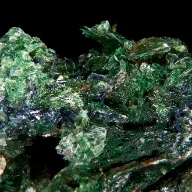 Fuchsite
Muscovite that took up chromium and turned green and glittering.
 Bloodstone
Dark green chalcedony spotted with red, and one of the two birthstones of March.
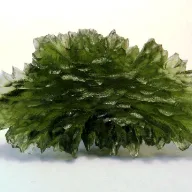 Moldavite
Bohemian glass made by an asteroid hitting Germany fifteen million years ago.
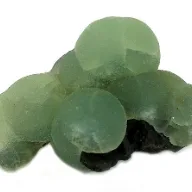 Prehnite
Green botryoidal crusts, usually with black epidote needles through them.
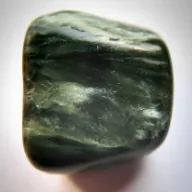 Seraphinite
Dark green chlorite with silver feathers running through it.
Saussurite
What a feldspar becomes when hot water gets at it for long enough.
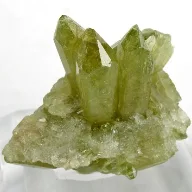 Vesuvianite
Named for the volcano that threw it out, and for looking like several other minerals at once.
 Zoisite
A grey-green rock mineral that produced two of the century's fashionable gems.